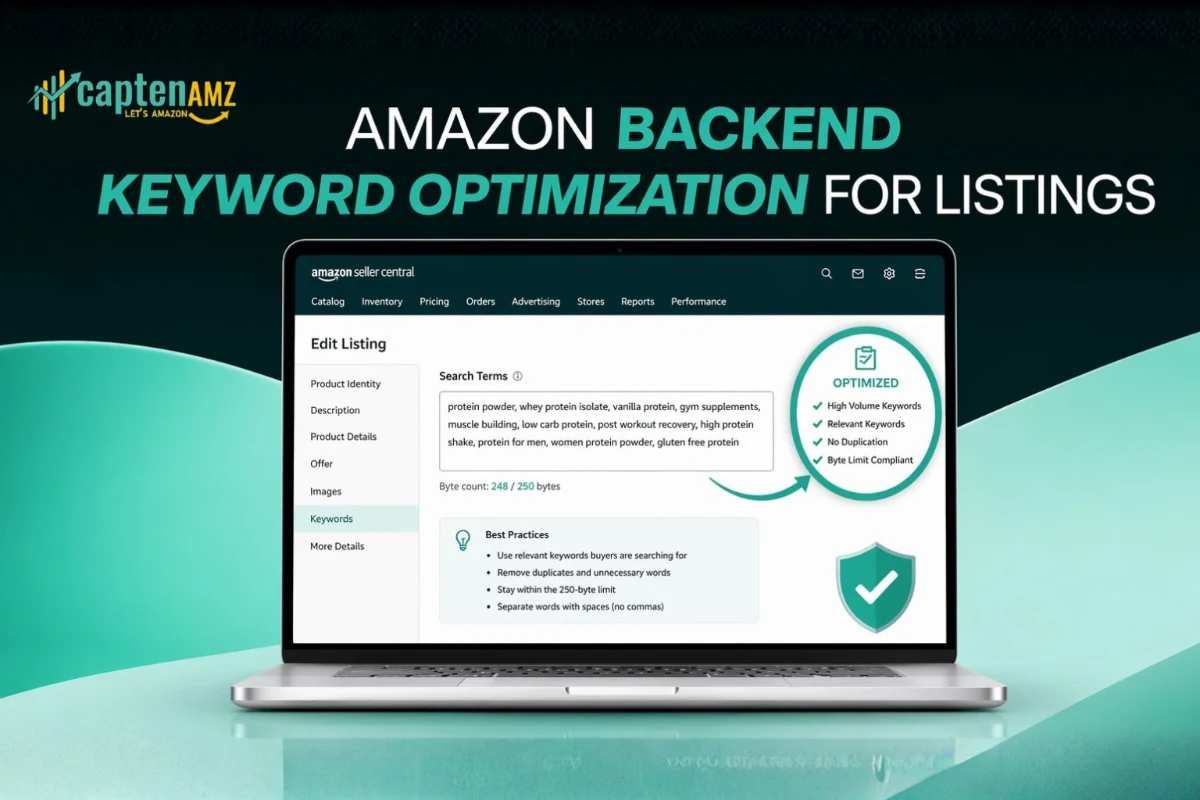
Your product title is perfect. Your bullet points are tight. Your images are high-resolution and your A+ content is beautifully designed. Yet your listing is buried on page three. Sound familiar? The culprit is almost always the most underutilised real estate in all of Amazon: your backend keyword fields. In 2026, Amazon backend keyword optimization is no longer a secondary task it is a primary ranking lever that separates page-one brands from invisible ones.
This expert guide from CaptenAMZ Amazon’s most trusted PPC and Catalog Management agency serving sellers across the USA (NJ, NYC, TX, CA), UK, and European marketplaces breaks down everything you need to know about Amazon backend keyword optimization: what it is, why it matters more than ever in 2026, how to execute it correctly inside Seller Central, and how to connect it with your PPC strategy for maximum ROI.
1. What Are Amazon Backend Keywords?
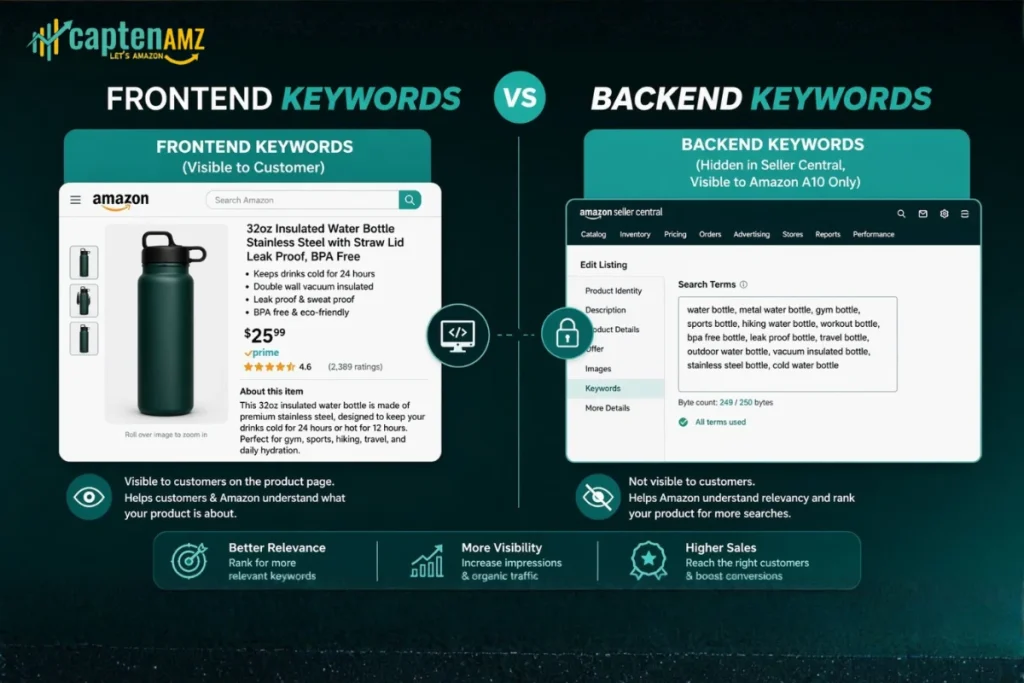
Amazon backend keywords are hidden search terms that sellers enter inside the Generic Keywords field (and related backend fields) within Amazon Seller Central. Customers never see them on the product detail page, but Amazon’s A10 algorithm reads them to determine which search queries your listing should be indexed for and ranked against.
Think of them as silent ranking amplifiers. While your visible listing content — title, bullet points, product description — focuses on conversion and readability, your backend search terms serve a single purpose: expanding your organic discoverability without cluttering your customer-facing copy.
Backend keyword fields in Seller Central include: the primary Search Terms / Generic Keywords field, Subject Matter, Other Attributes, Target Audience (use with care), and Intended Use (generally best left blank to avoid restricting visibility). Each field contributes to how Amazon indexes your ASIN against customer searches.
To learn how these backend fields integrate into a fully optimised listing strategy, see CaptenAMZ’s Amazon Listing Optimization service — where our experts handle backend keyword audits, rewrites, and indexing verification for brands across the USA, UK, and Europe.
2. Why Backend Keyword Optimization Is Critical in 2026
Amazon’s marketplace has never been more competitive. With millions of active sellers across the USA, the UK, Germany, France, and every major EU marketplace, the fight for page-one visibility is fought in milliseconds by Amazon’s algorithm. Sellers who ignore backend keyword optimization are unilaterally surrendering indexing coverage to competitors who do not.
Here is the quantified impact of properly optimised backend keywords:
| Metric | Without Backend Optimization | With Proper Backend Optimization |
| Search Indexing Coverage | Limited to front-end keywords only | Expanded to 100+ additional relevant searches |
| Organic Ranking Surface Area | Narrow — only explicit title/bullet terms | Wide — synonyms, misspellings, long-tail, bilingual |
| PPC Auto-Campaign Match Quality | Low — algorithm uses limited data | High — richer keyword pool for automatic targeting |
| Competitor Gap Opportunities | Missed — invisible to searchers using alternate terms | Captured — indexed for every valid variation |
| Rufus AI Answer Eligibility | Reduced — insufficient semantic signals | Elevated — strong contextual keyword web |
In 2026, as Amazon’s Rufus AI assistant now influences how over 250 million customers discover products through conversational queries, backend keyword optimization has taken on an additional strategic dimension — semantic and intent-based targeting, not just keyword matching. More on this in Section 7.
Related reading: Why Your Amazon Listing Isn’t Ranking (And How Amazon SEO Experts Fix It) — CaptenAMZ’s deep-dive into the most common ranking failures and their expert fixes.
3. The 2026 Byte Limit: What Has Changed & What Counts
| 2026 Update — Byte Limit Rules As of early 2026, Amazon’s guidance in Seller Central discussions points to a 200-byte limit for generic keywords/search terms in several category flows, while some categories still allow up to 500 characters per field. Always check your specific category in Seller Central. The safest practice: stay under 249 bytes and verify indexing manually after saving. |
Understanding the byte limit is essential before you type a single keyword. Here is what counts as bytes:
- Standard letters (A–Z, a–z) and numbers (0–9) = 1 byte each
- Spaces between words = 0 bytes (they do not count toward the limit)
- Special characters, hyphens, and accented letters (é, ü, ñ) = 2+ bytes each
- Commas and punctuation = 1 byte — but they are unnecessary and waste space
Best practice for 2026: write keywords in lowercase, separate words with single spaces only (no commas, no hyphens, no quotation marks), and avoid repeating any keyword already present in your title, bullet points, or product description. Repetition provides zero additional indexing benefit and wastes finite backend space.
| Rule of thumb: treat every byte as revenue. Each wasted byte is a missed keyword — and a missed keyword is a search you are not indexed for. |
4. Where to Find the Backend Keyword Fields in Seller Central
Many sellers spend months on Amazon without ever realising these fields exist. Here is exactly how to locate them:
- Log in to Seller Central at sellercentral.amazon.com.
- Navigate to Inventory → Manage All Inventory
- Find your product listing and click Edit
- Go to the Keywords tab (in most categories) or the Product Details tab and scroll to ‘Generic Keywords’
- Locate the Search Terms / Generic Keywords field — this is your primary backend optimization field
- Also check: Subject Matter, Other Attributes fields for additional indexing opportunities
- Click Save and Finish — indexing typically updates within a few hours, sometimes up to 24 hours
For sellers managing large catalogs with hundreds of ASINs, manual updates become impractical. CaptenAMZ’s Amazon Flat File Service enables bulk backend keyword updates across your entire product catalog using optimised flat file uploads — the same method enterprise brands use to keep thousands of listings fully optimised at scale.
5. How to Research the Right Amazon Backend Keywords
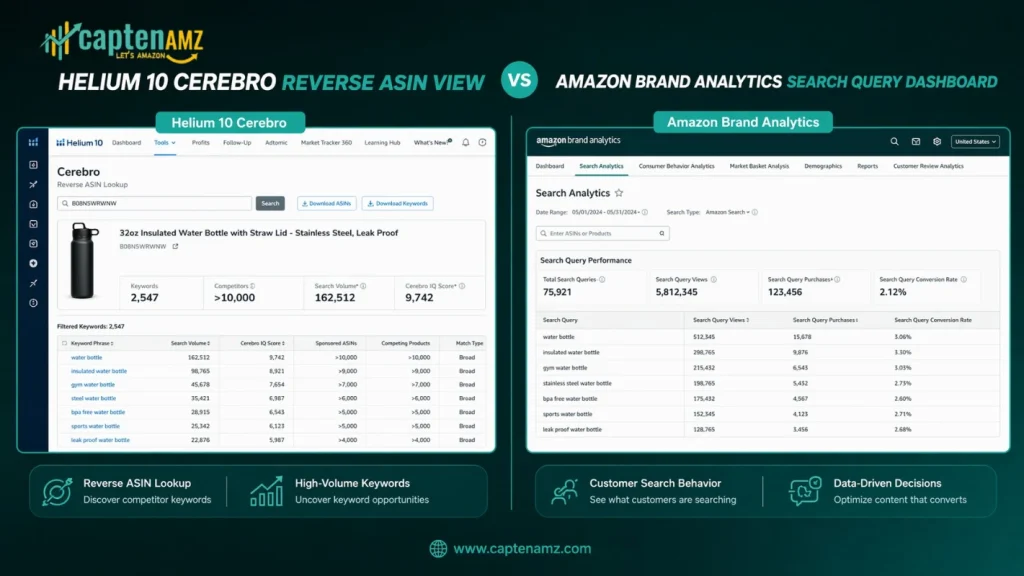
The quality of your backend keyword research determines the quality of your indexing. Here is the prioritised research framework CaptenAMZ uses for brands across New York, New Jersey, Texas, California, the UK, and EU marketplaces:
5.1 Mine Amazon Brand Analytics (Brand Registry Sellers)
Amazon Brand Analytics (ABA) is the gold standard for keyword data because it uses Amazon’s own search data, not third-party estimates. In the Search Query Performance dashboard, filter by your category, sort by Click Share and Conversion Share, and identify high-intent queries where competitors are winning clicks that should belong to you. These are your highest-priority backend targets.
5.2 Harvest PPC Search Term Reports
Your Sponsored Products automatic campaign Search Term Report is a direct readout of what real shoppers type into Amazon’s search box before buying your product or a competitor’s. Run auto campaigns for 4–6 weeks, then filter for terms with clicks but not yet present in your front-end listing or backend fields. These are proven, conversion-validated keywords — ideal for backend optimization.
This is where CaptenAMZ’s integrated Amazon PPC Management and listing optimization services deliver compounding returns — PPC data feeds backend keywords, which improve organic indexing, which reduces PPC cost-per-click over time.
5.3 Reverse ASIN Research on Top Competitors
Using tools like Helium 10 Cerebro, Jungle Scout, or SellerSprite, run a reverse ASIN search on your top three to five competitors. This reveals every keyword their listings are indexed for — including backend terms you cannot see on the frontend. Filter for high-volume, high-relevance terms not yet in your listing and add them to your backend field.
5.4 Customer Review & Q&A Mining
Customers describe your product in language that algorithms understand but sellers rarely use. Read through the top 50 reviews and all Q&A entries for your top competitors. Extract the specific words, phrases, and problem descriptions shoppers use. These natural-language terms are particularly powerful for Rufus AI intent matching — a critical 2026 ranking signal.
5.5 Multilingual & Regional Keyword Expansion
For sellers on Amazon US, include Spanish-language equivalents of your primary keywords — the US Hispanic market represents a significant and underserved buyer segment. For UK and EU sellers, include British English spellings (colour vs. color, nappy vs. diaper) and local measurement units (ml vs. fl oz, cm vs. inches). These regional variants are invisible in your title but critical for backend coverage.
CaptenAMZ’s Amazon Listing Optimization team provides full multilingual backend keyword research for brands operating across USA, UK, DE, FR, IT, and ES Amazon marketplaces — ensuring complete regional coverage from a single optimized catalog.
6. Step-by-Step: How to Optimize Backend Keywords in Your Amazon Listing Page
With your research complete, here is the precise execution workflow for Amazon backend keyword optimization:
- Build your keyword master list outside Seller Central. Use a spreadsheet or notepad. List every candidate keyword from your research, then de-duplicate aggressively against your title, bullet points, and description. Remove any term already present in frontend content.
- Prioritize by intent and volume. Place highest-volume, highest-conversion keywords first. Amazon likely gives more weight to terms earlier in the field, though this is not officially confirmed. Don’t risk burying your best keywords in byte-limit overflow.
- Check byte count before entering. Use a free byte counter tool to verify your keyword string is under your category’s limit (249 bytes is the safe ceiling). Remember: spaces between words do not count.
- Format correctly. All lowercase. Single spaces only between words. No commas, no semicolons, no quotation marks, no hyphens used as separators. Do not use competitor brand names, misleading terms, or prohibited content — these can cause listing suppression.
- Enter and save in Seller Central. Paste your optimized keyword string into the Generic Keywords field. Save and finish. Allow 24 hours for Amazon to fully index the updated terms.
- Verify indexing. After 24 hours, test indexing manually by searching your ASIN alongside the new keyword in Amazon’s search box (search: ASIN B0XXXXXXX keyword). If your product appears, it is indexed. If not, the term may be rejected — revise and retry.
- Schedule quarterly reviews. Backend keyword optimization is not a one-time task. Consumer search behavior shifts, seasonal terms rise and fall, competitors shift strategy, and Amazon’s algorithm evolves. Review and refresh backend keywords at minimum every three months.
| CaptenAMZ Expert Tip Never use competitor brand names or trademarked terms in your backend fields. Amazon’s algorithm and Brand Registry can detect this, resulting in listing suppression or account warnings. Focus exclusively on descriptive terms, synonyms, intended use cases, and audience descriptors. |
7. Amazon Rufus & A10 Algorithm: What This Means for Backend Keywords in 2026
The arrival of Amazon’s Rufus AI shopping assistant — now actively used by over 250 million Amazon customers — has fundamentally changed how sellers should think about backend keyword optimization in 2026.
Rufus does not simply match keywords. It understands search intent, context, and semantic meaning. When a shopper asks Rufus ‘What is the best lightweight blender for smoothies?’, Rufus maps this conversational query to product listings that are indexed for relevant intent signals — not just the literal words.
For backend keyword optimization, this means:
- Semantic keyword clusters beat isolated terms. Instead of ‘blender blender smoothie’, write intent-rich phrases: ‘lightweight blender for smoothies travel use portable kitchen’
- Problem-solution framing works. Include use-case descriptors like ‘back pain relief chair’ or ‘waterproof bag heavy rain cycling’ — the kind of conversational language Rufus maps to product intent
- Context beats raw volume. A perfectly contextual backend string of 200 bytes outperforms 500 bytes of loosely related high-volume terms
- Customer language = Rufus language. Terms mined from customer reviews and Q&A directly reflect how real buyers phrase their needs to Rufus
CaptenAMZ stays current with Amazon’s algorithm evolution. Our Amazon SEO experts integrate Rufus-aware semantic keyword strategies into every listing optimization engagement — because yesterday’s keyword stuffing is today’s ranking penalty.
Also see: The Amazon FBA Algorithm in 2025: What Rufus Wants — CaptenAMZ’s deep-dive into the Rufus ranking framework and what it means for your listing strategy.
8. Backend Keywords + PPC: The Power Combination That Compounds Revenue
The most sophisticated Amazon sellers in the USA, UK, and EU do not treat backend keyword optimization and PPC management as separate workstreams. They treat them as a closed-loop system that compounds returns over time.
Here is how the loop works:
- Launch PPC Auto Campaigns: Let Amazon’s algorithm identify relevant search terms using your existing listing content — including backend keywords — as the targeting data source
- Harvest Search Term Reports (4–6 weeks): Identify converting search terms from PPC data that are not yet in your backend fields
- Update Backend Keywords: Add high-converting PPC search terms to your generic keyword field, expanding organic indexing for proven revenue-generating queries
- Organic Ranking Improves: Better backend indexing + PPC sales velocity improves organic ranking for those terms, reducing PPC dependency
- Lower ACoS, Higher Organic Share: As organic ranking rises, PPC cost per acquisition falls compounding margin improvement over time
This closed-loop model is at the heart of CaptenAMZ’s Amazon PPC Optimization service. Our team bridges PPC data and listing optimization to create compounding organic growth for brands across New York, New Jersey, Texas, California, the UK, and European Amazon markets.
For a full breakdown of Amazon PPC strategy, see: What is Amazon PPC? A Complete Beginner’s Guide. For reducing wasted ad spend, explore our How to Lower Amazon TACoS Without Cutting Ad Spend expert guide.
9. Backend Keyword Mistakes That Kill Your Amazon Rankings
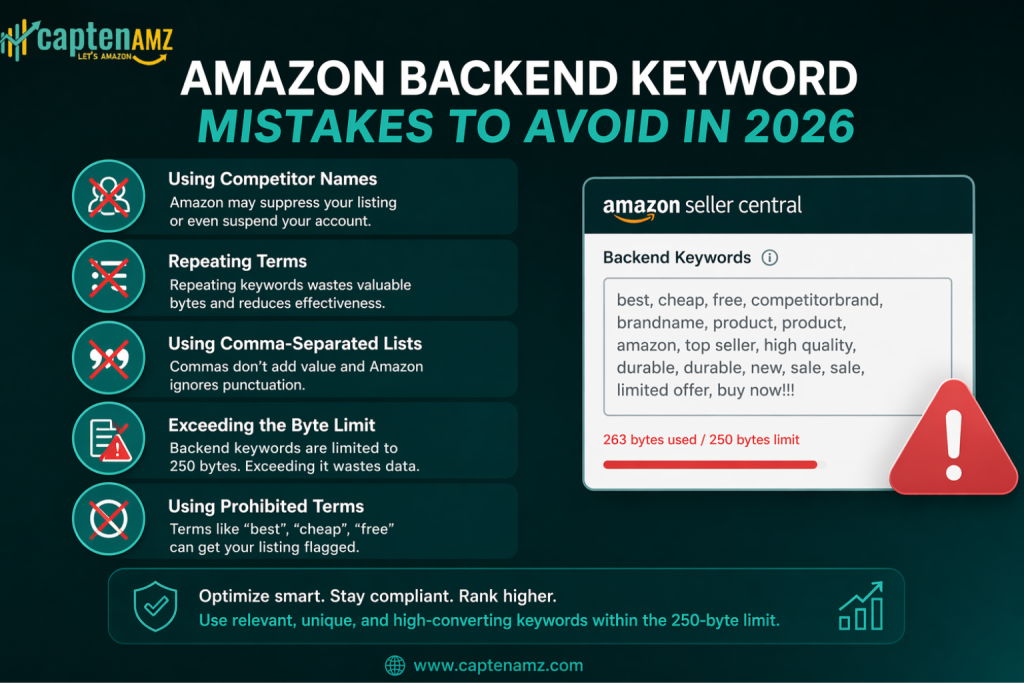
Every mistake in your backend keyword field either wastes indexing space or actively damages your listing’s standing. Here are the most costly errors CaptenAMZ audits regularly across seller accounts in the US and UK:
| Mistake | Why It Hurts | The Fix |
| Repeating front-end keywords | Zero additional indexing benefit; wastes limited bytes | Audit all frontend content first; use backend ONLY for new, non-overlapping terms |
| Using competitor brand names | Policy violation — risks listing suppression and account warnings | Focus on descriptive terms, use cases, and audience qualifiers |
| Comma or hyphen separators | Wastes 1 byte per separator; Amazon requires spaces only | Use single spaces between terms — no punctuation needed |
| Exceeding the byte limit | Amazon ignores everything beyond the limit silently | Use a byte counter; stay under 249 bytes; test indexing after saving |
| Adding irrelevant high-volume terms | Reduces relevance signals; hurts conversion-rate performance | Only include terms directly relevant to your product’s function and use case |
| Never updating backend keywords | Misses new seasonal terms, emerging search queries, PPC data | Schedule quarterly backend keyword audits and refreshes |
| Ignoring multilingual terms | Misses entire buyer segments (e.g. Spanish-speaking US buyers) | Add Spanish and regional-variant terms for USA and EU marketplace coverage |
A systematic Amazon PPC Audit from CaptenAMZ often reveals that backend keyword errors are directly responsible for 20–40% of missed organic impressions on underperforming listings. Our catalog review process cross-references PPC search term data, organic ranking reports, and backend field content to identify and close every indexing gap.
10. Backend Keyword Optimization for Global Sellers — USA, UK & EU
Amazon backend keyword optimization is not a one-size-fits-all task. Sellers operating across multiple marketplaces — USA, UK, Germany, France, Italy, Spain — must adapt their backend strategy to each region’s language, cultural terminology, and search behaviour.
United States (including NJ, NYC, TX, CA)
The US marketplace is Amazon’s most competitive. Backend keywords should cover American English spellings, include Spanish-language equivalents for major product categories, and target both coastal (NY, CA) and inland (TX) consumer search patterns. Urban buyers in New York City and Los Angeles often use different search terms than rural buyers in Texas — both groups deserve backend representation.
United Kingdom
British English spelling differences are significant: ‘colour’ not ‘color’, ‘nappy’ not ‘diaper’, ‘torch’ not ‘flashlight’, ‘trainers’ not ‘sneakers’. Additionally, UK buyers use metric measurements by default. Backend keywords for UK Amazon listings should reflect this vocabulary and unit preference throughout.
Germany, France & EU Marketplaces
Each EU marketplace requires native-language backend keywords. German buyers search in German; French buyers in French. Machine-translated backend fields rarely capture the nuanced search vocabulary that native speakers use. CaptenAMZ works with native-language Amazon SEO specialists for DE, FR, IT, ES, and NL marketplaces — ensuring your backend keyword fields speak the buyer’s language precisely.
For sellers scaling internationally, CaptenAMZ’s Amazon Catalog Management service provides end-to-end catalog and keyword management across all Amazon marketplaces — keeping your backend fields optimised, compliant, and locally relevant at every level of scale.
Related: How Professional Catalog Services Improve Amazon Rankings — CaptenAMZ’s analysis of how clean catalog structure drives organic sales across all markets.
11. Frequently Asked Questions — Amazon Backend Keyword Optimization
Q: Do backend keywords still work in 2026?
Yes — absolutely. As of 2026, backend keywords remain a confirmed indexing signal in Amazon’s A10 algorithm. While ranking also depends on sales velocity, CTR, and conversion rate, backend keywords are the mechanism that ensures your listing is even eligible to rank for a given search term. You cannot rank for a term you are not indexed for.
Q: Should I use the same keywords in the title and the backend?
No. Repeating frontend keywords in your backend field provides no additional indexing benefit and wastes valuable byte space. Use your backend exclusively for new terms — synonyms, alternate spellings, long-tail variants, use-case phrases, and bilingual terms — that do not naturally fit in your visible listing content.
Q: How long does Amazon take to index backend keywords?
Amazon typically indexes updated backend keywords within a few hours to 24 hours after saving changes in Seller Central. For large bulk updates via flat file, allow up to 48 hours. Always verify indexing by testing: search your ASIN alongside the new keyword in Amazon’s search bar.
Q: Can I use competitor names in my backend keywords?
No. Using competitor brand names or trademarked terms in backend fields violates Amazon’s policies and can result in listing suppression or account warnings. Focus exclusively on descriptive product terms, intended use cases, and audience qualifiers.
Q: What is the backend keyword byte limit on Amazon in 2026?
Amazon’s guidance as of early 2026 points to a 200-byte limit for generic keywords/search terms in some category flows, while others allow up to 500 characters. The safest best practice is to stay under 249 bytes. Always check your specific category’s requirements in Seller Central and test indexing after every update.
Q: How often should I update my backend keywords?
At minimum, review and refresh backend keywords every three months. Additionally, update them whenever you harvest significant new data from PPC Search Term Reports, launch in a new market, enter a seasonal campaign window, or identify new competitor keywords through reverse ASIN research.
Conclusion: Backend Keyword Optimization Is Your Invisible Competitive Edge
In 2026, Amazon’s marketplace rewards sellers who understand that optimization goes far deeper than what customers can see. Your product title earns clicks. Your images and A+ content drive conversions. But Amazon backend keyword optimization is what gets you indexed — and without indexing, every other investment in your listing is invisible.
The sellers winning on page one today — in New York, New Jersey, Texas, California, London, Berlin, and Paris — share one common discipline: they treat backend keyword optimization as a scientific, data-driven, and regularly refreshed process. They connect PPC insights to backend fields. They adapt to Rufus AI’s semantic intent signals. They cover multilingual buyer segments. They verify indexing, monitor ranking, and iterate every quarter.
This is exactly the process CaptenAMZ applies to every listing we manage. From the first backend keyword audit to quarterly refresh cycles, from US English to British spellings and European languages — our team ensures every byte of your backend field is working to expand your organic reach, lower your PPC costs, and compound your revenue growth.
If your listings are not indexed for every relevant search your customers are using, you are not competing at full capacity. Let CaptenAMZ show you exactly where your backend keyword optimization is failing — and how to fix it. See us on LinkedIn & Instagram.
| Get Your FREE Amazon Listing Audit — Worth $100 CaptenAMZ’s experts audit your backend keywords, frontend listing, PPC performance, and catalog structure. Serving brands across USA (NJ, NYC, TX, CA), UK & EU markets. ✅ Explore Amazon Listing Optimization → ✅ See Amazon Catalog Management Services → ✅ View Amazon PPC Management Agency → ✅ Amazon A+ Content & Brand Store → 🔥 Book Your FREE Discovery Call Now → |

Maria R. Donis is an Amazon eCommerce content specialist and digital marketing writer with hands-on experience creating data-driven, SEO-optimized content for Amazon-focused brands. She specializes in producing authoritative content around Amazon PPC management, catalog optimization, listing SEO, and marketplace growth strategies.
Maria collaborates closely with Amazon growth agencies like CaptenAMZ, ensuring that every piece of content reflects real Seller Central experience, platform-specific expertise, and up-to-date Amazon best practices. Her writing is guided by practical insights into how Amazon ads, search algorithms, and buyer behavior work in real-world scenarios.