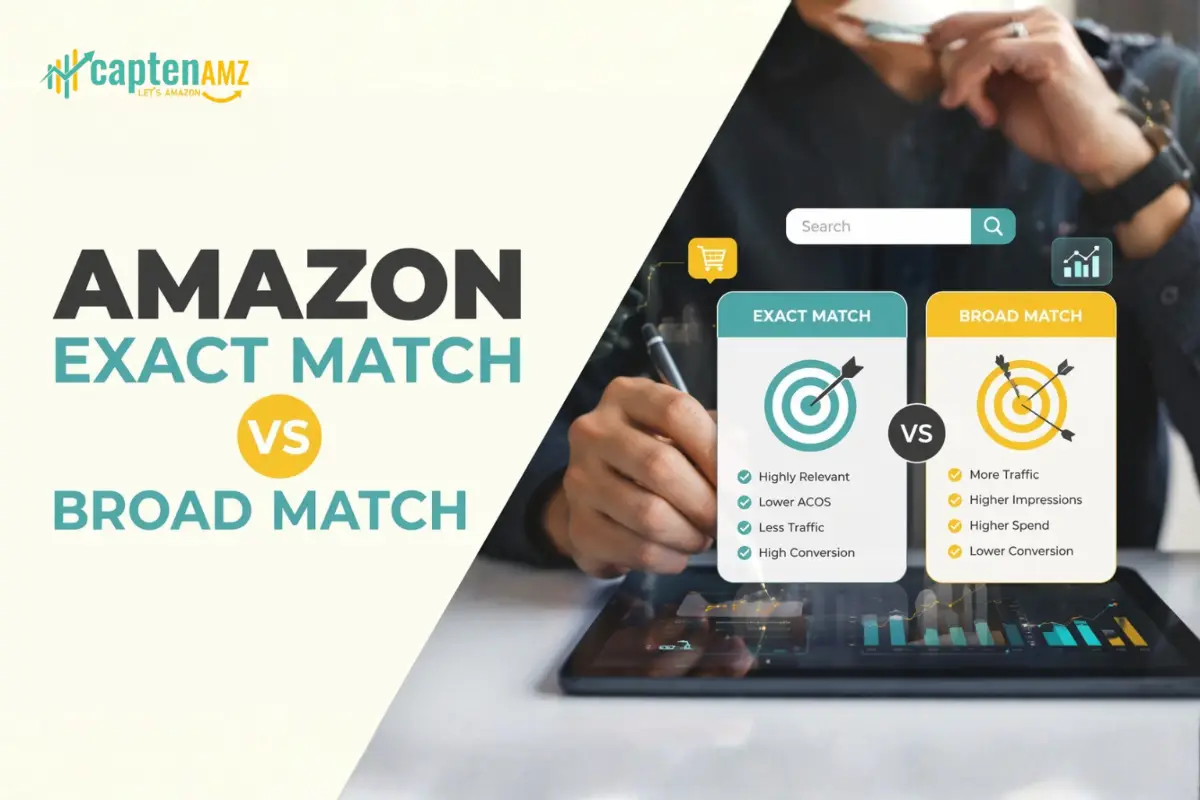
Every Amazon seller running Sponsored Products has faced the same crossroads: should you go broad and cast a wide net, or go exact and laser-target the buyer? It sounds simple but the wrong choice costs you hundreds, sometimes thousands, of dollars in wasted ad spend every single month.
Whether you’re a seller in New Jersey, New York City, Texas, California, London, or anywhere across the EU market, understanding Amazon exact match vs broad match is the foundational skill that separates profitable PPC campaigns from money pits. And in 2026, with Amazon’s algorithm becoming increasingly AI-powered and semantically intelligent, this decision matters more than ever.
In this guide — built on real PPC data, Amazon’s latest algorithm updates, and the expert insights from the team at CaptenAMZ — you’ll learn exactly what each match type does, when to use broad match keywords, when to switch to exact, and how to combine all three match types into a campaign architecture that wins.
Let’s break it down.
What Are Amazon PPC Match Types? (Quick Definition)
Before we compare exact match vs broad match on Amazon, let’s establish what keyword match types actually are.
In Amazon PPC campaigns, keyword match types control how closely a customer’s search query needs to match your targeted keyword before your ad enters the auction. Think of them as filters. Tighter filters = more precision. Wider filters = more discovery.
Amazon offers three manual keyword match types for Sponsored Products and Sponsored Brands campaigns:
- Broad Match — Widest reach, lowest precision
- Phrase Match — Middle ground, balanced targeting
- Exact Match — Tightest targeting, highest conversion intent
There is also a fourth, lesser-known option: the Broad Match Modifier — more on that below.

Your choice of match type directly impacts your impressions, click-through rate (CTR), ACoS, and ultimately your profitability. This is why the team at CaptenAMZ’s PPC Optimization service treats match type strategy as one of the first pillars we audit in every new account.
Amazon Broad Match: Maximum Reach, Maximum Risk
How Broad Match Works
When you set a keyword to broad match, Amazon shows your ad for any search query that contains your keyword terms — in any order, with additional words before or after, synonyms, plurals, and in 2025–2026, even semantically related terms thanks to Amazon’s AI-powered semantic matching engine.
Example: If your broad match keyword is wireless earbuds, your ad could show for:
- “best wireless earbuds for running”
- “Bluetooth earbuds waterproof”
- “noise-canceling headphones” (semantic variation)
- “earphones for gym workout”
The Pros of Amazon Broad Match
- Maximum impressions and discovery — ideal for new product launches
- Keyword mining — reveals what real shoppers are searching
- Lower CPCs — generally the cheapest match type per click
- Great for testing — identify which terms actually convert before investing heavily
The Cons of Amazon Broad Match
- Irrelevant clicks drain budget — you may appear for completely unrelated searches
- Lower conversion rates — traffic is less intent-driven
- Higher ACoS risk — without aggressive negative keyword management, broad match bleeds money
- Hard to control — in 2026, Amazon’s broad match is more permissive than ever
The core truth about broad match: it’s a discovery engine, not a conversion engine. Use it to find winners, not to scale them. If your Amazon PPC campaigns are running broad match on high-competition terms without a negative keyword strategy, you’re almost certainly overspending.
Amazon Exact Match: Precision Targeting for Proven Converters
How Exact Match Works
Exact match is the most restrictive keyword match type on Amazon. Your ad only shows when a shopper’s search query matches your keyword precisely — same words, same order. Amazon does allow minor variations like plurals and common misspellings as close variants, but no additional words before or after the phrase are permitted.
Example: If your exact match keyword is [wireless earbuds], your ad shows ONLY for:
- “wireless earbuds”
- “wireless earbud” (plural variation — allowed)
Your ad does NOT show for:
- “best wireless earbuds”
- “wireless earbuds for running”
The Pros of Amazon Exact Match
- Highest conversion rates — you’re reaching shoppers with direct purchase intent
- Full budget control — every click is predictable and qualified
- Lower ACoS on proven terms — when you’ve found a winning keyword, exact match extracts maximum ROI
- Clean reporting — search term reports are precise and easy to optimize
The Cons of Amazon Exact Match
- Limited reach — you miss out on long-tail variations that might convert
- Higher CPCs — exact match keywords are typically the most expensive
- Requires prior data — you need to already know what converts before committing to exact match
- Risky if overused early — new sellers who go straight to exact match often miss high-volume opportunities
Phrase Match: The Strategic Middle Ground
Phrase match sits between broad and exact. Your ad shows when a shopper’s search includes your keyword phrase in the correct order, but allows additional words before or after.
Example: Phrase match keyword "wireless earbuds" triggers for:
- “best wireless earbuds 2026”
- “buy wireless earbuds online”
- “wireless earbuds under $50”
But NOT for:
- “earbuds wireless” (wrong order)
- “Bluetooth earphones” (different phrase)
In Amazon’s 2025–2026 algorithm update, phrase match for Sponsored Brands now uses meaning-based matching, where intent — not just word order — can trigger your ad. This makes phrase match even more powerful as a mid-funnel targeting tool.
Broad Match vs Phrase Match vs Exact Match: When to Use Each
| Match Type | Best For | Campaign Stage | Risk |
|---|---|---|---|
| Broad Match | Discovery, new launches, keyword mining | Early (Week 1–4) | High |
| Phrase Match | Scaling proven terms with variation | Mid (Month 1–3) | Medium |
| Exact Match | Maximizing ROI on proven converters | Scaling (Month 3+) | Low |
At CaptenAMZ, our Amazon PPC Consultation service uses this exact progression framework — what we call the Discovery → Refinement → Profit ladder — across every seller account we manage, whether they’re based in NYC, California, Texas, London, or Frankfurt.
What Is the Broad Match Modifier on Amazon?
The broad match modifier is Amazon’s “fourth match type” that most sellers overlook. By placing a plus sign (+) before a word in your broad match keyword, you tell Amazon that word MUST appear in the customer’s search query.
Example: +men shoes (broad match modifier) would show for:
- “men sneakers”
- “running shoes for men”
- “men athletic footwear”
But NOT for:
- “women shoes” (doesn’t include “men”)
- “sneakers” (doesn’t include “men”)
The broad match modifier gives you the reach of broad match with a degree of control — making it particularly useful for Amazon PPC optimization when you want to protect a core term while still exploring variations.
Note: Broad Match Modifiers work differently in Sponsored Brands vs Sponsored Products campaigns, so always check campaign-level behavior in your Amazon Seller Central dashboard.
What Is Substitute Match on Amazon?
A question we get often: “What is substitute match in Amazon?”
Substitute match is part of Amazon’s Automatic Targeting system (not manual campaigns). When you run an automatic campaign, Amazon targets four match types automatically:
- Close Match — searches closely related to your product
- Loose Match — broader related searches
- Substitutes — competitor product detail pages (products similar to yours)
- Complements — product pages that complement yours
Substitute match is particularly powerful for competitive conquest — your ad shows on competitor listings. This is a strategy the CaptenAMZ PPC Management team uses strategically during product launch phases to gain visibility against established competitors in markets like the USA and UK.
The Winning PPC Architecture: Using All Three Match Types Together
Here is the proven framework that CaptenAMZ uses across client accounts in the US (NJ, NYC, TX, CA), the UK, and European markets:

Phase 1 — Discovery (Auto + Broad Match)
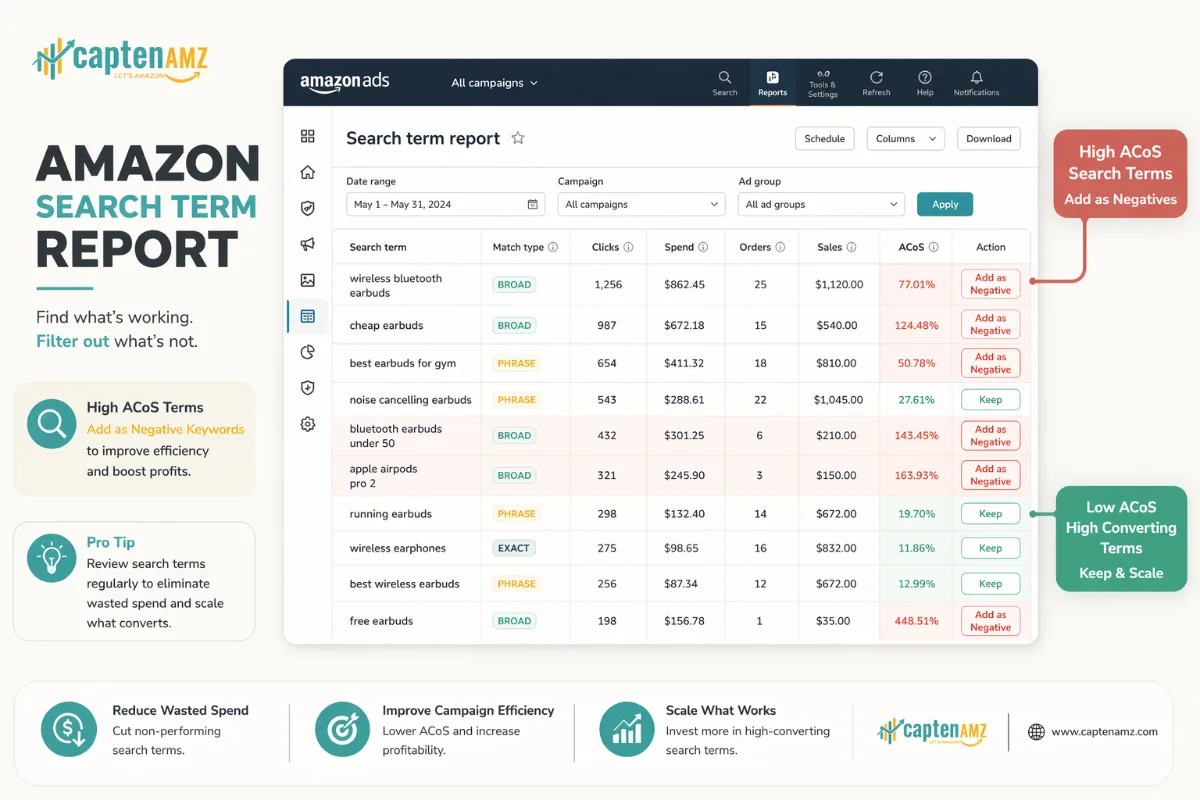
Launch an automatic campaign alongside a broad match manual campaign. Let both run for 2–4 weeks. Use the Search Term Report to identify which queries generate clicks and conversions. Add irrelevant terms as negative keywords immediately to stop wasted spend. This is also when Amazon Listing Optimization matters most — your listing must convert the traffic you’re paying to attract.
Phase 2 — Refinement (Phrase Match)
Take your top-performing broad match search terms and promote them to a dedicated phrase match campaign with slightly higher bids. This expands reach while maintaining relevance. Continue adding negative exact and negative phrase keywords to keep ACoS under control. Our Amazon PPC Audit service often uncovers thousands in monthly wasted spend at this exact stage.
Phase 3 — Profit (Exact Match)
Your highest-converting search terms graduate to exact match campaigns with your maximum bid. These are your money keywords — proven, high-intent, buyer-ready. This is where your best ROI lives. A well-structured exact match campaign, paired with optimized Amazon A+ Content, consistently delivers the lowest ACoS in any account.
Negative Keywords: The Overlooked Multiplier
No discussion of broad match vs exact match is complete without talking about negative keywords. Negative keywords tell Amazon which searches should NEVER trigger your ad.
Without a strong negative keyword strategy:
- Broad match campaigns hemorrhage budget on irrelevant queries
- Phrase match ads appear for low-intent informational searches
- Your overall ACoS inflates, masking the true performance of your winners
At CaptenAMZ, every campaign architecture we build — whether for a seller in New Jersey, a brand in London, or an FBA seller in Texas — includes a structured negative keyword list from Day 1, refined weekly using the Search Term Report.
Our Amazon PPC Management Agency team reviews negative keyword lists bi-weekly across all client accounts to ensure your ad dollars are working for you — not being wasted on shoppers who will never buy.
Broad Match vs Exact Match: Real-World ACoS Comparison
Here’s what the data consistently shows across CaptenAMZ-managed accounts in the USA and UK markets:
| Campaign Type | Average ACoS | Average CTR | Conversion Rate |
|---|---|---|---|
| Broad Match (no negatives) | 45–70% | 0.3–0.5% | 5–8% |
| Broad Match (with negatives) | 25–40% | 0.4–0.6% | 8–12% |
| Phrase Match | 20–35% | 0.5–0.8% | 10–15% |
| Exact Match | 12–25% | 0.8–1.5% | 15–25% |
Data reflects averages across CaptenAMZ client portfolio. Results vary by category, competition, and listing quality.
These numbers tell the story clearly: exact match wins on conversion efficiency, broad match wins on discovery volume. The key insight is that you need both — working together, not in isolation.
This is precisely why sellers who rely on a single match type consistently underperform against those with a structured, layered campaign architecture. If you’re unsure where your account stands, our Amazon PPC Audit gives you a complete diagnostic in 48 hours.
Amazon Broad Match vs Exact Match: Special Considerations for USA & International Markets
USA Markets (NJ, NYC, TX, California)
The US Amazon marketplace is the most competitive in the world. In dense markets like New York City or Los Angeles, CPCs for exact match keywords in competitive categories can exceed $3–5 per click. This makes the Discovery → Refinement → Profit funnel even more critical — you cannot afford to run broad match without tight negative keyword management.
UK & European Markets
UK and EU Amazon markets (amazon.co.uk, amazon.de, amazon.fr, amazon.es) often have lower CPCs but also lower search volumes. Broad match can be particularly effective here for initial keyword discovery since competition is lower, but listing quality — including Amazon Flat File optimization — becomes a critical conversion lever.
For international sellers, our Amazon Catalog Management service ensures your listings are properly structured for marketplace-specific indexing, maximizing the organic + paid synergy across every market you operate in.
How CaptenAMZ Maximizes Your Match Type ROI
At CaptenAMZ, we’ve managed hundreds of PPC campaigns across USA, UK, and European Amazon marketplaces. Our proprietary “Beyond Average” Framework™ includes:
- Week 1: Full Amazon PPC Audit — diagnosing current match type waste
- Week 2–4: Restructured campaign architecture with all three match types properly segmented
- Month 2: Negative keyword build-out and bid optimization per match type
- Month 3+: Exact match scaling on proven converters, with listing optimization to maximize CVR on each click
- Ongoing: Weekly search term reports, monthly strategy calls, transparent reporting
Whether you’re a solo seller in New Jersey or a multi-SKU brand scaling across USA, UK, and EU markets, our Amazon PPC Consultation is the fastest way to stop wasting ad spend and start scaling profitably.
Ready to stop guessing and start winning? Book your free PPC strategy call with CaptenAMZ today
Frequently Asked Questions (FAQ)
Should I use broad or exact match on Amazon?
Both — but at different stages. Use broad match when you’re launching a new product or mining for keyword data. Use exact match once you’ve identified your highest-converting search terms through your broad and phrase match campaigns. The most profitable Amazon PPC strategies use all three match types in a structured funnel, with robust negative keyword management throughout. Our CaptenAMZ PPC Consultation can help you determine the right balance for your specific product and market.
What is the difference between broad and phrase match on Amazon ads?
Broad match shows your ad for any search containing your keyword terms in any order, including synonyms, related terms, and semantic variations — giving maximum reach but lowest precision. Phrase match requires your keyword to appear in the correct order within the search query, though additional words are allowed before or after. Phrase match offers a middle ground: more relevant than broad, more reach than exact. In 2025–2026, Amazon has also introduced meaning-based matching for phrase match in Sponsored Brands, further expanding its flexibility.
What are the match types on Amazon?
Amazon offers three manual keyword match types for Sponsored Products and Sponsored Brands:
- Broad Match — widest reach, lowest precision
- Phrase Match — balanced targeting with keyword order preserved
- Exact Match — tightest targeting, highest conversion intent
Additionally, there’s the Broad Match Modifier (using a “+” prefix) for semi-controlled broad targeting. For Automatic campaigns, Amazon uses four targeting types: Close Match, Loose Match, Substitutes, and Complements. Our Amazon PPC Management Agency leverages all of these strategically across every client campaign.
What are the different types of PPC match types across platforms?
While this guide focuses on Amazon, the broader PPC landscape includes match types across platforms like Google Ads. On Amazon specifically, you have Broad, Phrase, and Exact for manual campaigns, plus the four Automatic targeting types (Close, Loose, Substitutes, Complements). The key difference from Google Ads is that Amazon’s match types are tied directly to purchase intent within a shopping context — making exact match keywords on Amazon particularly powerful for high-conversion, low-ACoS results. Need expert guidance navigating all of these? Our Amazon PPC Optimization team is here to help.
Ending Notes: Stop Choosing Between Broad and Exact — Start Using Both Strategically
The debate of Amazon exact match vs broad match isn’t a battle with a single winner. It’s a strategy question with a clear answer: you need both, used correctly, at the right time.
Broad match keywords are your exploration engine — they reveal what your customers are actually searching for, expand your reach, and fuel the data pipeline that makes the rest of your campaign smarter. Exact match keywords are your profit engine — they capture high-intent shoppers with laser precision, deliver the lowest ACoS, and scale your most proven winners. Phrase match is the bridge between the two, giving you flexibility with control.
The sellers winning on Amazon in 2026 — whether they’re operating from New Jersey, New York, California, Texas, London, or Berlin — aren’t the ones who picked a single match type and called it a day. They’re the ones who built structured, data-driven campaign architectures that progress from discovery to profit, with aggressive negative keyword management at every stage.
That’s exactly what CaptenAMZ does for sellers every single day.
If you’re tired of high ACoS, wasted ad spend, and PPC campaigns that don’t scale — it’s time for a conversation. Our Amazon PPC Consultation is built for sellers who want real results, not just reports. And with our Amazon PPC Audit, we’ll show you exactly where your current campaigns are leaking money — and how to fix it — within 48 hours. See us on LinkedIn & Instagram.
Your next breakthrough campaign starts with one decision: choosing an expert partner who knows the difference between broad, phrase, and exact match — and knows exactly how to use all three to grow your Amazon business.
📞Book Your Free CaptenAMZ Strategy Call Now

Maria R. Donis is an Amazon eCommerce content specialist and digital marketing writer with hands-on experience creating data-driven, SEO-optimized content for Amazon-focused brands. She specializes in producing authoritative content around Amazon PPC management, catalog optimization, listing SEO, and marketplace growth strategies.
Maria collaborates closely with Amazon growth agencies like CaptenAMZ, ensuring that every piece of content reflects real Seller Central experience, platform-specific expertise, and up-to-date Amazon best practices. Her writing is guided by practical insights into how Amazon ads, search algorithms, and buyer behavior work in real-world scenarios.