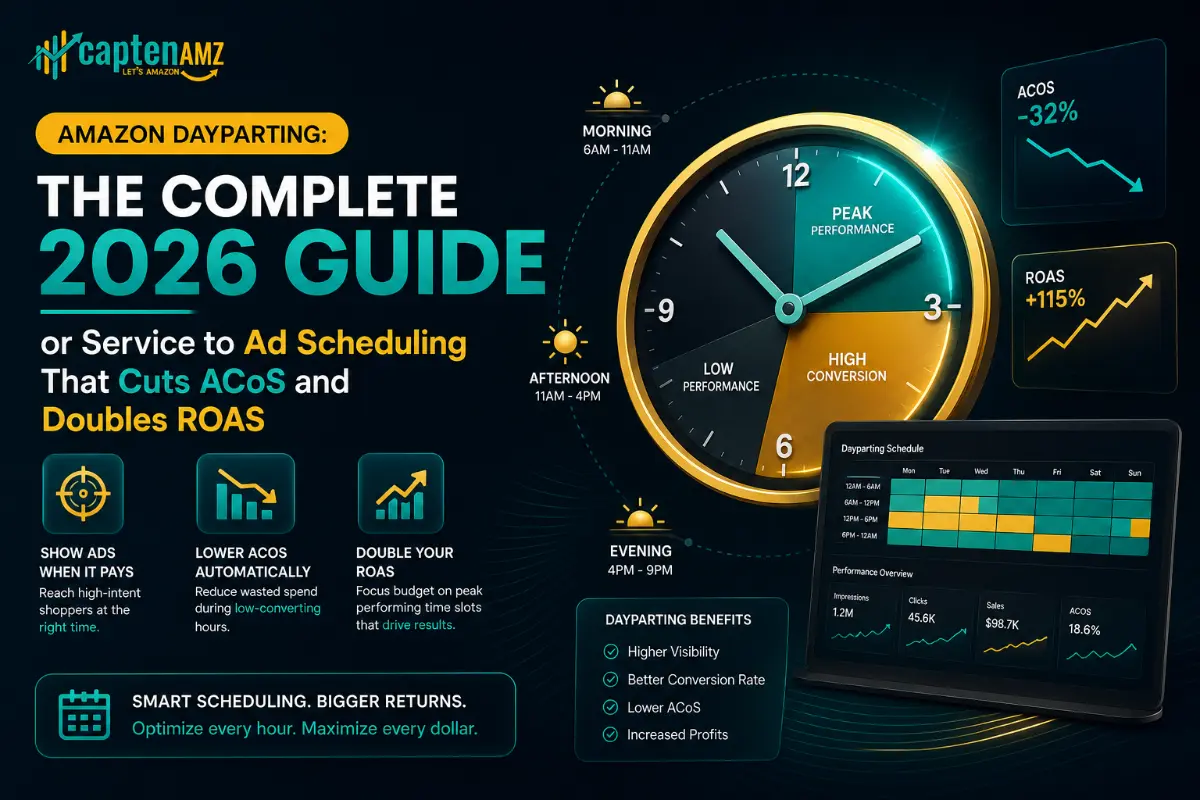
Imagine paying for ads at 3 AM when no one in your target market is awake to click them. That’s not a hypothetical it’s exactly what happens when sellers run their Amazon PPC campaigns 24/7 without a scheduling strategy. Every wasted impression during dead hours is money drained from a budget that could have dominated peak conversion windows.
Amazon dayparting, also called Amazon ad scheduling, solves this problem directly. It is the data-driven practice of adjusting your bids, budgets, and campaign delivery to align with the specific hours and days when your ideal customers are most likely to buy. Rather than spraying ad spend evenly across all 168 hours of a week, dayparting concentrates your budget where it generates the highest return.
For sellers competing in high-stakes markets like New York, New Jersey, California, Texas, and the United Kingdom, Amazon dayparting is no longer an advanced tactic it is a baseline requirement for profitable advertising in 2026. At CaptenAMZ, our Amazon PPC management team applies dayparting as a core component of every campaign strategy we build. This guide explains exactly how it works, how to implement it, and how to use it to beat your competition.
What Is Amazon Dayparting? (Definition and Core Concept)
Amazon dayparting is the process of scheduling your Amazon ads to run or bid more aggressively during specific hours of the day or specific days of the week, based on your product’s historical performance data.
Unlike Google Ads or Meta, which give advertisers direct hour-by-hour delivery controls, Amazon requires sellers to use budget rules, schedule rules, or third-party automation tools to achieve the same effect. The result, however, is identical: your ads appear prominently when buyers are actively ready to purchase, and your budget is protected during low-converting dead zones.
There are three core levers in Amazon dayparting:
Budget Rules (Schedule-Based): You can set rules inside Amazon Advertising Console to automatically increase your campaign budget during defined time windows. This is Amazon’s native dayparting option and it only supports budget increases, not decreases.
Bid Adjustments via Bulk Operations: By downloading a bulk sheet, modifying keyword bids manually by time of day, and re-uploading the file, sellers can increase or decrease bids across campaigns. This method is granular but time-intensive without automation.
Campaign Pause/Unpause: A manual approach where campaigns are paused during non-peak hours and reactivated during peak periods. This is the most aggressive form of dayparting but risks missing unexpected demand spikes.
Understanding which lever is right for your account depends on your product type, campaign stage, and available tooling which is exactly what an experienced Amazon PPC consultant assesses before deploying any dayparting strategy.
Why Amazon Dayparting Matters More in 2026 Than Ever Before
The competitive dynamics on Amazon have shifted dramatically. CPCs are rising across most categories. Amazon’s A10 algorithm gives increasing weight to conversion velocity and session quality. And shoppers have become far more deliberate — they research, compare, and convert during specific behavioral windows that are increasingly predictable from historical data.
Sellers who run undifferentiated 24/7 campaigns in this environment face three compounding problems. First, they spend budget during low-intent hours (early morning) when CPCs are artificially elevated because advertisers have not yet depleted daily budgets. Second, they miss high-conversion windows because their budgets are exhausted by the time peak hours arrive. Third, they generate poor-quality traffic signals that suppress organic ranking over time.
Amazon dayparting addresses all three issues simultaneously. By shifting budget concentration toward your verified peak hours, you improve your conversion rate per impression, reduce your ACoS, and send stronger purchase-intent signals to Amazon’s algorithm which in turn supports better organic placement.
For sellers working with CaptenAMZ’s Amazon PPC services, dayparting is implemented as part of a broader profitability framework, not as an isolated tactic. It works in combination with keyword segmentation, negative keyword architecture, and listing conversion optimization to produce compounding results over time.
The CPC Bid Rush: Understanding Amazon’s Budget Reset Cycle
One of the most overlooked dynamics in Amazon advertising is the midnight budget reset. Amazon refreshes every advertiser’s daily budget at midnight, which means the first few hours of each day are characterized by the highest advertiser competition and therefore the highest CPCs of the entire 24-hour cycle.
This is commonly called the “CPC bid rush.” During these early hours, all advertisers are bidding with fresh budgets and maximum aggression. Click costs spike, conversion rates remain relatively low because consumer activity is also lower, and a disproportionate share of your daily budget can evaporate before your most valuable shopping hours even begin.
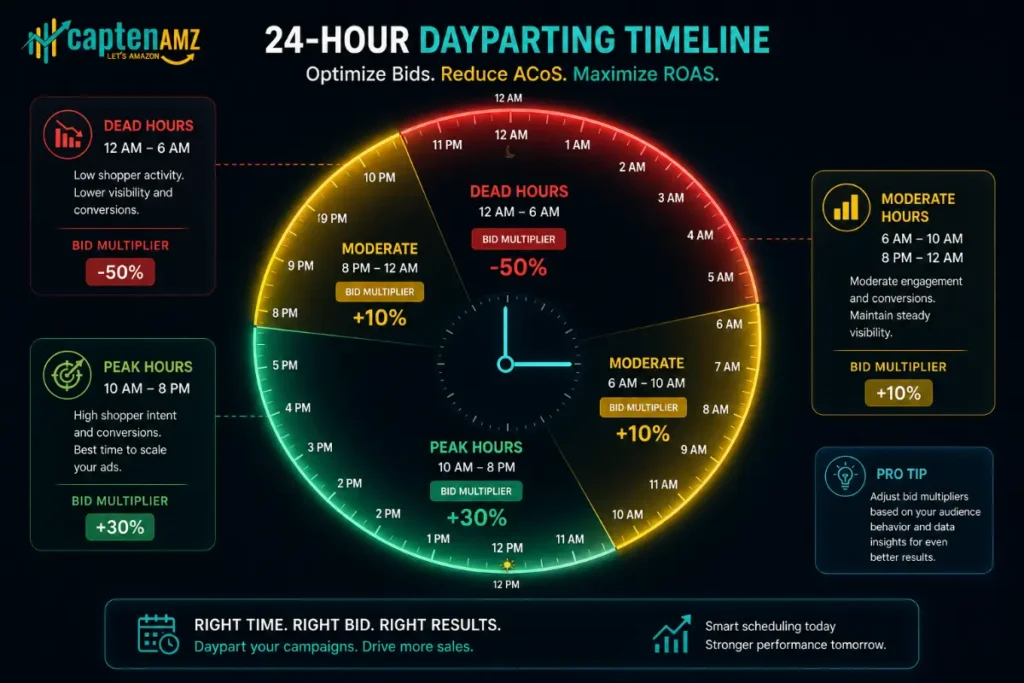
Effective dayparting accounts for this dynamic in two ways. First, it protects budget during the bid rush by reducing spend (through pausing or bid reduction) during those early hours. Second, it reallocates those saved dollars toward the 10 AM–8 PM window in most US time zones, where consumer intent, conversion rates, and purchase velocity are consistently strongest.
This is why our Amazon PPC advertising services always begin with a deep audit of hourly performance data before any scheduling recommendations are made.
How to Extract Hourly Performance Data from Amazon
Effective dayparting is impossible without hourly data. Amazon now provides this natively through the Sponsored Products Hourly Report, accessible directly inside Seller Central’s advertising console.
Step 1 — Access Amazon Marketing Stream or Hourly Reports: Navigate to your Amazon Advertising Console. Under Reports, locate the Sponsored Products hourly data. Download at minimum 30 days of data — 60 to 90 days is ideal for products with seasonal fluctuation.
Step 2 — Identify Your Peak Hours: Sort your data by conversion rate (CVR) and ACoS hour by hour. Hours where your CVR is above your campaign average and ACoS is below your target threshold are your peak hours. Mark them green. Hours where the inverse is true are your dead zones. Mark them red.
Step 3 — Identify Day-of-Week Patterns: Beyond hours, analyze performance by day. Data consistently shows that Sundays and Mondays outperform mid-week days for many consumer product categories in the United States, though your specific product data may differ.
Step 4 — Build Your Scheduling Matrix: Map your green hours against days of the week to create a bidding matrix. This becomes the foundation of your dayparting rule structure.
If you are working with an Amazon PPC management agency like CaptenAMZ, this data extraction and analysis is handled as part of your onboarding process, with a clear scheduling framework built from your actual account performance rather than generic industry benchmarks.
Step-by-Step: How to Set Up Amazon Dayparting in Seller Central
Amazon has improved its native dayparting tools significantly since 2023. Here is how to implement a basic dayparting strategy directly inside Seller Central without third-party software.
Setting a Budget Rule (Native Schedule Rule): Open your Amazon Advertising Console and select the campaign you want to schedule. Navigate to Rules, then select Add Budget Rule. Choose Schedule as the rule type, not Performance-based. Define your time window (for example, Monday through Friday, 10 AM to 8 PM). Set the budget increase amount as a percentage. Apply the rule and save.
This method only allows budget increases during specified windows. To create the inverse effect — protecting budget during off-peak hours — you need to use either bulk operations or third-party automation tools.
Using Bulk Operations for Bid Adjustments: Download a bulk operations file from your Campaign Manager. In the file, locate the keyword bid columns for the campaigns you want to daypart. Modify bid values upward for the time window you are about to target. Upload the file back into Campaign Manager. When the peak window ends, re-upload the original bid file to restore baseline bids. This manual cycle is effective but time-consuming for large accounts.
Campaign Pause/Unpause Method: In your bulk sheet, change the Status column of targeted campaigns to “paused” for off-peak periods. Upload. When your peak window begins, upload the original active file. This is the most aggressive method and should only be used for campaigns with very clear, stable peak patterns confirmed by 60+ days of data.
For brands managing multiple SKUs across US markets including New Jersey, New York City, California, and Texas, manual dayparting at scale is impractical. This is where professional Amazon PPC management with systematic execution delivers the highest ROI.
Amazon Dayparting Best Practices for USA, UK, and European Markets
Shopping behavior patterns differ significantly by geography, and dayparting strategies must account for regional timing differences to be effective.
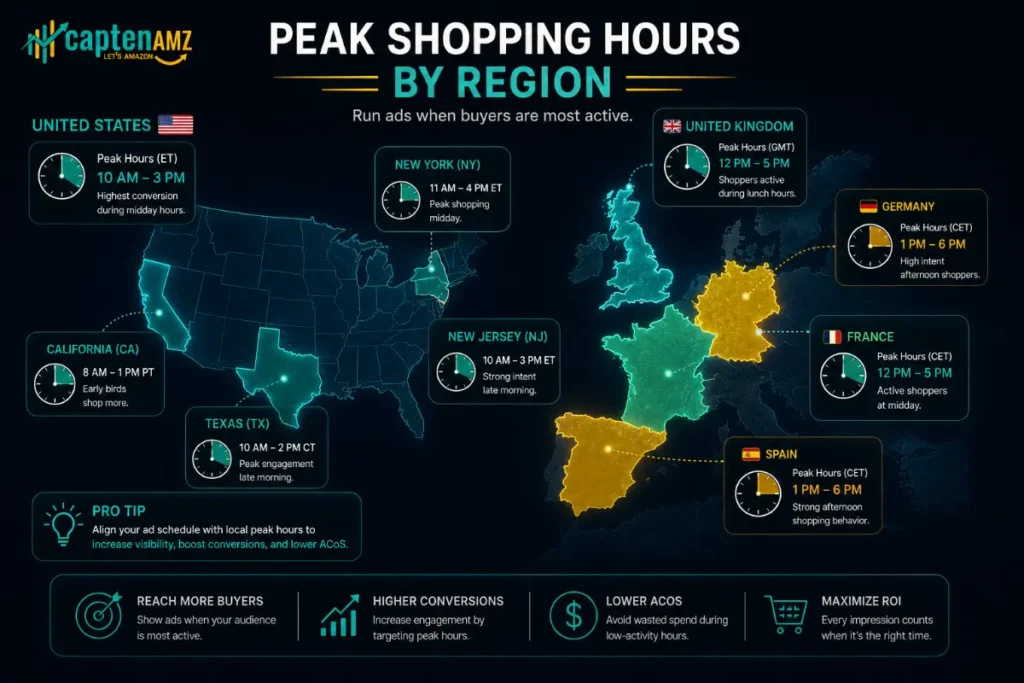
United States — Eastern Time Zone Priority: US shoppers show peak conversion windows between 11 AM and 2 PM (lunch browsing) and again between 7 PM and 10 PM (evening shopping). For sellers targeting New York and New Jersey buyers, Eastern Time peak windows should anchor your schedule. California and Texas sellers need to account for the 3-hour time zone offset, meaning a unified campaign serving both coasts requires a wider active window or segmented campaigns by geography.
United Kingdom and European Markets: UK Amazon shoppers peak between 8 PM and 11 PM on weekday evenings and show strong Saturday morning activity. European markets (Germany, France, Spain, Italy) follow similar patterns but with local holiday and seasonal variations that require dedicated campaign calendars. Sellers expanding into EU marketplaces through CaptenAMZ’s international PPC consulting services should always build geography-specific dayparting rules rather than replicating US schedules.
Seasonal Adjustments: During Prime Day, Black Friday, Cyber Monday, and Q4, dayparting rules should be reconsidered. High-demand events often benefit from maximum 24/7 coverage because shopper intent is elevated across all hours. Consider temporarily suspending dayparting restrictions during these windows and reactivating them post-event. Our team’s Amazon PPC campaign optimization playbooks include event-specific scheduling frameworks for every major shopping calendar moment.
When NOT to Use Amazon Dayparting
Dayparting is a powerful tool but it is not appropriate for every situation. Applying it incorrectly can reduce reach, starve Amazon’s algorithm of data, and harm campaign performance.
Do Not Daypart New Product Launches: During the first 30 to 60 days of a product launch, Amazon’s A9 algorithm needs consistent impression data to understand your product’s relevance and conversion potential. Restricting ad delivery during this period deprives the algorithm of the engagement signals it needs to rank your listing. Focus on maximizing data collection first, then introduce dayparting once you have 30+ days of hourly performance history.
Do Not Daypart Low-Budget Campaigns: If your daily campaign budget is under $20, splitting it across smaller time windows may result in too few impressions to generate meaningful data or consistent sales velocity. For thin-budget campaigns, broad optimization of bids and keywords will deliver faster gains than scheduling restrictions.
Do Not Apply Generic Industry Templates: Peak hours vary by product category, customer demographic, and marketplace. A fitness supplement brand in California does not have the same peak pattern as a home décor brand selling to New York buyers. Dayparting based on industry averages without validating against your own historical data is one of the most common mistakes we see in Amazon PPC audits.
Amazon Dayparting and Its Impact on TACoS and Organic Ranking
One of the most underappreciated benefits of well-executed Amazon dayparting is its effect on Total Advertising Cost of Sales (TACoS) and organic search ranking — not just immediate campaign ACoS.
When you concentrate ad spend during high-conversion hours, you generate a higher sales velocity per impression. Amazon’s algorithm interprets consistent sales velocity as a relevance signal, which gradually improves your organic keyword ranking. As organic ranking improves, you begin generating sales without ad spend — which reduces your TACoS even if your campaign ACoS remains stable or even increases slightly.
This flywheel effect is why strategic dayparting, when implemented alongside strong Amazon listing optimization and proper catalog management, tends to deliver compounding returns over 90 to 180 days rather than just short-term cost savings.
Tracking TACoS is essential for measuring the true impact of dayparting. At CaptenAMZ, every client account includes TACoS monitoring as part of weekly reporting, giving brands a complete picture of how ad scheduling improvements translate into organic revenue growth over time.
AI-Powered Amazon Dayparting: The Future of Ad Scheduling
Manual dayparting — downloading bulk sheets, adjusting bids, re-uploading files — is effective but unsustainable at scale. The evolution of AI tools for Amazon PPC has introduced a new generation of automated dayparting that adjusts bids and budgets in real time based on live performance signals rather than static schedules.
AI-powered dayparting tools connect to Amazon’s Marketing Stream API, which delivers hourly performance data including ACoS, CPC, and conversion rate. The AI analyzes these signals continuously and makes bid adjustments automatically — increasing bids when early-hour data shows strong conversion and reducing them when the data signals a dead zone is beginning.
For established Amazon brands managing large catalogs across multiple marketplaces, AI-powered dayparting is no longer optional. It is a competitive necessity. However, it is important to understand that AI tools optimize bids within the parameters you define — they do not replace strategic thinking, campaign architecture, or profit modeling. Expert human oversight remains essential.
At CaptenAMZ, we combine AI-assisted bid optimization with hands-on campaign strategy to ensure every scheduling decision aligns with your margin targets, brand goals, and long-term ranking strategy. Our approach is not automation for automation’s sake — it is precision execution guided by expertise.
Amazon Dayparting Checklist: What to Review Before You Launch
Before deploying a dayparting strategy, validate each item on this checklist to maximize success:
Data Readiness: Confirm you have at least 30 days of hourly Sponsored Products data. Identify your top three peak hours and your three worst-performing hours using CVR and ACoS as primary filters.
Campaign Maturity: Your product should have a consistent sales history. New launches should complete their initial 30–60 day data collection phase before dayparting is introduced.
Budget Sufficiency: Ensure daily campaign budgets are large enough to remain active through your full peak window without exhausting mid-way through.
Listing Conversion Alignment: Dayparting drives more qualified traffic to your listing. If your listing has weak images, poor A+ content, or missing SEO optimization, increased peak-hour traffic will not convert effectively. Align your Amazon A+ content services and listing quality before launching aggressive dayparting.
Negative Keyword Health: Wasted clicks on irrelevant search terms will corrupt your peak-hour data. Before running dayparting analysis, ensure your campaigns have a clean negative keyword list. An Amazon PPC audit from CaptenAMZ includes a full negative keyword review as standard.
Monitoring Cadence: Commit to reviewing dayparting performance weekly for the first 60 days. Peak windows shift seasonally and with competitor behavior. Static rules that worked in January may need adjustment by March.
CaptenAMZ’s Amazon Dayparting Framework: How We Do It for USA and Global Brands
At CaptenAMZ, Amazon dayparting is embedded into every managed PPC account from day one. Our framework follows a structured sequence that prioritizes data integrity, margin protection, and scalable execution across US markets including New York, New Jersey, California, Texas, and Florida, as well as UK and European marketplaces.
Phase 1 — Baseline Audit: Every new client begins with a comprehensive Amazon PPC audit that includes hourly performance analysis across all active campaigns. We identify existing peak windows, dead zones, budget waste patterns, and CPC anomalies before making any scheduling changes.
Phase 2 — Strategy Design: Based on audit findings, we design a custom dayparting schedule aligned with your product category, customer geography, campaign budget, and profitability targets. Strategies for New York City brands with high CPCs differ from strategies for Texas or California sellers operating in mid-competition categories.
Phase 3 — Execution and Monitoring: Schedules are implemented using the most appropriate method for your account size — native Amazon rules for smaller accounts, AI-assisted automation for larger catalogs. All changes are tracked with before/after performance benchmarks.
Phase 4 — Optimization and Scaling: After 30 to 60 days, we review performance and refine the dayparting schedule based on observed results. As campaigns mature, dayparting rules become progressively more granular, eventually operating at the keyword and ASIN level for maximum precision.
This system has helped CaptenAMZ clients achieve consistent ACoS reductions while growing total attributed sales results that are documented in our Amazon PPC case studies.
Ready to see this framework applied to your account? Get a free Amazon PPC audit from CaptenAMZ and receive a customized dayparting recommendation within your strategy report.

Frequently Asked Questions About Amazon Dayparting Service & Guide
What is Amazon dayparting in simple terms?
Amazon dayparting means running your ads or spending more of your budget — during the specific hours when your customers are most likely to buy, rather than running ads equally around the clock.
Does Amazon allow dayparting natively?
Yes. Amazon Advertising Console supports budget schedule rules and campaign scheduling natively. However, native tools only allow budget increases, not decreases. Full bid-level dayparting requires bulk operations or third-party tools.
How much historical data do I need to start dayparting?
A minimum of 30 days of hourly Sponsored Products data is recommended. Sixty to ninety days provides more reliable patterns, especially for products with any day-of-week variation in sales.
Can dayparting hurt my organic ranking?
If implemented incorrectly on new products or with budgets that are too restrictive, dayparting can reduce sales velocity and harm organic ranking. Proper implementation — timed after the launch phase with sufficient budget — strengthens organic ranking by generating higher-quality conversion signals.
Does dayparting work for Amazon UK and European markets?
Yes, but schedules must be calibrated to regional shopping behavior. UK peak hours differ from US peak hours. Sellers expanding into EU marketplaces should build region-specific rules rather than applying US schedules globally. CaptenAMZ supports sellers across US and international Amazon marketplaces with geography-specific campaign strategies.
How does dayparting connect to ACoS and TACoS reduction?
Dayparting reduces ACoS by concentrating spend during high-conversion windows, generating more sales per dollar of ad spend. Over time, this improved conversion velocity boosts organic ranking, which generates organic sales and reduces TACoS the total cost of advertising as a percentage of all revenue, both paid and organic.
Conclusion: Amazon Dayparting Is Profit Engineering, Not Just Budget Management
Amazon dayparting is not simply about pausing ads when no one is shopping. It is a disciplined, data-backed strategy that transforms how your advertising budget works turning passive spend into active, conversion-focused investment during the windows that actually move the needle for your business.
For sellers across the United States, United Kingdom, and European markets, the difference between a profitable Amazon PPC account and one that bleeds budget often comes down to timing precision. When you know your data, build the right schedule, align it with strong Amazon listing optimization and A+ content, and monitor performance consistently, dayparting becomes one of the highest-ROI levers available to any Amazon seller.
At CaptenAMZ, we specialize in exactly this kind of precision execution. Our team works with brands in New York, New Jersey, California, Texas, Florida, the UK, and beyond to build Amazon PPC strategies that are profitable by design not by accident. From PPC consulting to full Amazon PPC management, we integrate dayparting into a complete advertising system that scales sustainably and protects your margins at every stage.
If your campaigns are running 24/7 without a scheduling strategy, you are leaving profit on the table every single day. The fix is systematic, the data is available inside your account right now, and the results lower ACoS, higher ROAS, stronger organic ranking are measurable within 60 days. See us on LinkedIn & Instagram.
Book your free Amazon PPC audit with CaptenAMZ today and let us show you exactly when your ideal customers are buying and how to make sure your ads are there when they do.

Maria R. Donis is an Amazon eCommerce content specialist and digital marketing writer with hands-on experience creating data-driven, SEO-optimized content for Amazon-focused brands. She specializes in producing authoritative content around Amazon PPC management, catalog optimization, listing SEO, and marketplace growth strategies.
Maria collaborates closely with Amazon growth agencies like CaptenAMZ, ensuring that every piece of content reflects real Seller Central experience, platform-specific expertise, and up-to-date Amazon best practices. Her writing is guided by practical insights into how Amazon ads, search algorithms, and buyer behavior work in real-world scenarios.