
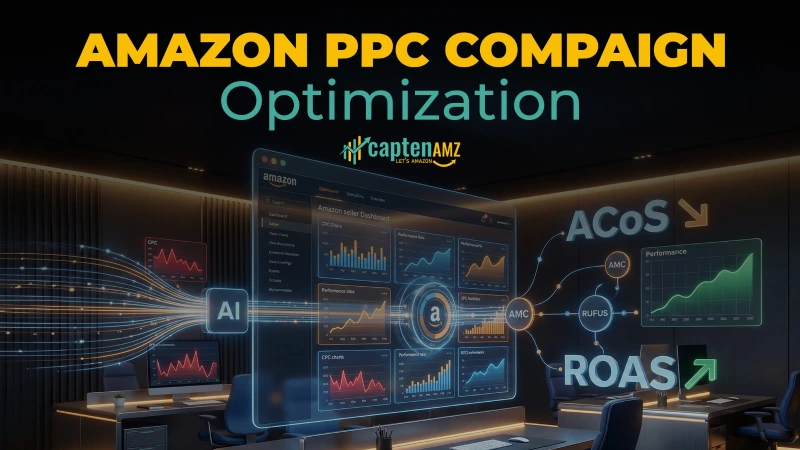
Amazon PPC Campaign Optimization is no longer about setting bids and waiting for results. In today’s competitive Amazon marketplace, successful sellers continuously analyze data, refine targeting, and optimize budgets to increase Return on Ad Spend (ROAS) while keeping Advertising Cost of Sales (ACoS under control.
Whether you are launching a new product or scaling an established brand, mastering Amazon PPC campaign optimization helps you reduce wasted ad spend, capture high-intent traffic, and improve both paid and organic rankings.
This guide breaks down advanced yet practical optimization strategies used by high-performing Amazon sellers and professional PPC agencies.
What Is Amazon PPC Campaign Optimization?
Amazon PPC Campaign Optimization is the ongoing process of improving ad performance by adjusting bids, keywords, targeting methods, placements, and budgets based on real performance data.
The primary goals are:
- Increasing ROAS
- Lowering ACoS and TACoS
- Improving conversion rates
- Scaling profitable keywords
- Eliminating wasted ad spend
Unlike “set and forget” advertising, optimization is a continuous cycle of testing, learning, and refining.
How Amazon PPC Campaigns Actually Work
Amazon PPC operates on an auction-based system. Sellers bid on keywords or products, and Amazon decides which ads appear based on:
- Bid amount
- Relevance
- Historical performance
- Conversion probability
The highest bid does not always win. Ads with better relevance, CTR, and conversion rates often outperform higher bids at a lower cost which is why optimization matters.
Core Pillars of Amazon PPC Campaign Optimization
Search Term Report Analysis
Search term reports are the foundation of Amazon PPC campaign optimization. They reveal exactly what shoppers typed before clicking your ads.
Key actions:
- Identify converting search terms and move them into manual exact-match campaigns
- Add irrelevant or high-spend terms as negative keywords
- Monitor CTR and conversion rate to spot inefficiencies
Weekly review is considered best practice for consistent performance improvement.
Keyword Match Type Optimization
Using the correct keyword match types allows you to balance discovery and efficiency.
- Broad match: Used for keyword discovery and expansion
- Phrase match: Filters intent while still allowing variation
- Exact match: Targets high-converting, high-intent searches
An optimized campaign structure uses broad for discovery, phrase for refinement, and exact for scaling winners.
Negative Keyword Strategy
Negative keywords are one of the most powerful tools in Amazon PPC campaign optimization.
They help:
- Stop irrelevant traffic
- Reduce wasted spend
- Improve ACoS
- Increase conversion rates
High-cost, zero-conversion terms should always be added as negatives at the campaign or ad group level.
Campaign Structure for Scalable Optimization

A clean campaign structure improves control, reporting, and profitability.
Recommended structure:
- Auto campaigns for keyword harvesting
- Manual broad and phrase campaigns for refinement
- Manual exact campaigns for scaling profitable terms
- Separate campaigns for branded and non-branded keywords
This structure allows precise bid control and better performance analysis.
Bid Optimization by Placement
Amazon allows bid adjustments for placements such as:
- Top of Search
- Product Pages
- Rest of Search
Optimization strategy:
- Increase bids for placements with strong ROAS
- Reduce bids where clicks are expensive and conversions are low
- Test aggressive top-of-search bids for launches and ranking pushes
Placement optimization can significantly impact visibility and profitability.
Budget Allocation & Scaling Strategy
Budget optimization ensures money flows toward profitable campaigns.
Best practices:
- Increase budgets on campaigns hitting target ACoS
- Reduce or pause campaigns exceeding break-even ACoS
- Avoid budget caps on high-performing campaigns during peak hours
Smart budget reallocation is key to scaling without increasing overall spend.
Advanced Amazon PPC Campaign Optimization Tactics
Auto-to-Manual Keyword Mining
Auto campaigns should never run unmanaged. Their real value is keyword discovery.
Optimization process:
- Pull converting search terms from auto campaigns
- Launch them into manual exact campaigns
- Reduce bids or budgets on auto campaigns over time
This process steadily improves efficiency while expanding profitable reach.
Optimization Frequency & Performance Cycles
Amazon PPC optimization should follow a structured cadence.
- Weekly: Bid adjustments, negative keywords, budget shifts
- Bi-weekly: Keyword expansion and campaign refinement
- Monthly: Performance audits, structure changes, scaling decisions
Consistent optimization beats aggressive but irregular changes.
Key Metrics to Track for Optimization
To evaluate Amazon PPC campaign optimization success, monitor:
- ACoS
- ROAS
- TACoS
- CTR
- Conversion rate
- CPC
High CTR with poor conversion usually indicates listing issues, not keyword problems.
Product Listing Quality and PPC Performance
Even the best-optimized PPC campaigns fail without strong product listings.
Optimization checklist:
- High-quality images
- Clear, benefit-driven bullet points
- Keyword-optimized titles and descriptions
- Competitive pricing
- Strong reviews and ratings
PPC performance improves naturally when listings are retail-ready and conversion-focused.
Amazon PPC Optimization for Different Business Goals
New Product Launches
- Higher bids
- Aggressive top-of-search placement
- Broad and auto campaigns for visibility
Established Products
- Exact-match scaling
- Low ACoS focus
- Budget efficiency and ROAS optimization
Goal-based optimization prevents wasted spend and accelerates growth.
Common Amazon PPC Optimization Mistakes

- Letting auto campaigns run unchecked
- Ignoring negative keywords
- Optimizing too frequently without data
- Scaling bids without conversion proof
- Running PPC on poor listings
Avoiding these mistakes alone can drastically improve results.
Why Professional Amazon PPC Campaign Optimization Matters
Amazon PPC has become too competitive for guesswork. Professional optimization combines:
- Data-driven decision-making
- Advanced campaign structuring
- Continuous testing and refinement
- Strategic scaling aligned with business goals
Brands that treat PPC as a growth system not just ads consistently outperform competitors.
Frequently Asked Questions (FAQs)
How to optimize a PPC campaign?
To optimize a PPC campaign, start by analyzing performance data such as ACoS, ROAS, CTR, and conversion rate. Identify high-converting search terms and move them into exact-match campaigns, reduce bids on low-performing keywords, and add irrelevant terms as negative keywords. Continuous bid adjustments, budget reallocation, placement optimization, and regular search term analysis are the foundation of effective Amazon PPC campaign optimization.
What are the 4 P’s of Amazon?
The 4 P’s of Amazon success typically refer to:
- Product – Quality, differentiation, and listing optimization
- Price – Competitive pricing aligned with conversion goals
- Promotion – Amazon PPC, deals, coupons, and external traffic
- Placement – Visibility through search rankings, ads, and categories
Amazon PPC plays a critical role in promotion and placement, directly influencing both paid and organic performance.
Is PPC better than SEO?
PPC is not better than SEO they work best together. PPC delivers immediate visibility and traffic, while SEO builds long-term organic growth. On Amazon, PPC supports SEO by increasing sales velocity and keyword relevance, which can improve organic rankings. A balanced strategy using both PPC optimization and listing SEO delivers the strongest results.
What is the optimization score on PPC ads?
An optimization score is a performance indicator provided by ad platforms that reflects how well a campaign follows best practices. While Amazon does not show a formal optimization score like Google Ads, performance metrics such as ACoS, CTR, conversion rate, and TACoS act as real indicators of how optimized an Amazon PPC campaign is.
Is $10 a day enough for Google Ads?
$10 per day can be enough for Google Ads in low-competition niches or for testing purposes, but results may be limited. On Amazon PPC, daily budgets depend on category competition, keyword CPCs, and campaign goals. For meaningful Amazon PPC optimization, budgets should align with expected conversion costs and break-even ACoS.
What is a good optimization score?
In platforms that use optimization scores, anything above 70% is generally considered good, while scores above 80–90% indicate strong campaign health. On Amazon, a “good” optimization level is reflected by stable ACoS, improving ROAS, efficient CPCs, and consistent conversions rather than a numeric score.
What is the 80/20 rule in SEO?
The 80/20 rule in SEO means that around 80% of results often come from 20% of keywords or pages. In Amazon PPC campaign optimization, this principle applies strongly a small set of high-performing keywords usually generates most of the sales. Identifying and scaling those keywords is key to profitable growth.
How much does 1,000 impressions cost in Google Ads?
The cost of 1,000 impressions (CPM) in Google Ads varies by industry, competition, and targeting, typically ranging from $2 to $20 or more. Amazon PPC does not use CPM pricing; instead, it operates on a cost-per-click (CPC) model, where advertisers pay only when shoppers click on ads.
Is 75 a good SEO score?
A score of 75 is generally considered good for SEO tools that use scoring systems. However, SEO success is better measured by rankings, traffic, engagement, and conversions. On Amazon, strong SEO performance is reflected through organic keyword rankings, consistent sales velocity, and improved visibility supported by optimized PPC campaigns.
Final Thoughts: Turn Data Into Profitable Growth
Amazon PPC Campaign Optimization is not a one-time task. It is an ongoing system that transforms raw data into measurable growth. By refining keywords, controlling bids, optimizing placements, and aligning campaigns with business goals, sellers can dramatically improve ROAS while reducing wasted spend.
When executed correctly, Amazon PPC doesn’t just drive paid sales it strengthens organic rankings, boosts brand visibility, and fuels long-term profitability. See us on LinkedIn & Instagram.
If you want expert-level Amazon PPC Campaign Optimization that reduces ACoS and scales profitably, partnering with an experienced Amazon PPC team can save months of trial and error and thousands in wasted ad spend.

Maria R. Donis is an Amazon eCommerce content specialist and digital marketing writer with hands-on experience creating data-driven, SEO-optimized content for Amazon-focused brands. She specializes in producing authoritative content around Amazon PPC management, catalog optimization, listing SEO, and marketplace growth strategies.
Maria collaborates closely with Amazon growth agencies like CaptenAMZ, ensuring that every piece of content reflects real Seller Central experience, platform-specific expertise, and up-to-date Amazon best practices. Her writing is guided by practical insights into how Amazon ads, search algorithms, and buyer behavior work in real-world scenarios.