
Most Amazon sellers panic when TACoS creeps above 15% and immediately reach for the kill switch on their ad spend. That instinct is understandable but it’s also one of the most damaging mistakes you can make for your long-term growth.
Here is the truth: you can lower Amazon TACoS without cutting ad spend and in fact, doing it the right way means spending smarter while growing your total revenue faster.
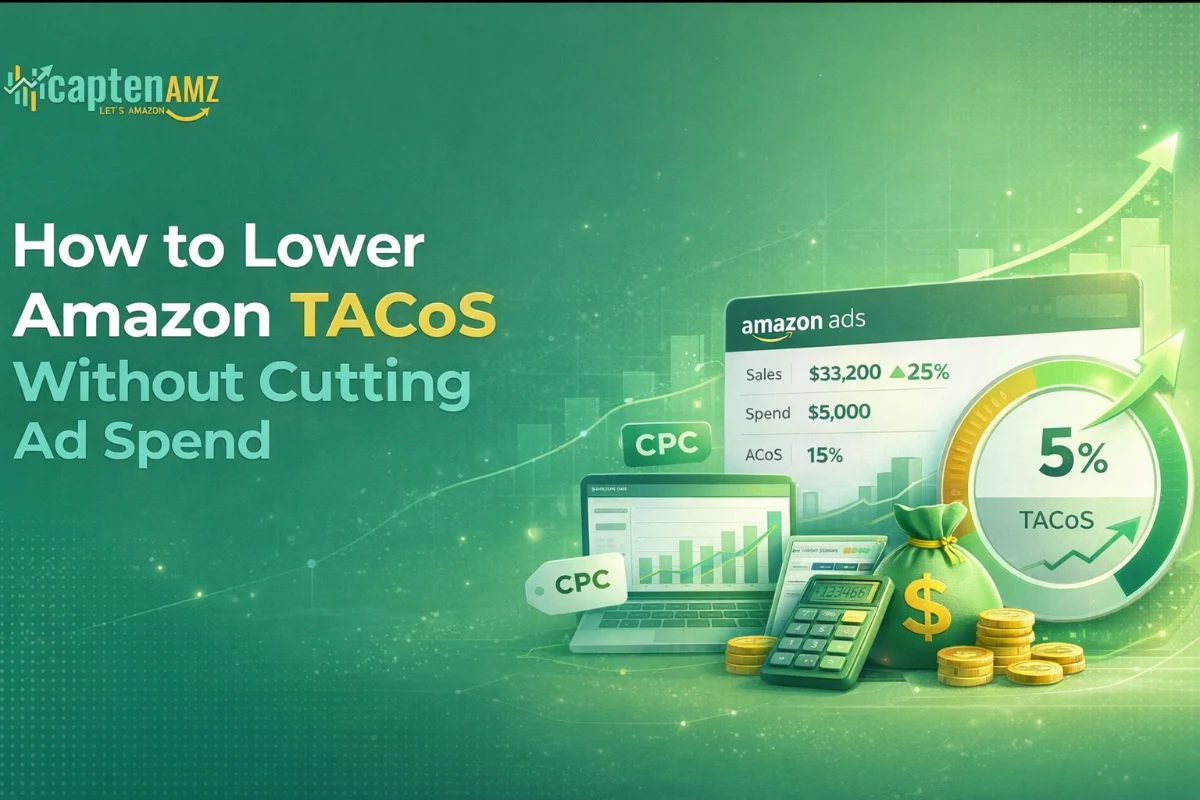
If your TACoS is high, the problem isn’t how much you’re spending on ads. It’s that your organic sales aren’t keeping pace. TACoS is simply your total ad spend divided by your total revenue (paid + organic). So there are only two real levers: reduce wasted ad spend, or grow total sales. This guide covers both in detail.
At CaptenAMZ, we manage Amazon PPC campaigns for brands doing 6- and 7-figures, and lowering TACoS without sacrificing ad momentum is one of the most common challenges we solve. Here’s the complete framework.
What Is Amazon TACoS? (And Why It Matters More Than ACoS)
TACoS (Total Advertising Cost of Sales) measures what percentage of your total revenue is being consumed by ad spend.
TACoS Formula:
TACoS = (Total Ad Spend ÷ Total Revenue) × 100
Where Total Revenue = Ad-Attributed Sales + Organic Sales
Unlike ACoS, which only measures ad-attributed sales, TACoS gives you the full picture of ad efficiency across your entire business. A falling TACoS means your organic engine is growing. A rising TACoS means your business is becoming dangerously dependent on paid traffic.
TACoS Benchmarks by Product Stage
| Product Stage | Target TACoS Range |
|---|---|
| New Launch (0–90 days) | 20%–35% (acceptable) |
| Growing Product | 12%–20% |
| Mature / Established | 6%–12% (healthy) |
| Market Leader / Brand | Below 6% (ideal) |
A good TACoS target for most sellers is between 6% and 10%. If you’re above 15% on a mature product, your organic foundation needs serious work.
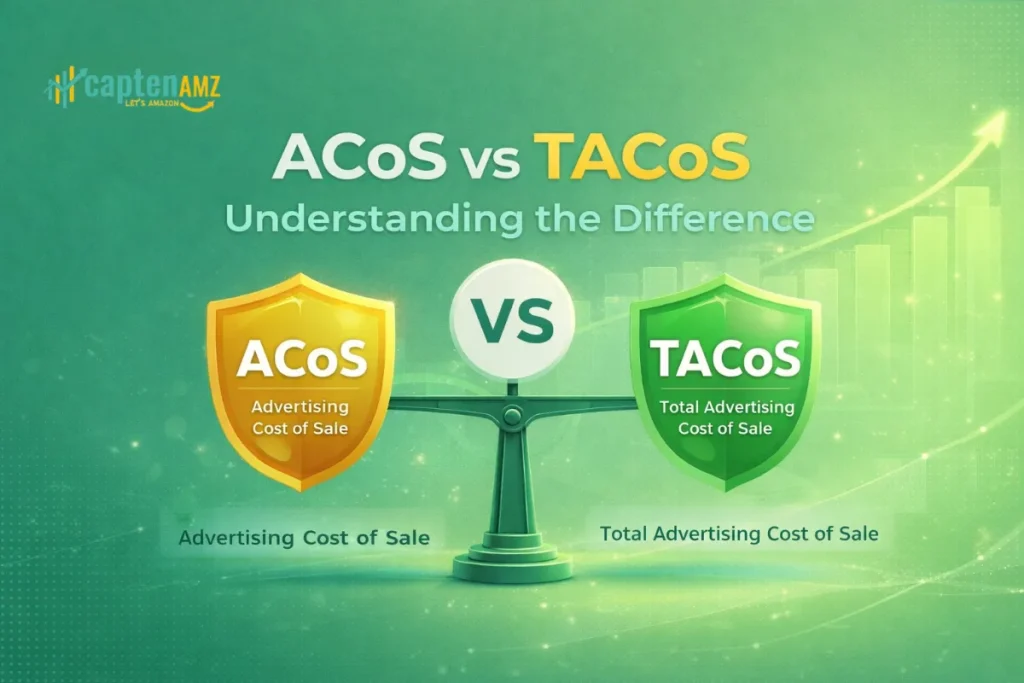
ACoS vs TACoS: Understanding the Difference
| Metric | Measures | Best For |
|---|---|---|
| ACoS | Ad spend vs. ad sales only | Short-term campaign efficiency |
| TACoS | Ad spend vs. total sales | Long-term brand health |
An increasing ACoS with a decreasing TACoS is actually a positive sign — it means your organic sales are growing faster than your paid sales. Never optimize ACoS in isolation. Learn more about how CaptenAMZ’s Amazon PPC Optimization service approaches both metrics together.
Why You Should NOT Cut Ad Spend to Lower TACoS
Cutting ad spend to reduce TACoS creates a negative sales cycle:
↓ Ad Spend → ↓ Ad Sales → ↓ Sales Velocity → ↓ Organic Rankings → ↓ Organic Sales → ↑ TACoS (long-term)
When you reduce spend, you lose sales velocity signals. Amazon’s A9/A10 algorithm uses conversion data and sales history to determine organic rank. Fewer sales mean lower rankings, which means fewer organic impressions, which means even less organic revenue — and suddenly your TACoS gets worse, not better.
The right goal is: spend the same (or more), but direct every dollar toward higher-converting targets while simultaneously building your organic foundation.
7 Proven Strategies to Lower Amazon TACoS Without Cutting Ad Spend
Strategy 1: Fix Your Listing Conversion Rate First
Your TACoS problem is often a listing problem in disguise. If your listing converts at 8% while your competitor converts at 18%, you’re paying for the same traffic but getting half the sales. That directly inflates your TACoS.
Before scaling or restructuring campaigns, audit every element of your listing:
Title Optimization Your title should lead with your highest-volume, highest-converting keyword. It should include the primary benefit, key attribute (size, material, quantity), and brand name. A keyword-stuffed title that reads unnaturally drives bounces and kills conversion.
Bullet Points & Description Bullets should not just list features — they should answer buyer objections and build purchase confidence. Each bullet is an opportunity to address a search query your customer had when they clicked.
Images & Video The primary image drives click-through rate (CTR). Lifestyle images and infographics drive conversion. Video is now a significant trust signal, especially for higher-priced products. If your images look like stock photography, expect lower CVR.
A+ Content / Enhanced Brand Content A+ Content has been shown to increase conversion rates by 5–10% on average. It reduces buyer hesitation, communicates brand trust, and cross-sells related products — all of which grow total revenue without touching your ad budget.
Our Amazon Listing Optimization service is purpose-built to close the gap between your ad traffic and your actual conversions. Every click you’re already paying for works harder when the listing converts.
Pricing Competitiveness Check the Buy Box win rate. If you’re not winning the Buy Box consistently or your price is more than 10–15% above the category average for comparable listings, your conversion rate is suppressed — and your TACoS suffers.
Strategy 2: Use Ad Spend to Build Organic Rankings Strategically
The most powerful long-term TACoS reducer is increasing organic sales — and the fastest way to build organic rank is through strategic PPC. This is the “graduation strategy” used by top Amazon agencies.
Step 1: Identify your target keywords Use Auto and Broad campaigns to harvest search terms with strong click-to-order ratios. Any search term that generates 3–5 orders with a reasonable ACoS should be graduated.
Step 2: Graduate converting search terms Move your top converters from Auto/Broad discovery campaigns into dedicated Exact Match campaigns with more precise bid control. This increases ad visibility for your best keywords, drives more sales velocity, and signals keyword relevance to Amazon’s algorithm.
Step 3: Win organic rank, then reduce bids gradually Once a keyword achieves page 1 organic placement, you can cautiously reduce the bid on that keyword’s Exact campaign because organic impressions now supplement paid visibility. Total sales remain stable, but your TACoS-per-keyword drops.
This is the foundation of how CaptenAMZ Amazon PPC Management approaches long-term TACoS reduction — using PPC as an organic rank investment, not just a revenue tool.
Strategy 3: Aggressive Negative Keyword Management
Wasted ad spend is a silent TACoS killer. Every dollar spent on irrelevant clicks is a dollar that could have gone toward high-converting placements. Negative keyword management is not a one-time task — it’s a weekly discipline.
How to find wasteful search terms:
- Pull your Search Term Report from Seller Central weekly
- Filter for search terms with 15+ clicks and zero orders
- Add these as Negative Exact to the relevant campaigns (and Negative Phrase at the portfolio level if applicable)
Common negative keyword categories to add:
- Competitor brand names (unless you’re running a targeting strategy)
- Irrelevant modifiers (“used,” “wholesale,” “DIY kit” if you don’t sell kits)
- Size/color/attribute mismatches
- Overly broad head terms that generate browsers, not buyers
Every dollar you stop wasting on non-converting clicks can be redirected toward proven high-ROI placements, improving both ACoS and overall TACoS.
Our Amazon PPC Audit service routinely finds 20–35% wasted spend from negative keyword gaps alone. That reclaimed budget, redirected to high-converting targets, dramatically accelerates TACoS improvement.
Strategy 4: Restructure Campaigns Around Profit Margin, Not Just ACoS
Many sellers set a flat ACoS target across all products — say 15% — and optimize every campaign to hit it. This ignores the reality that different products have different margin structures, different organic rank positions, and different TACoS trajectories.
Segment campaigns by:
- Product lifecycle stage — New launches need aggressive spend (high TACoS is expected). Mature products with strong organic rank should have lower TACoS targets and tighter bid controls.
- Profit margin — High-margin products can tolerate a higher ACoS because the contribution margin is larger. Low-margin products need stricter guardrails.
- Organic rank strength — If a product ranks on page 1 organically for its main keyword, its TACoS should be naturally lower. If it’s page 3, it needs PPC support.
Structure your campaigns to reflect these realities. Don’t apply the same bid rules to a top-10 organic ranking product and a newly launched ASIN — they require completely different strategies.
This is core to the CaptenAMZ PPC Optimization framework — ASIN-level margin-aware bid strategy, not one-size-fits-all ACoS chasing.
Strategy 5: Use Dayparting and Placement Modifiers to Concentrate Spend
Not all clicks are equal. Clicks at 2:00 AM on a Tuesday convert at a very different rate than clicks at 8:00 PM on a Saturday. Yet most sellers run their campaigns 24/7 at flat bids, burning budget during low-converting hours.
Dayparting (Scheduled Bidding) Analyze your campaign performance by hour and day using Seller Central reports or a third-party tool. Identify your highest-converting windows and concentrate budget there. If your best conversion hours are 6 PM–11 PM, reduce bids (or use rules to suppress campaigns) from 12 AM–9 AM. Same budget, better results.
Placement Bid Modifiers Amazon allows you to adjust bids for three placement types:
- Top of Search (first page)
- Rest of Search
- Product Pages
For keywords with high purchase intent, top-of-search placements often convert significantly better and support organic rank signals. Increasing placement modifiers for top-of-search on your core converting keywords improves conversion rate and organic rank simultaneously — both of which lower TACoS over time.
Strategy 6: Maximize Average Order Value (AOV) to Dilute TACoS
TACoS = Ad Spend ÷ Total Revenue. One of the cleanest ways to lower it without touching spend is to increase the revenue denominator by raising average order value.
Tactics to increase AOV:
Product Bundles Create bundles of 2-packs, 3-packs, or complementary product combinations. A bundle that sells for $45 with similar ad cost as your $20 single unit immediately reduces TACoS by more than 50% on that unit type. Bundle listings are also often less competitive, meaning lower CPCs.
Variations If you sell multiple sizes or flavors, ensure they’re set up as parent-child variations on a single listing. This consolidates reviews, improves Buy Box competitiveness, and allows customers to trade up to higher-priced options.
Cross-Sell via A+ Content Use the comparison module in A+ Content to cross-sell complementary products in your catalog. Customers who add a second product increase both revenue and purchase frequency — reducing your TACoS per customer acquisition.
A strong catalog architecture that enables bundling and cross-selling is one of the highest-leverage TACoS strategies available. Our Amazon A+ Content & Brand Store service is specifically designed to create these revenue-compounding content structures.
Strategy 7: Drive External Traffic to Boost Organic Sales Velocity
External traffic converts into sales that don’t cost you a single PPC dollar — but they still count toward your total revenue. More organic sales in the denominator = lower TACoS automatically.
Effective external traffic channels:
- Social Media (Meta/TikTok Ads) — Direct traffic to your Amazon listing or brand store. Amazon’s Brand Referral Bonus program gives you a 10% rebate on sales driven from external sources tagged with Attribution links.
- Email Marketing — If you have a customer list, email drives some of the highest-converting traffic with near-zero marginal cost.
- Influencer / UGC Marketing — Micro-influencers in your niche drive authentic traffic with high purchase intent. Even a few thousand highly targeted visitors can meaningfully impact sales velocity.
- SEO / Content Marketing — Long-term organic traffic from Google that lands on Amazon product pages or brand stores adds pure organic sales without paid ad cost.
Every external sale reduces your TACoS by adding revenue to the denominator without adding ad spend to the numerator.
TACoS Trend Analysis: What the Numbers Are Telling You
Don’t just track TACoS in isolation — track the relationship between TACoS and ACoS together.
| TACoS Trend | ACoS Trend | What It Means |
|---|---|---|
| ↑ Increasing | ↑ Increasing | Dangerous. Ads burning money, organic declining |
| ↑ Increasing | ↓ Decreasing | Organic sales shrinking — investigate listing/ranking |
| ↓ Decreasing | ↑ Increasing | Great sign — organic growing fast |
| ↓ Decreasing | ↓ Decreasing | Best scenario — efficiency improving across the board |
Review TACoS monthly at the product level, not just account level. A product stuck at 25% TACoS may be masking 5 ASINs performing at 8%, creating a misleadingly “healthy” blended average.
TACoS Reduction Checklist for Amazon Sellers
Use this checklist before touching a single bid:
- Audit listing: title, bullets, images, A+ Content, pricing
- Check Buy Box win rate (should be 80%+)
- Pull Search Term Report — identify and add negatives
- Confirm campaign structure is segmented by product lifecycle
- Verify Exact Match campaigns exist for top 10–20 converting keywords
- Check placement modifiers — are top-of-search modifiers set for core keywords?
- Review hourly performance — identify low-converting hours
- Analyze TACoS by ASIN, not just account-wide
- Check external traffic opportunity — is Brand Referral Bonus set up?
How CaptenAMZ Lowers TACoS for Growing Amazon Brands
At CaptenAMZ, we don’t manage ads in isolation. We treat TACoS as the primary health metric for every brand we work with — and we attack it from both sides simultaneously.
Our approach combines:
- Amazon PPC Management — Structured campaigns, smart keyword graduation, negative keyword automation, and bid rules that protect margins
- Amazon PPC Audit — Deep-dive into wasted spend, missing negatives, structural issues, and TACoS leakage across every campaign
- Listing Optimization — Conversion-focused titles, bullets, and A+ Content that turn your existing traffic into more sales
- Amazon A+ Content & Brand Store — Cross-sell architecture, brand trust, and higher AOV built into the content layer
- PPC Consultation — For sellers who want strategic guidance on TACoS targets, campaign structure, and organic rank investment planning
The result? Brands that partner with CaptenAMZ typically see TACoS improvement within 60–90 days, not by cutting spend, but by redirecting it more intelligently while simultaneously improving the organic foundation.
Frequently Asked Questions
Q: What is a good TACoS on Amazon?
A good TACoS for most established Amazon products is between 6% and 10%. New products launching may see 20–35% in the first 60–90 days, which is normal and expected. TACoS below 5% for a mature product typically indicates strong organic visibility.
Q: How is TACoS different from ACoS?
ACoS (Advertising Cost of Sales) only measures ad spend against ad-attributed revenue. TACoS measures ad spend against total revenue — including organic sales. TACoS is the more comprehensive metric for evaluating overall ad efficiency and business health.
Q: Why is my TACoS increasing even though my ACoS is stable?
If ACoS is stable but TACoS is increasing, it usually means your organic sales are declining as a percentage of total revenue. This is a warning sign that your listings may need optimization, your organic rankings are slipping, or your ad dependency is growing.
Q: Can I lower TACoS without reducing ad spend?
Yes — and that’s the smarter approach. By improving listing conversion rates, graduating high-performing keywords to Exact Match, adding aggressive negatives, and driving external traffic, you increase total revenue faster than ad spend grows, which lowers TACoS without touching budget.
Q: How long does it take to lower TACoS on Amazon?
With the right strategy, meaningful TACoS improvement is typically visible within 30–60 days. Listing optimization and negative keyword cleanup produce the fastest results. Organic rank improvement from strategic keyword graduation takes 60–90 days to compound.
Q: What tools can help me track and lower TACoS?
Amazon’s native Advertising Console provides TACoS data. Third-party tools like Helium 10, Perpetua, and Scale Insights offer more granular ASIN-level tracking. However, the most impactful improvements come from strategic execution, not just tools. A structured Amazon PPC audit often reveals more actionable insights than any software dashboard.
Final Thoughts: TACoS Is a Signal, Not a Problem to Be Cut Away
TACoS doesn’t lie. A high TACoS tells you that your total business is too reliant on paid advertising. But the solution isn’t to spend less — it’s to build the organic foundation that makes every ad dollar work harder and last longer.
The brands that win on Amazon in 2026 are those that treat PPC as a long-term organic investment, not just a short-term traffic tool. They optimize listings to convert existing traffic better. They graduate converting keywords to build organic rank. They eliminate waste through disciplined negative management. And they grow AOV and external traffic to add revenue without proportional ad spend.
That’s how you lower Amazon TACoS without cutting ad spend — and sustain profitability as you scale. See us on LinkedIn & Instagram.
If you’re ready to stop guessing and start growing, book a free strategy call with CaptenAMZ and get a clear action plan tailored to your TACoS situation.

Maria R. Donis is an Amazon eCommerce content specialist and digital marketing writer with hands-on experience creating data-driven, SEO-optimized content for Amazon-focused brands. She specializes in producing authoritative content around Amazon PPC management, catalog optimization, listing SEO, and marketplace growth strategies.
Maria collaborates closely with Amazon growth agencies like CaptenAMZ, ensuring that every piece of content reflects real Seller Central experience, platform-specific expertise, and up-to-date Amazon best practices. Her writing is guided by practical insights into how Amazon ads, search algorithms, and buyer behavior work in real-world scenarios.