

Your Amazon product title is doing three jobs at the same time.
It has to satisfy Amazon’s search algorithm so your product gets indexed for the right queries. It has to pass a human eye-scan in under two seconds so the shopper chooses to click your listing. And it has to communicate enough value that the click feels like the right decision before they even land on your page.
Most Amazon sellers get one of these three jobs right. The ones consistently ranking on page one and converting above 15% get all three right — and it starts with understanding exactly how to construct a title that works for all three simultaneously.
This guide gives you the exact Amazon product title formula used by top-performing sellers across the USA and European markets, with real examples by category, before-and-after rewrites, and the advanced techniques most competitor guides never cover.
If your titles are not ranking where they should, or your click-through rate is lower than your impression count deserves, this is where the fix begins.
Why Your Product Title Is Your #1 Ranking Asset

Every element of an Amazon product listing contributes to ranking and conversion. But no element carries more combined weight than the title.
It is the first field Amazon’s algorithm reads. It is the first thing shoppers see in search results. On mobile devices — where over 70% of Amazon traffic originates — it is often the only thing a shopper sees before deciding to click or scroll past your listing entirely.
Here is how the impact compounds. A well-written title does three jobs simultaneously. It tells Amazon’s search engine what your product is and which queries it should rank for. It earns the click from the shopper by communicating relevance within under two seconds. And it signals to Amazon’s AI systems — COSMO and Rufus — your product’s use case, audience, and problem-solving value.
A weak title fails all three of these jobs, and the consequences cascade. Lower organic ranking. Reduced click-through rate. Worse PPC conversion. Higher ACoS on every campaign you run against that listing.
In catalog audits of brands across New Jersey, New York, Texas, California, the UK, and Germany, our team at CaptenAMZ consistently finds the same pattern. The most impactful quick win in any underperforming listing is almost always the title. A title rewrite can move keyword rankings within 14 to 21 days and lift CTR within the first reporting week — without touching bids, A+ Content, or images.
This is why our Amazon Catalog Management service always begins with a title audit before any other optimization step.
A well-optimized listing converts at 15 to 25 percent. A weak one converts at 8 percent or below. The difference in those numbers is rarely images or A+ Content. It almost always starts with the title.
The Three Algorithms Your Title Must Satisfy in 2026
This is where 2026 differs from every previous year. Amazon’s product discovery system now operates in three distinct layers, and your title must work for all of them simultaneously. Optimizing for only one is a strategy that is already producing declining results for thousands of sellers across the USA and Europe.
Layer 1: A9 — Traditional Keyword Matching
Amazon’s core ranking algorithm — still A9, though substantially rebuilt — is primarily a probabilistic and lexical system. It calculates the probability that a search query will result in a conversion for your specific ASIN, weighted heavily by keyword presence in your title, historical sales velocity, click-through rate, and conversion rate.
This is why your primary keyword must appear early in your title. The algorithm gives more ranking weight to words that appear in the first several positions. This is the system most sellers have learned to optimize for, and it remains essential. But it is no longer sufficient on its own.
Layer 2: COSMO — Semantic Intent Matching
COSMO, which stands for Common Sense Knowledge Generation and Serving System, is Amazon’s AI-powered knowledge graph deployed across search relevance and recommendations. Unlike A9, COSMO does not match keywords to titles — it maps products to intent.
A shopper searching “shoes for a wedding” does not need to see the word “wedding” in your title. COSMO infers the intent and surfaces products whose listings communicate formal footwear attributes, even without exact keyword overlap. The practical implication: a title that only communicates what a product is will underperform one that also communicates who it is for, what it does, and what problem it solves.
Layer 3: Rufus — Conversational AI Discovery
Rufus, Amazon’s generative AI shopping assistant, now processes over 20 percent of Amazon’s searches. Rufus users convert at a 60 percent higher rate than non-Rufus users.
Rufus reads your title as the first line of a conversation, not a keyword field. It evaluates whether your title answers the natural-language question the shopper is asking. Titles that read as keyword dumps actively degrade Rufus’s confidence in your listing. Titles that read as clear noun phrases give Rufus structured signal to recommend you accurately.
Read how Amazon Rufus Sponsored Prompts work and why titles optimized for conversational intent are now a direct revenue driver — not just an SEO tactic.
The Proven Amazon Product Title Formula
After auditing hundreds of top-ranking, high-converting listings across every major Amazon category, one structural formula consistently outperforms alternatives. It satisfies all three algorithm layers simultaneously while remaining readable to human shoppers.

The Formula:
Brand + Primary Keyword + Key Feature or Material + Size or Variant + Use Case or Benefit
Example: CaptenAMZ Insulated Water Bottle — Stainless Steel, BPA-Free — 32 Oz — Keeps Drinks Cold 24 Hours, For Gym and Hiking
This formula is not arbitrary. Each component plays a specific strategic role.
Brand — Always Lead with It
Starting with your brand name satisfies Amazon’s category style guides in most product types, builds brand recognition in search results, and protects against competitor hijacking. If your brand name is long, use its abbreviation — but never omit it. For generic private label products, brand presence also signals authenticity and reduces listing vulnerability.
Primary Keyword — Your Highest-Volume, Highest-Intent Search Term
This is the most critical placement decision. Amazon’s algorithm assigns significantly more ranking weight to keywords appearing early in the title. The primary keyword should be the exact search term that represents your ideal buyer’s first thought — not a variation, not a long-tail version.
Place it immediately after your brand name. Use keyword tools like Helium 10 or Jungle Scout to find the term with the highest search volume that accurately describes your specific product. This keyword research is a core component of CaptenAMZ’s professional catalog optimization service.
Key Feature or Material — Your Primary Differentiator
What is the single most important attribute that separates your product from competitors? Material quality like 304-Grade Stainless Steel, a certification like BPA-Free, a technology like Double-Wall Vacuum Insulation, or a construction method like Hand-Forged.
This element serves COSMO by providing a specific, attributable characteristic that maps your product to intent-based queries. It also serves conversion — shoppers scanning titles in under two seconds need to immediately grasp why your product is the right one.
Size or Variant — Critical for Shoppers Who Filter
Include this whenever size, quantity, or variant is a primary shopping filter in your category. Examples: 32oz, Pack of 2, XL Fits 12–14, 2-Pack. Shoppers who do not see the variant they need in the title frequently bounce without clicking — a lost impression that sends a negative CTR signal to the algorithm. Include size and variant information before the 80-character mobile cutoff whenever possible.
Use Case or Benefit — For COSMO, Rufus, and Conversion
This final component is what most competitor titles omit — and what increasingly separates listings that win Rufus recommendations from those that do not. “Keeps Drinks Cold 24 Hours” is a benefit. “For Gym, Hiking and Outdoor Sports” is a use case. Both communicate context that COSMO uses to map your product to intent-based search scenarios, and both help the shopper visualize owning the product before clicking.
Write this element the way a knowledgeable human would say it, not the way a keyword tool would suggest it.
Character Limits, Mobile Rules and Amazon’s 2025 Enforcement Update
Amazon updated its product title requirements in January 2025, and enforcement is now active. Non-compliant titles are automatically adjusted after 14 days — meaning Amazon will rewrite your title for you, and the result is rarely optimized for ranking or conversion.
The Three Character Zones You Need to Know
Zone 1: Mobile Priority Zone — 0 to 80 characters Visible on all devices. This is where your Brand, Primary Keyword, Key Feature, and Variant must live. Everything the shopper needs to understand your product and click. If a shopper on their phone cannot immediately tell what your product is and why it is relevant to their search, your click-through rate dies regardless of how good the full title looks on desktop.
Zone 2: Full Title Zone — 80 to 150 characters Visible on desktop and tablet. Use this space for your use case phrase, secondary keywords, and additional differentiating features. Extend the value proposition for desktop users who see the complete title.
Zone 3: Risk Zone — 150 to 200 characters Desktop only and often truncated depending on the browser and device. Add variant detail or secondary targeting terms here if necessary — but avoid padding content that repeats keywords you have already used. Amazon penalizes word repetition across the title.
The practical rule: treat 80 characters as your hard deadline for critical information, and 150 characters as your realistic target for the full title. Going to 200 characters is possible, but every character beyond 150 is desktop-only and carries diminishing optimization value.
If your existing titles have been auto-modified by Amazon, our guide to why Amazon listings are not ranking explains how to identify suppressed or auto-corrected titles and recover them.
Banned Words, Prohibited Phrases and Auto-Suppression Triggers
Knowing what to include in your title is only half the skill. Knowing what will get your listing flagged, suppressed, or auto-corrected is equally important.
Absolute Prohibitions — These Will Trigger Suppression or Auto-Correction
Promotional language: Best Seller, Top Rated, Number 1 Choice, On Sale, Free Shipping, Limited Time, Sale Price Seller information: contact details, URLs, or account names HTML tags or special characters: !, $, ?, _, {, }, ^ unless part of your registered brand name Competitor brand names: trademark violation that risks account suspension Word repetition: the same word more than twice in a single title, excluding prepositions and articles Subjective claims without substantiation: Amazing, Perfect, Premium, High-Quality Pricing or availability information: 2 for 1, Back in Stock, Get It Today
Formatting Rules That Affect Ranking
Use Title Case only. Capitalize the first letter of each word, except articles (a, an, the), prepositions (in, on, for, with), and conjunctions (and, or, but). ALL CAPS in titles is prohibited and triggers automated correction.
Spell out measurements where possible. Use 32 Ounce rather than 32oz, 12 Inch rather than 12″. Numbers used as part of a product name like 3-Pack are acceptable.
No emojis. Emojis in titles are prohibited and will be removed.
Use hyphens for compound attributes. BPA-Free, Double-Wall, Non-Slip are all acceptable and preserve keyword indexing across both the full term and its component words.
Suppressed listings and title violations are among the most common causes of invisible ranking drops. Our Amazon Catalog Support service handles suppression resolution, title compliance, and catalog cleanup across single ASINs and multi-product catalogs.
The Formula Applied: Real Examples by Category
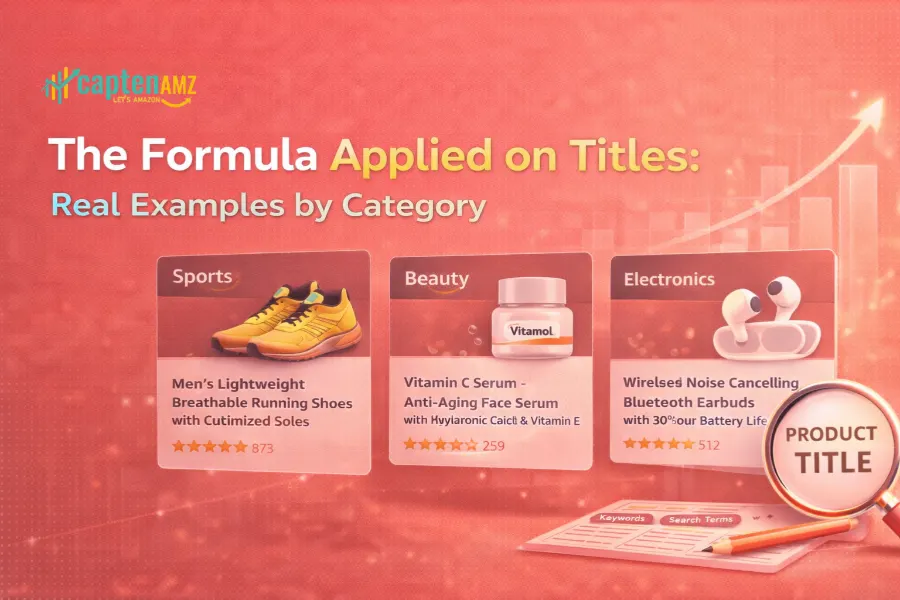
The core formula remains consistent across categories, but the weight and order of each component shifts based on what shoppers in that category care about most.
Home and Kitchen Formula: Brand + Product Type + Material or Feature + Size + Use Case
Strong title: KitchenEdge Stainless Steel Mixing Bowl Set — Non-Slip Base, Airtight Lids — 3-Piece (1.5, 3, 5 Qt) — For Baking, Salad and Meal Prep
Weak title to avoid: KitchenEdge Bowl Set Mixing Bowl Salad Bowl Kitchen Bowl Stainless Steel Bowl Set of 3
Sports and Outdoors Formula: Brand + Primary Keyword + Material + Size + Use Case
Strong title: HydroCore Insulated Water Bottle — BPA-Free Stainless Steel, Leak-Proof Lid — 32 Oz — Keeps Cold 24 Hr, Hot 12 Hr — For Gym, Hiking and Travel
Weak title to avoid: Water Bottle Insulated Stainless Steel Sports Bottle Hydro Flask Style Gym Bottle 32oz Leak Proof
Apparel Formula: Brand + Department + Style + Material + Key Feature + Size Range
Strong title: UrbanForm Men’s Classic Fit Dress Shirt — Wrinkle-Free Cotton Blend, Spread Collar — Available in Sizes S–3XL
Weak title to avoid: Men Dress Shirt Classic Fit Formal Office Shirt Button Down Shirt for Men Business Shirt
Electronics Formula: Brand + Model + Product Type + Key Spec + Use Case
Strong title: SoundPeak Pro X7 Active Noise Cancelling Headphones — 40Hr Battery, Bluetooth 5.3, Foldable — For Work, Travel and Studio
Weak title to avoid: Wireless Headphones Bluetooth Headphones Noise Cancelling Over Ear Headphone Best Headphones 2026
Health and Personal Care Formula: Brand + Product Type + Key Ingredient + Benefit + Size or Count
Strong title: VitaBlend Vitamin D3 + K2 Supplement — 5000 IU D3, 100 mcg K2 MK-7 — Supports Bone and Immune Health — 90 Softgels
Weak title to avoid: Vitamin D Supplement Best Vitamin D Immune Support Bone Health Vitamins High Potency D3 Pills
Baby Products Formula: Brand + Product Type + Safety Feature + Key Spec + Age Range
Strong title: SnugSafe Baby Monitor — 1080p HD Camera, Two-Way Audio, Night Vision, No WiFi Required — For Newborns 0 to 5 Years
Weak title to avoid: Baby Monitor Video Baby Monitor Camera Baby Camera Monitor Baby Monitor with Camera and Audio
Good vs. Bad: Side-by-Side Title Rewrites
The fastest way to understand what separates a high-performing title from a weak one is direct comparison.
Example 1 — Kitchen Accessory
Weak title: Garlic Press Stainless Steel Garlic Press Easy Squeeze Garlic Mincer Garlic Crusher Kitchen Tool
Strong title: ChefCore Stainless Steel Garlic Press — Easy Squeeze, No Peeling Required, Dishwasher Safe — For Home Cooks and Professional Kitchens
The weak title repeats “garlic press” three times, triggering Amazon’s word repetition penalty. It uses near-identical synonym phrases stacked together, communicates nothing about use case or benefit, and gives COSMO zero structured intent signal. The strong title leads with the brand, places the primary keyword once precisely, adds two specific differentiating features, and closes with a use case phrase that COSMO maps to cooking intent.
Example 2 — Electronics
Weak title: Bluetooth Speaker Portable Speaker Wireless Speaker Outdoor Speaker Waterproof Speaker Small Speaker for Travel
Strong title: BassCore Portable Bluetooth Speaker — IPX7 Waterproof, 360 Degree Sound, 20Hr Battery — For Outdoor, Beach and Travel
The weak title stacks the same product type five times with minimal variation. The strong title leads with one clean product description, adds three specific, measurable differentiators, and ends with three use case scenarios that Rufus can map to conversational search queries.
Writing Titles for COSMO and Rufus Beyond Keywords
This section is where most competitor guides stop short — and where the biggest ranking opportunities in 2026 are hidden.
COSMO does not care whether your title contains the exact words in a search query. It cares whether your listing communicates the attributes of a product that satisfies the shopper’s underlying intent. Your title contributes to that understanding through noun phrase optimization — not keyword density.
A noun phrase is a Feature + Benefit + Context string. “IPX7 Waterproof Jacket — Breathable, Windproof — For Trail Running and Summit Hikes” is a noun phrase. “Hiking Jacket Outdoor Jacket Waterproof Jacket Windproof Jacket Men Women” is a keyword list. COSMO processes the first as structured, high-confidence intent signal. It processes the second as low-quality, intent-ambiguous content.
Rufus reads your title as the answer to a question. If a shopper asks Rufus “What water bottle should I use for hiking?” and your title reads “HydroCore Insulated Water Bottle — BPA-Free Stainless Steel — 32 Oz — Keeps Cold 24 Hours, For Gym and Hiking” — Rufus can confidently extract a structured answer from that title and recommend your product. If your title reads “Water Bottle Insulated Steel Outdoor Sports Fitness Gym Bottle 32oz BPA Free” — Rufus treats it as low-confidence and is less likely to surface your listing.
The Three Noun Phrase Types COSMO Rewards
Feature Plus Proof phrases communicate specific, measurable attributes. “Double-Wall Vacuum Insulation” outperforms “insulated.” “304-Grade Stainless Steel” outperforms “stainless steel.” “IPX7 Waterproof Rated” outperforms “waterproof.” Specificity gives COSMO a measurable attribute to map to intent queries.
Benefit Plus Outcome phrases communicate measurable value, not vague claims. “Keeps Drinks Cold 24 Hours,” “Lasts Up to 40 Hours Per Charge,” “Fits Carry-On Requirements.” These also satisfy Amazon’s review alignment requirement — if your title claims something specific, customer reviews can verify it, which COSMO treats as a trust signal.
Use Case Plus Audience phrases are COSMO’s strongest intent-mapping signals. “For Gym, Hiking and Travel,” “For Home Cooks and Professional Kitchens,” “Designed for Newborns 0 to 12 Months.” These place your product inside specific use-case buckets within COSMO’s knowledge graph, making it discoverable for conversational queries even when the query does not contain every word in your title.
How to Find the Right Keywords for Your Title
A title formula is only as strong as the keyword intelligence behind it. The right primary keyword is not the one with the highest search volume — it is the one with the highest search volume that is genuinely relevant to your specific product and has a realistic chance of conversion given your listing’s current review count, pricing, and competitive position.
Step 1 — Identify Your Seed Keywords
Start with what your product actually is. Type your product into Amazon’s search bar and observe the auto-complete suggestions. These represent real searches from real shoppers and are the strongest available signal of actual search volume and purchase intent. Record every suggestion that is relevant to your specific product variant.
Step 2 — Run a Reverse ASIN on Your Top Competitors
Use Helium 10 Cerebro or Jungle Scout to run a reverse ASIN lookup on the top three to five listings in your category. Identify which keywords they rank for organically, particularly in positions 1 through 20. The intersection of high-search-volume terms that appear across multiple top-ranked ASINs is your primary keyword target list. This same competitive intelligence is how CaptenAMZ’s professional catalog optimization service builds title keyword strategies from day one of every new engagement.
Step 3 — Prioritize by Intent, Not Volume Alone
A keyword with 50,000 monthly searches but broad intent like “water bottle” will convert far worse than one with 15,000 monthly searches and purchase intent like “insulated water bottle for hiking 32 oz.” For title placement, prioritize the most specific, highest-intent keyword that still has meaningful volume. Typically this falls in the 3,000 to 20,000 monthly search range depending on your category.
Step 4 — Distribute Secondary Keywords to Bullets and Backend
Your title can only carry so many keywords before it becomes unreadable. Everything that does not fit naturally in the title — long-tail variations, synonym terms, misspellings, use-case phrases — belongs in bullet points and backend search term fields. This is the keyword distribution strategy that maximizes indexing surface area without sacrificing title quality. For catalog-wide keyword distribution across large multi-ASIN catalogs, our Amazon Catalog Management team handles the full architecture.
How Your Title Directly Affects Your PPC Performance
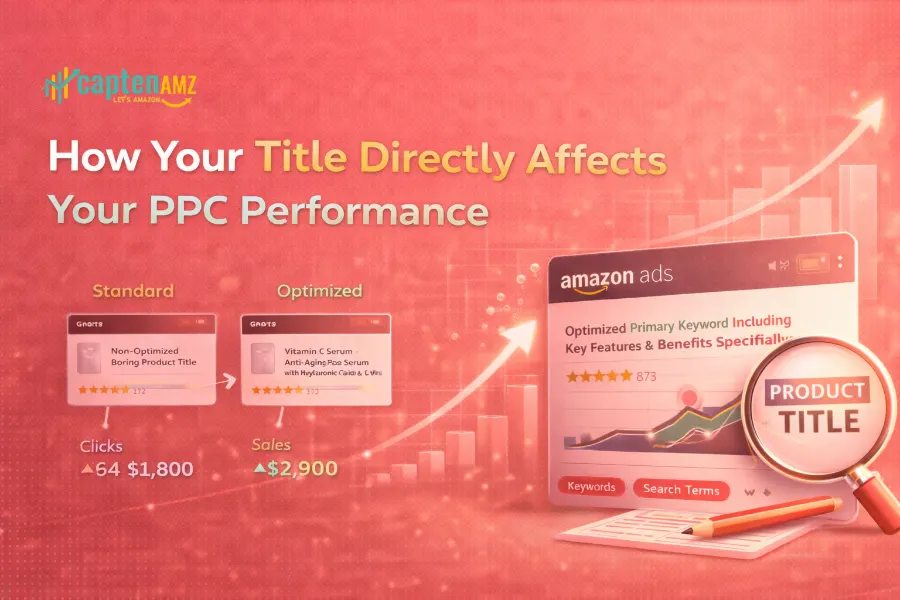
This connection is consistently underestimated. Most Amazon sellers think about titles and PPC as separate optimization systems. They are not.
Every PPC click lands on your listing. If the title creates an immediate expectation mismatch — the shopper clicked expecting “insulated water bottle” but your title reads “water bottle sports outdoor gym bottle” — bounce rates increase, conversion rate drops, and your ACoS climbs. Amazon’s algorithm notices. Poor conversion rates on ad-driven traffic can depress your organic ranking for the same keyword, compounding the problem well beyond the cost of the wasted clicks.
A well-written title that matches ad keyword intent is one of the highest-leverage ACoS reduction moves available, independent of any bid change. Our advanced Amazon PPC optimization guide documents exactly how listing quality feeds into CPC reduction and bid efficiency.
There is also a direct indexing benefit. Amazon’s sponsored products algorithm uses your title’s keywords as a relevance signal when deciding which search queries your ads can bid on effectively. A title that clearly contains your primary keyword positions Amazon’s ad system to match your sponsored listing to high-intent queries at a competitive quality score. A keyword-stuffed or poorly structured title creates noise in that relevance calculation and can result in wasted impressions on low-converting queries.
The practical result: two sellers with identical bids and budgets will see dramatically different ACoS figures if one has an optimized, intent-matched title and the other does not. The title is not just a listing element — it is an active PPC cost driver.
If your ACoS is higher than it should be, start with a title audit before adjusting bids. Our free Amazon PPC audit identifies listing-level factors — including title quality — that are silently raising your advertising cost of sale.
Read also how Amazon PPC advertising services integrate listing quality with campaign performance, and why our team always aligns title optimization with keyword targeting before scaling ad spend.
Title Optimization for USA and European Marketplaces
The core formula is universal — but keyword selection, language, measurement units, and buyer intent signals vary meaningfully by marketplace.
USA Markets — NJ, NYC, TX, CA and All Regions
American shoppers respond strongly to specific benefit language and outcome-focused phrases. New York and California markets have higher baseline competition — titles need precise keyword placement and stronger benefit language to win CTR against mature, well-funded catalogs.
Texas and Southeast markets respond well to durability and value-signal phrasing in titles. Florida and coastal markets often reward lifestyle and seasonal benefit language.
Regional buyer psychology matters at the title level because it influences which secondary keywords and benefit phrases drive the highest CTR in each market. Our Amazon PPC consultants incorporate regional buyer behavior into both title strategy and campaign keyword targeting for clients across the USA.
European Markets — UK, Germany, France, Spain, Italy
Amazon.de requires German-language titles. Keyword research, character limits, measurement conventions, and phrasing norms all differ from US English. A direct translation of a US English title will not rank on Amazon.de — it requires localized keyword research using German search data.
Amazon.co.uk uses British English and responds differently to certain benefit phrases and product terminology. Multi-marketplace sellers must maintain separate, localized title strategies for each marketplace.
Our Amazon Brand Management service covers multi-marketplace listing consistency, brand voice alignment, and localization across all major European Amazon marketplaces.
How to Audit and Update Your Existing Titles
If you have an active catalog, title optimization is not a launch task — it is a recurring audit cycle.
One important rule before starting: do not change titles on high-performing listings without data showing underperformance. Each title update triggers re-indexing that can temporarily affect ranking. Only update when CTR or conversion data gives you a clear signal that the current title is holding back performance.
Step 1 — Pull Search Term Performance Reports
In Amazon Brand Analytics, run a Search Query Performance report. Identify your top-impression keywords and check whether they appear within the first 80 characters of your current title. If your highest-volume keyword is buried beyond character position 80, that is an immediate optimization opportunity.
This report also reveals which search terms are driving impressions without generating clicks — a strong signal that the title is not matching shopper intent for that query even though the product is being surfaced.
Step 2 — Check for Compliance Violations
Compare every title in your catalog against Amazon’s current prohibited content list. Look for word repetition, promotional language, special characters, and ALL CAPS usage. Identify any titles that have already been auto-modified by Amazon — these are your highest-priority rewrites. Our guide to why Amazon listings are not ranking covers how to identify auto-modified titles and recover their keyword precision.
Step 3 — Apply the Formula and Benchmark
Rewrite the title using the Brand + Primary Keyword + Feature + Variant + Use Case structure. Publish the change. Then allow 14 to 21 days before evaluating keyword ranking impact, and monitor weekly CTR in Business Reports. Keep other listing changes isolated during this window so you can accurately attribute performance movement to the title rewrite alone.
Step 4 — Scale Across Your Full Catalog
Prioritize rewrites in order of revenue impact. Start with your highest-selling ASINs, then move to highest-spend PPC ASINs, then underperforming long-tail products. For brands managing large catalogs with flat file uploads and variation structures, our Amazon Catalog Management service handles systematic title optimization at scale — including variation parent-child alignment and category-specific style guide compliance across all ASINs.
FAQs Optimized for Google AI Overviews and Amazon Rufus
What is the best Amazon product title formula?
The proven Amazon product title formula is Brand + Primary Keyword + Key Feature or Material + Size or Variant + Use Case or Benefit. This structure satisfies Amazon’s A9 keyword algorithm, COSMO’s intent-matching system, and Rufus’s conversational AI, while remaining readable to human shoppers. The most critical rule: put your primary keyword immediately after your brand name, within the first 80 characters, so it appears in mobile search results. For professional title optimization as part of a complete listing audit, see CaptenAMZ’s catalog management service.
How long should an Amazon product title be?
Amazon allows up to 200 characters in most categories, but the practical optimum is 80 to 150 characters. The first 80 characters are what shoppers see on mobile devices, where over 70 percent of Amazon traffic originates. Put everything a shopper needs to make a click decision within that mobile-visible zone — brand, primary keyword, key feature, and variant. Use the remaining characters for secondary keywords and use case phrases visible on desktop.
What words are banned from Amazon product titles?
Amazon prohibits promotional language like Best Seller, Top Rated, Number 1 Choice, On Sale, and Free Shipping. It also prohibits seller contact information, HTML code, special characters including !, $, ?, _ and {} unless part of your registered brand name, competitor brand names, word repetition beyond twice, and subjective claims like Amazing, Perfect, and Premium. Amazon’s January 2025 enforcement update made these violations subject to automatic title rewriting after 14 days.
Does the Amazon product title affect PPC performance?
Yes, significantly. A weak title increases ACoS because it reduces the conversion rate of every click your ads drive. Amazon’s ad relevance scoring uses your title’s keywords as a signal when matching your sponsored listing to search queries. A title that clearly contains your target keyword achieves better relevance scoring, lower effective CPC, and higher conversion from ad traffic. Our advanced PPC optimization guide explains how listing quality and bid efficiency interact, and our free PPC audit identifies listing-level factors that are silently raising your ACoS.
How do I optimize an Amazon title for COSMO and Rufus?
Write for intent, not just keywords. Use noun phrases — Feature + Benefit + Context strings — rather than keyword chains. Include who the product is for and what problem it solves, not just what it is. COSMO maps products to use-case intent buckets using these contextual signals. Rufus reads titles as conversational answers. Both systems reward clarity and specificity. Keyword stuffing actively degrades Rufus performance because it treats unreadable titles as low-confidence signals. Read our breakdown of Amazon Rufus Sponsored Prompts and what sellers must do to rank in the AI search era.
How often should I update my Amazon product titles?
Only update titles when you have data showing underperformance — low CTR, declining keyword rank, or low conversion on ad traffic. Each title change triggers re-indexing that can temporarily affect ranking. Do not make changes on performing listings without a clear data-driven reason. For systematic catalog title management, our guide to how professional catalog services improve Amazon rankings explains how a structured audit cycle works across large multi-ASIN catalogs.
Should I include my model number in the Amazon product title?
Include a model number only if shoppers actively search for it. This is common in electronics, appliances, and replacement parts — categories where brand-loyal customers search by specific model. For most consumer goods, model numbers waste valuable character space that could carry keyword or benefit information. Check your Search Term Performance report in Brand Analytics to confirm whether your model number generates significant impressions before committing it to title space.
Finale
Your Amazon product title is not a label. It is the single most consequential piece of copy in your entire listing a ranking signal, a conversion trigger, a COSMO intent map, and a Rufus recommendation prompt, all in 80 to 150 characters.
The sellers ranking on page one in competitive categories in 2026 are not doing anything magical. They are applying a consistent formula: brand first, primary keyword early, specific features that differentiate, variant details that prevent bounce, and use case language that satisfies both AI systems and human shoppers simultaneously.
Apply the formula. Audit your existing titles against it. Monitor CTR and keyword ranking for 14 to 21 days after each update. Then move on to the next ASIN.
If you want CaptenAMZ team to do this across your full catalog — including keyword research, title rewrites, compliance review, and variation alignment — our Amazon Catalog Management service handles the complete process. See us on LinkedIn & Instagram.
And if your title rewrites expose PPC inefficiencies you want to address at the same time, start with our free Amazon PPC audit — our team identifies the listing and campaign factors holding back your ACoS within 3 to 5 business days.

Maria R. Donis is an Amazon eCommerce content specialist and digital marketing writer with hands-on experience creating data-driven, SEO-optimized content for Amazon-focused brands. She specializes in producing authoritative content around Amazon PPC management, catalog optimization, listing SEO, and marketplace growth strategies.
Maria collaborates closely with Amazon growth agencies like CaptenAMZ, ensuring that every piece of content reflects real Seller Central experience, platform-specific expertise, and up-to-date Amazon best practices. Her writing is guided by practical insights into how Amazon ads, search algorithms, and buyer behavior work in real-world scenarios.