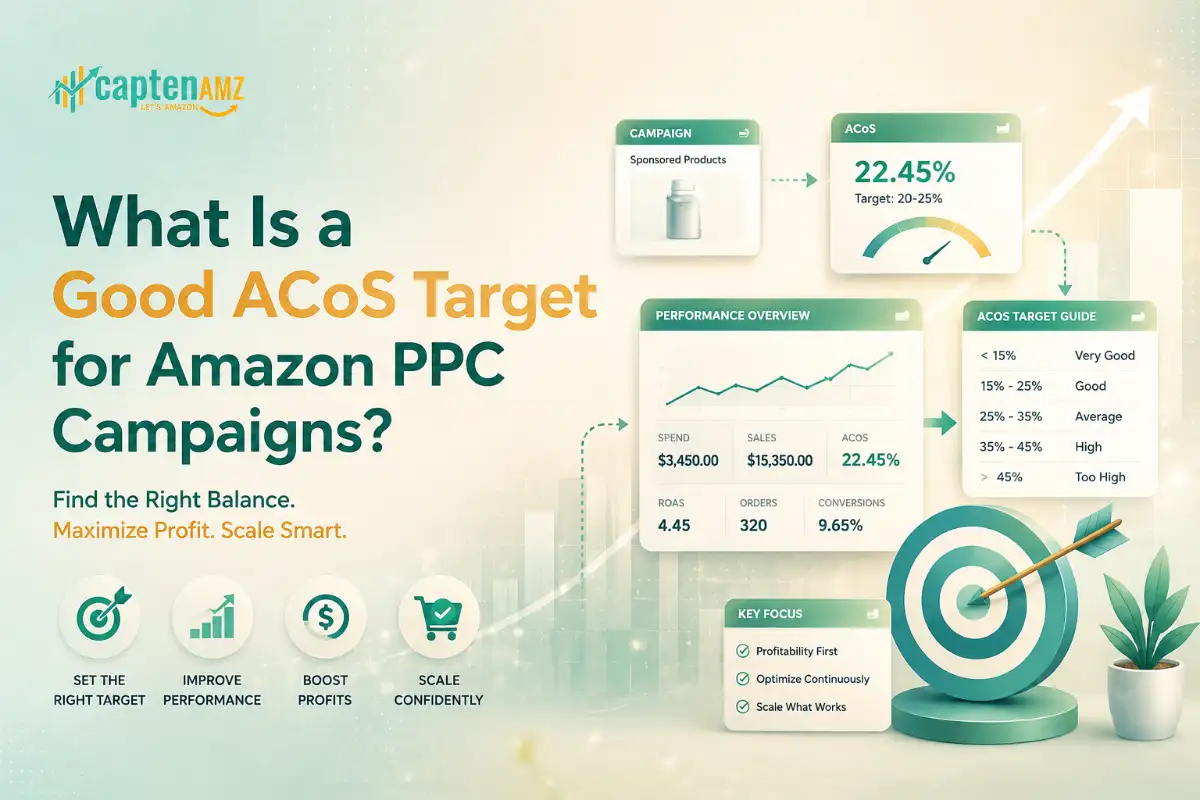
If you’re running Amazon PPC campaigns in 2026 and you don’t have a clear ACoS target, you are not running ads you’re burning money.
ACoS, or Advertising Cost of Sales, is the single most important profitability metric in Amazon advertising. It tells you exactly how many cents you spend in ads to generate every dollar in revenue. Get the target right, and your campaigns become a scalable growth engine. Get it wrong, and you’ll watch your margins disappear one click at a time.
Here’s the truth most guides won’t tell you about Good ACoS Target for Amazon PPC Campaigns: there is no single universal “good ACoS.” The right target depends on your product’s margin, your campaign goal, your product’s lifecycle stage, and the competitive density of your category. A 30% ACoS might be excellent for a high-margin supplement brand in California and disastrous for a low-margin electronics accessory seller in Texas.
At CaptenAMZ, we’ve helped brands across the USA from New York City to New Jersey, from Texas to California, and across European and UK markets define, track, and hit their precise ACoS targets. In this guide, we’ll give you the exact framework to find yours.
Whether you’re just learning what Amazon PPC is or you’re a seasoned seller scaling with professional Amazon ads management, this guide will clarify every layer of the ACoS equation.
What Is ACoS on Amazon?
ACoS stands for Advertising Cost of Sales. It measures the percentage of ad-attributed revenue that you spent on advertising.
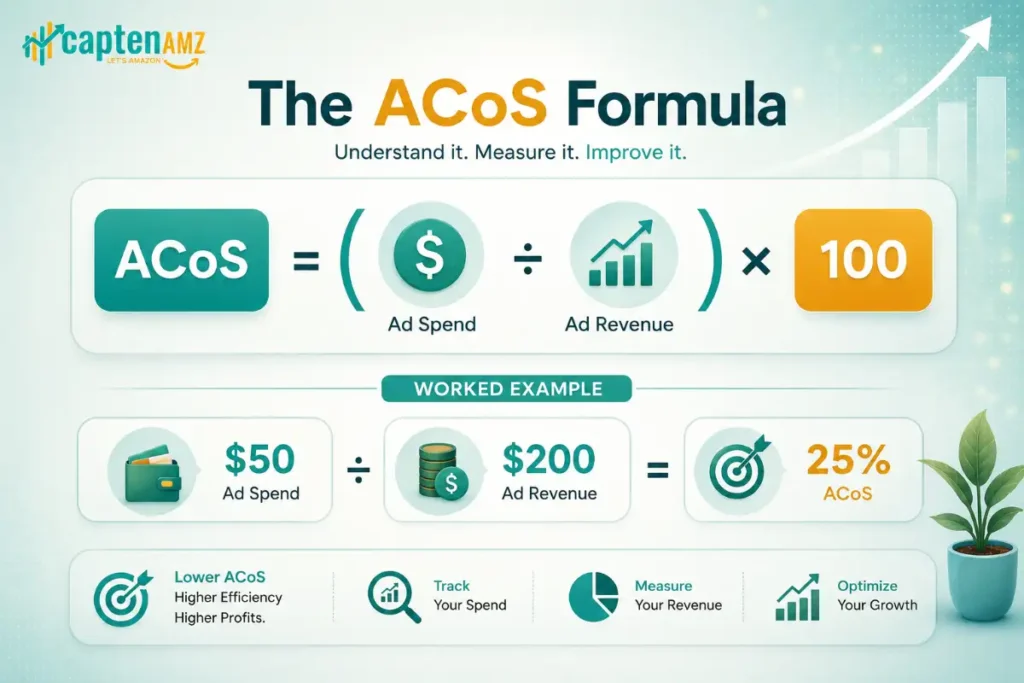
ACoS Formula:
ACoS = (Ad Spend ÷ Ad Revenue) × 100
Example:
- You spend $50 on Amazon Sponsored Products
- Those ads generate $200 in sales
- Your ACoS = (50 ÷ 200) × 100 = 25%
This means for every dollar earned from ads, you spent $0.25 a relatively efficient result depending on your margins.
ACoS is a campaign-level efficiency metric. It tells you how well your ads are converting spend into revenue, but it does not tell you the full picture of your business profitability. For that, you need TACoS.
ACoS vs TACoS: Understanding the Full Profitability Picture
Before setting an ACoS target, you must understand how it relates to TACoS (Total Advertising Cost of Sales).
| Metric | Formula | What It Measures |
|---|---|---|
| ACoS | Ad Spend ÷ Ad Revenue | Efficiency of ad-generated sales only |
| TACoS | Ad Spend ÷ Total Revenue (Ad + Organic) | Advertising’s impact on the whole business |
Why this matters:
A seller might run an ACoS of 35% — which looks high in isolation. But if their TACoS is 12%, it means their PPC investment is driving strong organic sales growth, and the business as a whole is highly profitable.
A declining TACoS over time is a powerful signal: your PPC campaigns are improving your organic keyword rankings, reducing your reliance on paid traffic, and compounding your growth. This is the ideal trajectory every Amazon brand should pursue.
Our guide to Amazon PPC metrics including ACoS, TACoS, CTR, and CPC goes deeper into how these numbers interact and what they signal at every stage of your account.
What Is a Good ACoS Target for Amazon PPC? The Real Answer
Here’s the framework you actually need:
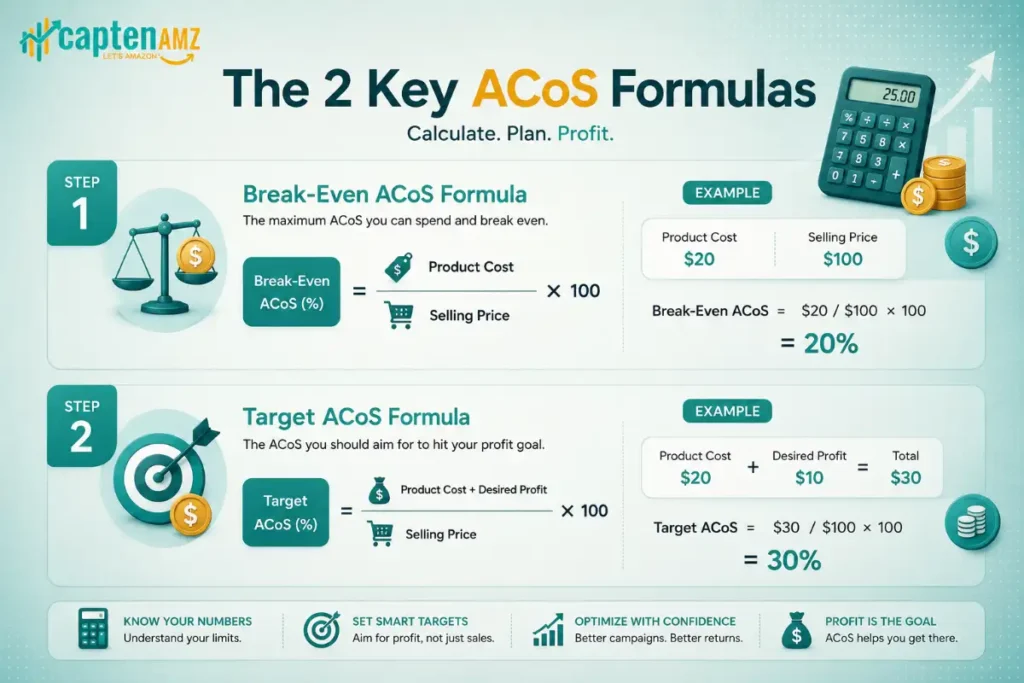
Step 1: Calculate Your Break-Even ACoS
Your break-even ACoS is the maximum ACoS where you make exactly $0 profit. Any campaign running above your break-even ACoS is losing money. Any campaign running below it is profitable.
Break-Even ACoS Formula:
Break-Even ACoS = (Sale Price − All Non-Ad Costs) ÷ Sale Price × 100
Non-ad costs include: product COGS, FBA fees, referral fees, shipping, returns, and any overhead.
Example:
- Sale price: $35
- COGS + FBA + referral fees: $22
- Profit before ads: $13
- Break-even ACoS = (13 ÷ 35) × 100 = 37.1%
Any campaign running below 37.1% ACoS on this product is profitable. Above it, you’re losing money.
Step 2: Set Your Target ACoS Based on Desired Margin
Target ACoS = Break-Even ACoS − Desired Profit Margin %
Using the example above:
- If you want a 15% profit margin: Target ACoS = 37.1% − 15% = 22.1%
- If you want a 10% profit margin: Target ACoS = 37.1% − 10% = 27.1%
This calculation must be done per ASIN, not per account. A $20 phone case with low COGS might have a break-even ACoS near 48%, while a supplement at $25 with higher manufacturing costs might land around 36%. Running both products at the same ACoS target guarantees you’re either underspending on one or overspending on the other.
Our Amazon PPC optimization services are built on this per-ASIN calculation framework — not generalized account averages.
ACoS Benchmarks by Product Lifecycle Stage (2026)
Your ACoS target should not be static. It must evolve as your product moves through its lifecycle.
🚀 Launch Phase: ACoS 30%–50% (Sometimes Higher)
During a product launch, profitability is not the primary goal — visibility, sales velocity, review accumulation, and organic ranking are. New listings face higher CPCs because Amazon’s algorithm has less confidence in them, meaning you pay more per click to win auctions.
A launch-phase ACoS of 30%–50% is not a failure. It is an investment in data collection and ranking momentum. Without it, your listing remains invisible and your organic trajectory never starts.
Our Amazon PPC strategy guide for 2026 details exactly how to structure launch campaigns to build ranking momentum without burning your entire budget.
📈 Growth Phase: ACoS 20%–30%
As your listing gains reviews, improves its conversion rate, and accumulates historical data, CPCs begin to stabilize. This is the phase where you shift focus from visibility to efficiency. Your keyword targeting becomes more precise, negative keywords reduce waste, and your bid structure becomes more mathematical.
At this stage, your Amazon PPC campaign optimization focus shifts toward harvesting converting search terms from auto campaigns, moving them to exact-match manual campaigns, and tightening bids by placement type.
✅ Maturity Phase: ACoS 10%–20%
For established products with strong organic rankings, significant review counts, and proven conversion rates, a well-managed ACoS of 10%–20% is achievable and represents excellent efficiency. At this stage, your PPC spend primarily serves to defend top-of-search positions, run branded keyword defense campaigns, and conquer competitor ASINs.
ACoS Benchmarks by Product Category (2026 Data)
While your margin-driven break-even ACoS is always your primary anchor, category benchmarks provide a useful reality check.
| Product Category | Typical ACoS Range | Notes |
|---|---|---|
| Electronics & Accessories | 15%–25% | High competition; strong CVR drives efficiency |
| Health & Supplements | 20%–35% | High margins allow flexibility; review velocity matters |
| Home & Kitchen | 20%–30% | Mid-range margins; visual content drives CVR |
| Sports & Outdoors | 18%–30% | Seasonal variability; lifestyle imagery important |
| Beauty & Personal Care | 22%–35% | Brand trust is a conversion driver |
| Books & Media | 30%–45% | Lower margins require tight ACoS control |
| Baby Products | 20%–32% | Safety messaging drives conversion; high trust threshold |
| Pet Supplies | 18%–28% | Strong repeat purchase; TACoS context matters |
Average across Amazon (2026): The overall average ACoS sits around 22%–35%, with top performers in the 18%–26% range. Average CPCs have climbed to approximately $1.12 (up 15.5% year-over-year), projected to reach $1.18–$1.25 through 2026. During Q4, expect CPCs to spike an additional 20%–30%, which can push a normally profitable campaign above its break-even ACoS if bids aren’t adjusted proactively.
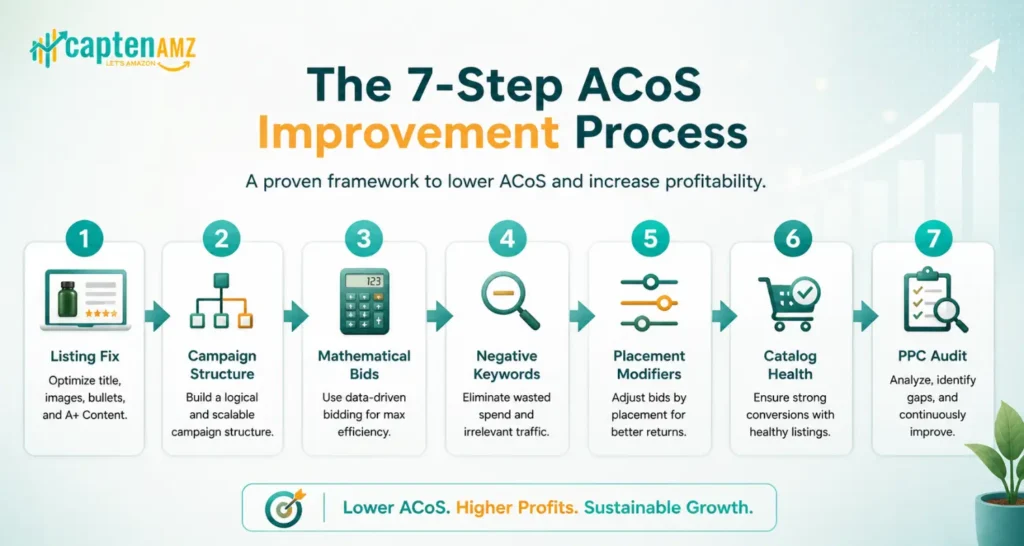
7 Proven Strategies to Hit and Maintain Your ACoS Target
1. Fix Your Listing Before Scaling Your Ads
This is the most overlooked ACoS lever. A poorly optimized listing forces Amazon’s algorithm to charge you more per click because your conversion rate is weak. High-converting listings directly reduce CPCs — Amazon rewards listings that convert with lower auction costs.
Your Amazon product listing optimization must come before or alongside any PPC scaling effort. This includes optimized titles using the correct Amazon product title formula, high-quality images, compelling bullet points, and Amazon A+ Content that builds buyer trust.
PPC traffic sent to a weak listing is not an ads problem — it’s a catalog problem. If your listing isn’t ranking on Amazon organically, fixing it is the single highest-leverage move to lower your ACoS.
2. Build a Three-Layer Campaign Architecture
The highest-performing Amazon PPC accounts separate their campaigns by function:
Layer 1 — Research Campaigns (Auto + Broad + Phrase): Discover converting search terms. Do not judge these on ACoS alone — they generate data. Learn how to optimize Amazon PPC research campaigns for maximum keyword intelligence.
Layer 2 — Performance Campaigns (Exact Match): Harvest proven converting terms from Layer 1. These campaigns should run at or below your target ACoS. This is where profit is made.
Layer 3 — Defense + Conquest Campaigns (Sponsored Brands + ASIN targeting): Protect your brand searches with Sponsored Brands ads and compete on competitor ASINs with ASIN-targeted Sponsored Products.
3. Use Mathematical Bid Calculations
Stop guessing bids. Calculate them.
Optimal Bid = Target ACoS × Average Order Value × Conversion Rate
Example: Target ACoS = 20%, Average Order Value = $35, Conversion Rate = 12%
- Optimal Bid = 0.20 × 35 × 0.12 = $0.84
This formula ensures every bid is rooted in your actual profit targets, not platform suggestions or competitor-chasing. Our Amazon PPC optimization techniques use this mathematical bidding system as the foundation for every campaign.
4. Implement Aggressive Negative Keyword Management
Irrelevant clicks are the #1 cause of inflated ACoS. A shopper searching for a product that doesn’t match yours costs you the same CPC as a high-intent buyer — but never converts.
Review your Search Term Report every week. Add irrelevant, low-converting terms as negative exact or negative phrase matches. If you sell premium products, “cheap,” “free,” and “DIY” are obvious targets. But your account will contain hundreds of long-tail negatives that only show up in the data.
Negative keyword management is a core component of our Amazon PPC management services and is one of the fastest ways to see ACoS improvement within 2–3 weeks.
5. Adjust Bids by Placement Type
Amazon allows separate bid modifiers for three placements: Top of Search, Rest of Search, and Product Pages. Most sellers run all placements at the same bid — a significant inefficiency.
Top-of-Search placements convert at significantly higher rates than Product Page placements in most categories. This means you can afford to bid more aggressively for Top of Search while pulling back bids on Product Pages, achieving the same ACoS at higher revenue volume.
Our Amazon PPC consultants analyze placement-level performance data for every account to find and exploit these efficiency opportunities.
6. Leverage Catalog Health to Compound ACoS Gains
A clean, well-structured catalog directly reduces ACoS by improving indexing, removing duplicate ASINs that split authority, and strengthening organic ranking. When organic ranking improves, your TACoS trends downward even if ACoS stays flat — a signal that your advertising is doing its job.
Our professional catalog services work in tandem with PPC to build this organic foundation. Strong catalog health means PPC traffic converts at a higher rate, which feeds ranking signals back into the algorithm — creating a virtuous cycle of improving efficiency.
7. Run a PPC Audit Before Making Any Major Changes
If your ACoS is elevated and you’re not sure why, don’t start randomly changing bids or pausing campaigns. A structured PPC audit and ACoS reduction plan will identify the exact levers — whether it’s keyword cannibalization, listing quality issues, campaign structure inefficiencies, or budget misallocation — before you touch anything.
CaptenAMZ offers a free 30-point PPC audit that identifies wasted spend, negative keyword gaps, and catalog issues for USA-based sellers across New York, New Jersey, Texas, California, and Florida, as well as European and UK markets.
ACoS Targets for USA Regional Markets: What Sellers in NYC, NJ, TX, CA & UK Need to Know
Amazon advertising competition varies significantly by geographic seller concentration and product category mix. While ACoS is calculated the same way everywhere, the competitive CPC environment and buyer behavior in high-concentration seller markets can push your CPCs — and therefore your ACoS — higher.
Key regional considerations:
New York City (NYC) and New Jersey: High seller density in lifestyle, fashion, beauty, and consumer electronics. CPCs in these categories run above national averages. Sellers operating in these markets benefit most from laser-targeted keyword lists, tight match types, and strong listing conversion rates to offset CPC pressure. CaptenAMZ serves brands across the entire NYC and NJ Amazon seller ecosystem.
Texas (Houston / Dallas): Outdoor, durability, and home improvement categories dominate. Statewide shopping events and regional seasonality influence demand windows. Sellers here should align their ACoS targets with these demand cycles and use Amazon PPC strategy tools to bid up during peak periods.
California (Los Angeles / San Francisco): Some of the most competitive Amazon brands in health, wellness, beauty, and sustainability operate here. Premium products and strong brand storytelling through Amazon brand management services and A+ Content are essential to maintain conversion rates that keep ACoS in range.
European and UK Markets: VAT implications, marketplace-specific category structures, and different CPC dynamics all affect break-even ACoS calculations for sellers expanding internationally. The same margin-first framework applies, but the inputs will differ by marketplace. CaptenAMZ supports brands scaling across USA and European Amazon marketplaces.
Common ACoS Mistakes That Kill Profitability
Mistake 1: Setting one ACoS target for the entire account. Every ASIN, every campaign type, and every product lifecycle stage should have its own target. Account-wide ACoS is a vanity metric.
Mistake 2: Always chasing a lower ACoS. During a product launch or aggressive market-share phase, a higher ACoS is the correct strategic choice. Obsessing over ACoS reduction when you should be building ranking is a costly error.
Mistake 3: Ignoring TACoS while optimizing ACoS. If you cut bids to reduce ACoS and your organic rankings deteriorate, you’ve won a battle and lost the war. Always monitor TACoS alongside ACoS.
Mistake 4: Not adjusting for seasonal CPC inflation. Q4, Prime Day, and back-to-school periods push CPCs 20%–30% higher in most categories. If you don’t pre-adjust targets and budgets, profitable campaigns become unprofitable overnight.
Mistake 5: Scaling spend before the listing is ready. More ad spend on a low-converting listing equals higher ACoS, not more sales. Fix listing quality issues before scaling budgets.
Real-World ACoS Case Study: CaptenAMZ Results
At CaptenAMZ, our proprietary “Beyond Average Framework™” has delivered measurable ACoS improvements across diverse product categories and seller markets:
- 131% ROI increase with ACoS reduced by 39% for a USA-based brand
- ACoS stabilized at 27% with TACoS brought down to 13% for a scaling private-label brand
- 6x ROI increase in the first 3 months for a new product launch using lifecycle-stage ACoS targeting
These outcomes are the result of systematic campaign architecture, per-ASIN break-even calculations, listing alignment, and continuous optimization — not one-time fixes. This is what professional Amazon PPC management delivers versus self-managed campaigns.
Frequently Asked Questions About Amazon ACoS Targets
Q: What is a good ACoS for Amazon in 2026? A: A good ACoS is one that sits below your break-even ACoS. Generally, 15%–25% is excellent for mature products, 20%–30% is healthy for growth-stage products, and 30%–50% is acceptable during a product launch phase. Always calculate your own break-even first.
Q: Is a lower ACoS always better? A: No. An extremely low ACoS (under 5%) often means your ads are under-spending and you’re losing impressions and ranking momentum. The goal is to hit your target ACoS not minimize ACoS at the expense of sales volume.
Q: How is ACoS different from ROAS? A: ACoS and ROAS are inverses of each other. ACoS = Ad Spend / Ad Revenue. ROAS = Ad Revenue / Ad Spend. A 25% ACoS = 4x ROAS. Neither is superior use both to get a full picture of ad efficiency.
Q: How often should I review my ACoS target? A: At minimum monthly, and immediately when: your product transitions lifecycle stages, CPC benchmarks change significantly (e.g., Q4), you change pricing, or your product reviews cross a major threshold (25, 50, 100 reviews).
Q: Can Amazon PPC improve organic ranking and reduce ACoS over time? A: Yes. Strategic PPC spend increases sales velocity, which improves organic keyword rankings. As organic rankings strengthen, TACoS trends downward, meaning your total advertising cost as a share of total revenue decreases — even if campaign-level ACoS remains stable.
Outro: Stop Guessing Your ACoS Target — Start Engineering It
Your ACoS target is not a number you pick from a blog post. It is a number you calculate from your own margins, your product lifecycle stage, your category’s CPC environment, and your business growth goals.
The sellers winning on Amazon in 2026 — across New York, New Jersey, Texas, California, the USA, and in European and UK markets — are not the ones running the lowest ACoS. They are the ones running the right ACoS for every product at every stage of its growth.
At CaptenAMZ, we specialize in exactly this — building data-backed, margin-driven Amazon PPC systems that hit precise ACoS targets while growing TACoS-positive organic momentum. Whether you need a complete Amazon PPC management service, a targeted PPC audit and ACoS reduction plan, or strategic Amazon PPC consulting to restructure underperforming campaigns, our team is ready to build your profitability roadmap.
From per-ASIN break-even analysis and campaign architecture to listing optimization, catalog health, A+ Content, and full Amazon brand management CaptenAMZ operates as your dedicated Amazon growth partner, not just an ads manager. See us on LinkedIn & Instagram.
Ready to stop guessing and start scaling profitably?
Get Your Free Amazon PPC Audit from CaptenAMZ — We identify exactly where your ACoS is leaking and build a clear plan to fix it within 3–5 business days.
Serving Amazon sellers across USA (New York, New Jersey, Texas, California, Florida), Europe, and UK markets with no hidden fees and a limited client roster to ensure top-tier results.

Maria R. Donis is an Amazon eCommerce content specialist and digital marketing writer with hands-on experience creating data-driven, SEO-optimized content for Amazon-focused brands. She specializes in producing authoritative content around Amazon PPC management, catalog optimization, listing SEO, and marketplace growth strategies.
Maria collaborates closely with Amazon growth agencies like CaptenAMZ, ensuring that every piece of content reflects real Seller Central experience, platform-specific expertise, and up-to-date Amazon best practices. Her writing is guided by practical insights into how Amazon ads, search algorithms, and buyer behavior work in real-world scenarios.