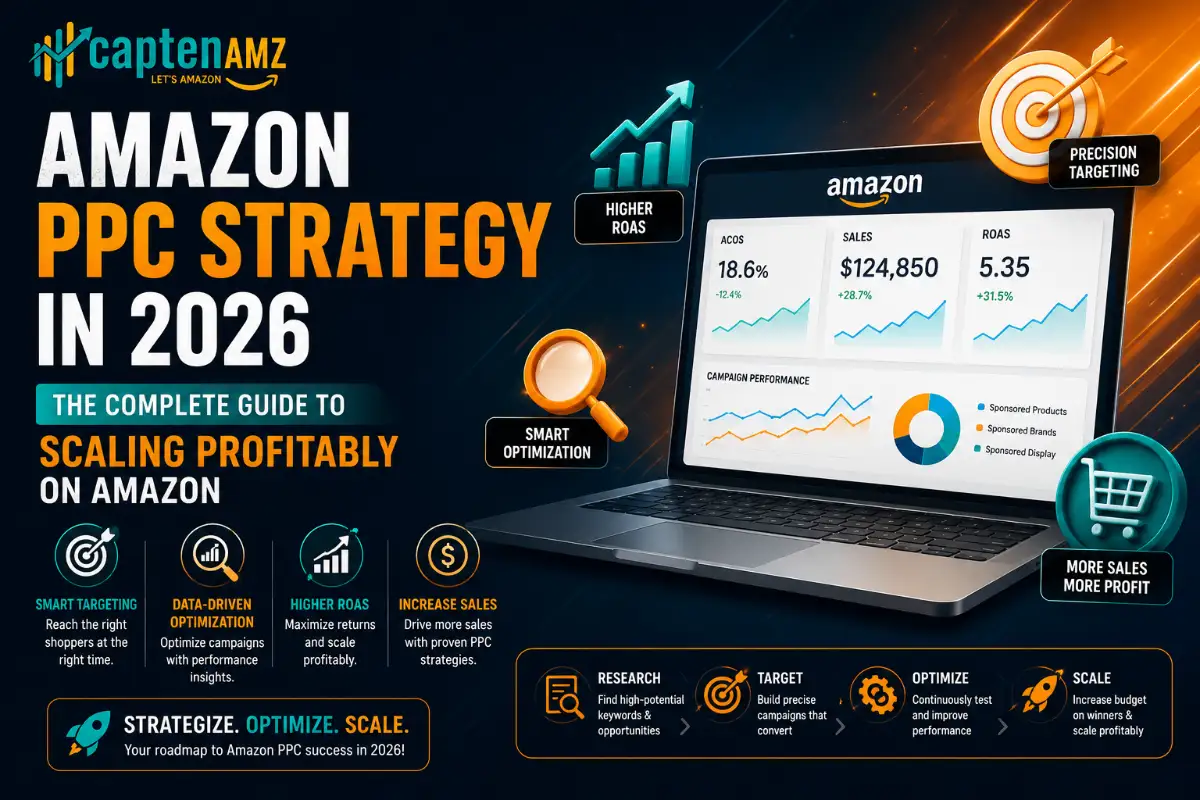
Every dollar you spend on Amazon advertising is a decision. Run it strategically, and your ads become the engine that powers organic growth, captures market share, and compounds your profitability over time. Run it reactively — raising bids when sales dip, slashing budgets when ACoS spikes — and you’re essentially funding your competitors’ growth.
Amazon PPC (Pay-Per-Click) advertising has shifted dramatically in 2026. Rising CPCs, AI-powered bidding, and a more crowded marketplace have made guesswork obsolete. Brands that are winning today operate with a deliberate, data-driven Amazon PPC strategy — one that connects campaign structure, keyword intent, bid management, and listing quality into a single, cohesive system.
This guide breaks down exactly how to build, optimize, and scale that system, whether you’re selling in the USA, UK, New York, New Jersey, Texas, California, or across European marketplaces. From campaign architecture to TACoS management to the role of A+ Content, everything you need is here.
If you’d rather have an expert team handle it for you, CaptenAMZ’s Amazon PPC Management Agency handles the full advertising lifecycle for brands across the US and EU — but first, let’s build your knowledge from the ground up.
What Is Amazon PPC and Why Does Strategy Matter More Than Budget?
Amazon Pay-Per-Click advertising is a performance-based model where you pay only when a shopper clicks your ad. The most common ad types are:
- Sponsored Products — appear directly in search results and on product detail pages, driving clicks for specific ASINs
- Sponsored Brands — display your logo, a custom headline, and multiple products at the top of search results, building brand recognition
- Sponsored Display — retarget shoppers both on and off Amazon, extending your reach across Amazon’s display network

The critical insight most sellers miss: budget size doesn’t determine success — strategy does. A $5,000/month account with poor structure will consistently lose to a $2,000/month account built on clean segmentation, intent-matched targeting, and continuous optimization.
That’s the philosophy behind every campaign CaptenAMZ manages, and it’s why sellers across New York, New Jersey, Texas, California, and across Europe trust our Amazon PPC advertising services to turn wasteful spend into measurable revenue.
Step 1: Build a Campaign Structure That Actually Scales
The most common Amazon PPC mistake is dumping all keywords into a single campaign. This destroys visibility into performance and makes it impossible to control spend efficiently.
A winning campaign structure separates intent into three layers:
Auto Campaigns — Your Data Mine
Auto campaigns let Amazon’s algorithm match your ads to relevant search terms automatically. They’re not “set it and forget it” — they’re your intelligence layer. Run them consistently to surface high-converting keywords you would never discover manually, then feed those terms into tightly managed manual campaigns.
Manual Campaigns — Your Precision Engine
Once you have proven keywords from auto campaigns, move them into manual campaigns segmented by match type:
- Broad Match — casts the widest net, useful for testing demand
- Phrase Match — captures more specific intent while maintaining reach
- Exact Match — your profit campaigns; highest control, lowest wasted spend
Single-ASIN campaigns within manual targeting give you the clearest attribution data, tightest budget control, and the most precise keyword optimization. For closely related variations or bundles, multi-ASIN setups can work — but watch for data muddying.
Also Read: What Is a Good ACoS Target for Amazon PPC Campaigns? Amazon PPC Service or Guide
Branded vs. Competitive vs. Generic Segmentation
Separate your campaigns by keyword intent:
- Branded campaigns protect your market share from competitors bidding on your name
- Competitor campaigns place your ads on rival listings, particularly where their reviews or pricing create openings
- Generic/category campaigns capture broad category shoppers in discovery mode
This three-layer structure is the foundation of every account our team manages. Need your campaigns rebuilt from scratch? Our PPC audit service identifies structural flaws and maps your recovery plan before any spend is touched.
Step 2: Master Keyword Research for Amazon PPC
No keyword strategy — no visibility. It is that simple. But effective Amazon keyword research in 2026 goes beyond high-volume terms. You need to understand purchase intent at every stage of the buyer journey.
The Keyword Funnel Explained
- Top-of-funnel (broad discovery): Shoppers browsing categories, not yet decided. Capture attention here with Sponsored Brands.
- Mid-funnel (problem-aware): Shoppers researching solutions. Phrase match keywords perform well here.
- Bottom-of-funnel (purchase-intent): Shoppers ready to buy. Exact match on high-converting terms is your highest-priority investment.
Allocate your ad budget proportionally: roughly 20–25% top funnel, 25–30% mid funnel, and 45–55% bottom funnel to keep your pipeline full without draining margin on awareness spend.
Negative Keywords: The Hidden Profit Lever
For every keyword you add to a campaign, there are dozens of irrelevant search terms burning your budget quietly. Negative keywords are the single most underused profit lever in Amazon PPC.
Review your Search Term Reports weekly. Remove search terms with high impressions but zero conversions. Block broad terms that attract shoppers looking for entirely different products. Over time, aggressive negative keyword sculpting can reduce wasted spend by 20–35% while improving your ACoS significantly.
Our Amazon PPC consultation service often identifies thousands of dollars in preventable negative keyword waste during initial audits — especially in accounts managing large catalogs across USA and European marketplaces.
Step 3: Bidding Strategy — From Dynamic Bidding to Placement Multipliers
How you bid is as important as what you bid on. Amazon offers three primary bidding modes:
- Dynamic Bids — Down Only: Amazon reduces your bid when conversion probability is low. This is the safest starting point for most campaigns — it protects budget during low-intent traffic windows without limiting your reach when intent is high.
- Dynamic Bids — Up and Down: Amazon adjusts bids in both directions. Use this selectively on proven high-converting keyword sets.
- Fixed Bids: Full manual control. Best for exact match campaigns where you have strong historical conversion data and want to control spend precisely.
Placement Multipliers
Beyond bid type, Amazon lets you increase bids by percentage for top-of-search placements versus product pages versus rest-of-search. If your data shows top-of-search placements converting at 2x the rate of product pages, adding a 50–80% placement multiplier for top-of-search positions will improve ROAS without raising your base bid.
Test placement multipliers in 10–20% increments. Let data run for 14 days minimum before drawing conclusions. This pacing approach also allows Amazon’s algorithm to re-learn efficiently without volatility.
Our Amazon PPC management team actively manages placement strategies across all three placements to maximize ROAS for brands in competitive US and EU markets.
Step 4: Understand the Metrics That Actually Drive Profit
Too many sellers obsess over ACoS in isolation. But ACoS alone tells you almost nothing about the health of your advertising ecosystem. These are the metrics that matter:
ACoS (Advertising Cost of Sale)
The percentage of ad-attributed revenue spent on advertising. Lower is better — but aggressively low ACoS often signals under-investment during launch or ranking phases.
TACoS (Total Advertising Cost of Sale)
TACoS measures ad spend as a percentage of total revenue (organic + paid). This is the strategic metric. When TACoS decreases as organic sales rise, your PPC campaigns are building long-term ranking and halo revenue. When TACoS rises with flat organic sales, your ads aren’t creating compounding value — they’re just buying short-term traffic.
Rule of thumb: Don’t raise ad spend unless TACoS holds stable for 14+ consecutive days.
ROAS (Return on Ad Spend)
Revenue generated per dollar of ad spend. Use rolling ROAS averages, not single-day snapshots, to evaluate campaign health.
CTR (Click-Through Rate)
A low CTR signals that your main image, title, or pricing isn’t compelling shoppers to click. Before fixing bids, fix the listing. Which brings us to the most overlooked element of Amazon PPC strategy.
Step 5: Listing Optimization — The Foundation Your PPC Relies On
Your campaigns can be perfectly structured, your bids mathematically optimized, and your keywords laser-targeted — and you’ll still waste money if your listing doesn’t convert.
Amazon’s algorithm evaluates your listing quality as a signal of relevancy. Strong titles, precise bullet points, high-quality images, and compelling descriptions improve your Quality Score equivalent, which directly reduces your effective CPC over time.
What a High-Converting Listing Looks Like
- Title: Front-loaded with primary keyword, includes key features, optimized for both search and readability
- Bullet Points: Address buyer pain points directly, include secondary keywords naturally
- Description / A+ Content: Tells your brand story, answers objections, and builds conversion trust
- Images: Professional, lifestyle, infographic-style — showing the product in use and communicating value visually
CaptenAMZ’s listing optimization service transforms underperforming product pages into high-converting assets that support both organic ranking and paid campaign efficiency.
Our Amazon A+ Content services take this further — building enhanced content modules with comparison charts, brand storytelling, and mobile-optimized layouts that turn traffic into buyers. For brands working in the USA, UK, or EU, professional A+ Content is no longer optional; it’s expected by modern Amazon shoppers.

Step 6: The Auto-to-Manual Keyword Harvesting Loop
One of the most powerful operating rhythms in Amazon PPC is the structured cycle of harvesting, promoting, and negating keywords between campaigns. Here’s how it works in practice:
- Launch auto campaigns with moderate bids across all targeting types (close match, loose match, substitutes, complements)
- Review Search Term Reports weekly — identify search terms with 5+ clicks and at least one conversion
- Promote winning terms to manual campaigns as exact match targets with adjusted, competitive bids
- Add winning terms as negatives in auto campaigns to prevent overlap and cannibalization
- Add zero-conversion, high-spend terms as negatives in both auto and manual campaigns
This loop keeps your auto campaigns constantly discovering new opportunities while your manual campaigns become more refined and more profitable over time. It’s the same system our Amazon PPC management team runs for every account — weekly, without exception.
Step 7: Product Targeting and Competitor ASIN Campaigns
Beyond keywords, Amazon allows you to target specific product listings (ASINs) directly. This opens two powerful strategic paths:
Competitor Targeting
Place your Sponsored Product or Sponsored Display ads directly on competitor listings — particularly those with weaker reviews, higher prices, or lower ratings. Shoppers already in a purchase mindset who land on a weaker competitor’s page can be captured with a strategically placed ad.
Complementary Product Targeting
Target ASINs that are frequently bought alongside your products. If you sell coffee mugs, targeting coffee machine listings puts your product in front of buyers actively completing a purchase bundle. This drives highly relevant incremental sales with minimal CPCs.
Product targeting campaigns complement keyword campaigns and provide unique data on which competitor markets and adjacent categories are accessible to your brand.
This is a key tactic our team applies for clients in New York, New Jersey, Texas, California, and across UK and EU markets where category competition is intense. Learn more about how our Amazon PPC management approach incorporates ASIN-level targeting.
Step 8: Scaling Your Amazon PPC Strategy Profitably
Growth on Amazon doesn’t come from doubling your budgets. It comes from efficiency gains that create room for controlled expansion. Here’s the profit-first scaling framework:
Phase 1 — Stabilize
Get ACoS under control. Eliminate wasted spend through negative keywords. Ensure your TACoS is trending down or holding flat before adding any new budget.
Phase 2 — Optimize
Identify your top 20% of keywords generating 80% of conversions. Raise bids incrementally on these terms — 10–15% per week maximum. Monitor for 14 days before the next adjustment.
Phase 3 — Expand
Once your core campaigns are stable and profitable, expand into new keyword clusters, new match types, and Sponsored Brand campaigns to build brand awareness. For established brands, Sponsored Brand Video ads offer exceptionally high engagement rates at lower CPCs than equivalent search placements.
Phase 4 — Protect
As you scale, defend your brand aggressively. Run branded keyword campaigns to prevent competitors from capturing your branded traffic. A brand that doesn’t protect its name on Amazon essentially pays competitors to poach its buyers.
Brands we’ve worked with across supplement, home goods, and apparel categories have followed this exact framework. Our EU PPC case study demonstrates how structured scaling — not budget dumping — grew a client’s revenue by 131% while reducing ACoS by 39%.
The Role of Amazon Catalog Management in PPC Performance
A fact most sellers discover too late: broken catalog data directly undermines PPC performance. Suppressed listings, parent-child variation errors, and wrong category placements all cause ads to underperform or stop showing entirely.
Amazon’s algorithm uses your catalog health as a relevancy signal. Clean, accurate, well-structured listings receive better placement priority in both organic and paid results.
CaptenAMZ’s Amazon Catalog Management services address listing suppression, variation setup, flat file errors, category corrections, and ongoing catalog health monitoring — so your PPC campaigns always have a clean, high-quality foundation to run on.
This is particularly critical for brands managing large catalogs across multiple US and European marketplaces. Our flat file services handle bulk uploads, variation corrections, and attribute conflicts that would otherwise halt your advertising entirely.
Amazon PPC Strategy for USA, UK, and European Marketplaces
Running PPC across multiple marketplaces introduces unique challenges that require localized strategy — not just translated keywords.
USA (Amazon.com): The most competitive marketplace globally. CPCs are higher across most categories. Strategy must prioritize TACoS management and profit margins from day one. Sellers in high-competition states like New York, New Jersey, Texas, and California should build aggressive brand-defense campaigns alongside category targeting.
UK (Amazon.co.uk): Consumer behavior, seasonal peaks, and category dynamics differ meaningfully from the US. Keyword research must be conducted in British English with UK-specific search intent in mind. VAT implications affect margin calculations for profitability targets.
Germany, France, Italy, Spain (EU): Language-specific keyword research is non-negotiable. German consumers, for example, respond differently to ad copy compared to UK or US buyers. Category saturation varies significantly — some niches that are hyper-competitive in the US are significantly more accessible in Germany or France.
CaptenAMZ manages PPC across all these marketplaces. Whether you’re scaling in the USA, entering the UK, or expanding into European Amazon marketplaces, our team builds market-specific strategies rooted in real performance data — not generic templates.
Common Amazon PPC Mistakes That Are Draining Your Budget Right Now
Understanding what to avoid is as important as knowing what to do. Here are the most costly Amazon PPC mistakes we identify during audits:
Keyword cannibalization — Multiple campaigns bidding on the same keywords, competing with themselves and inflating CPCs.
Single match type dependence — Relying only on broad match or only on exact match loses either discovery or efficiency.
No negative keyword strategy — Spending thousands on irrelevant terms that will never convert.
Ignoring placement data — Not adjusting placement multipliers based on where conversions actually happen.
Bidding before listing quality is ready — Sending paid traffic to underoptimized listings with poor images or weak copy.
Scaling spend before stabilizing efficiency — Raising budgets when TACoS is still climbing creates compounding losses.
Not separating branded campaigns — Mixing branded and generic keywords makes attribution nearly impossible and leaves brand terms underprotected.
If any of these resonate, a structured Amazon PPC audit will diagnose exactly what’s broken and map a clear path to recovery.
Real Results: What a Professional Amazon PPC Strategy Delivers
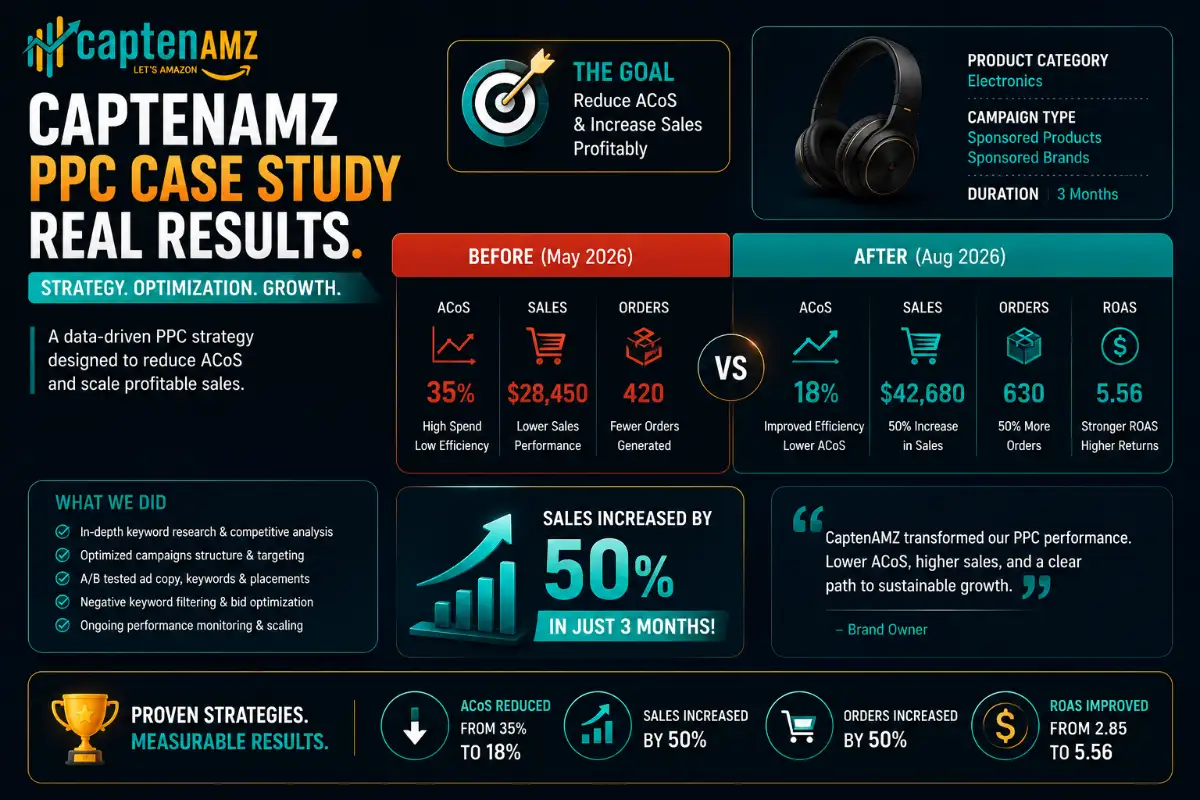
Here’s what structured Amazon PPC strategy has delivered for CaptenAMZ clients:
- Supplement Brand (USA): Sales grew 6x in the first three months. TACoS reduced from 18% to 9%. Revenue climbed from $200K to $300K within 45 days of onboarding.
- Client Case (ACoS Reduction): ACoS dropped from 35% to 18% while total sales increased by over 50% in 90 days.
- EU Expansion Case: 131% ROI increase. ACoS reduced by 39%. TACoS stabilized at 13% across EU marketplaces.
These results aren’t accidents. They’re the output of deliberate campaign structure, consistent keyword harvesting, competitive ASIN targeting, and synchronized listing quality. Every result started with a deep audit and a strategy built around that brand’s specific goals, margins, and market.
You can read the full breakdowns on our Amazon PPC case studies page.
Frequently Asked Questions About Amazon PPC Strategy
What is a good ACoS for Amazon PPC? It depends entirely on your profit margin. As a starting benchmark, your target ACoS should be below your margin percentage. If your product margin is 40%, targeting an ACoS of 25–30% leaves room for profitability. During launch phases, a temporarily higher ACoS is acceptable to drive ranking velocity.
How often should I optimize my Amazon PPC campaigns? At a minimum, weekly. During peak seasons like Q4, daily monitoring is recommended to catch budget exhaustion and bid fluctuations before they impact performance.
How long does Amazon PPC take to show results? Initial learning typically takes 2–4 weeks. Meaningful performance improvements from structural optimization become visible within 6–8 weeks of consistent management.
Should I use auto or manual campaigns? Both — together. Auto campaigns discover keywords. Manual campaigns scale the ones that convert. Running them in parallel and maintaining an active harvesting loop between them is the most effective long-term structure.
Is Amazon PPC management worth outsourcing? For brands spending more than $3,000–$5,000/month in ad spend, professional management almost always outperforms self-management in terms of ACoS efficiency, time savings, and strategic clarity. Book a free strategy session with CaptenAMZ to assess whether your account is a good fit.
End Notes: Build an Amazon PPC Strategy That Works as Hard as You Do
Amazon PPC is not a tactic. It’s a system — and like any system, its performance is determined entirely by how well it’s designed, maintained, and evolved over time.
The brands dominating Amazon in 2026, whether in New York, New Jersey, California, Texas, the UK, or across European markets, are not outspending their competitors. They’re outthinking them. They’re running cleaner campaign structures, harvesting keywords more systematically, protecting their brand terms more aggressively, and synchronizing their advertising with listing quality and catalog health in ways that compound over time.
The strategies in this guide represent the exact approach our team at CaptenAMZ applies every day across hundreds of active campaigns in the most competitive categories on Amazon. See us on LinkedIn & Instagram.
If you’re ready to stop guessing and start scaling:
👉 Start with a Free Amazon PPC Audit — We’ll identify exactly where your budget is leaking, what your campaign structure is missing, and what a realistic improvement roadmap looks like for your brand.
👉 Explore our full Amazon PPC Management service — Serving brands across the USA (NJ, NY, TX, CA), UK, Germany, France, and the broader EU marketplace.
👉 Book a 1-on-1 PPC Consultation — Senior-level guidance without a full management commitment. Ideal if you manage ads in-house and need expert direction.
👉 Strengthen your listing foundation — Because the best PPC strategy in the world won’t save a listing that doesn’t convert.
👉 Clean your catalog first — Suppressed listings and broken variations silently kill your ad performance every single day.
Your next stage of Amazon growth starts with the right strategy — and the right team behind it.
CaptenAMZ | Trenton, NJ | Serving USA, UK & European Amazon Sellers captenamz.com | info@captenamz.com

Maria R. Donis is an Amazon eCommerce content specialist and digital marketing writer with hands-on experience creating data-driven, SEO-optimized content for Amazon-focused brands. She specializes in producing authoritative content around Amazon PPC management, catalog optimization, listing SEO, and marketplace growth strategies.
Maria collaborates closely with Amazon growth agencies like CaptenAMZ, ensuring that every piece of content reflects real Seller Central experience, platform-specific expertise, and up-to-date Amazon best practices. Her writing is guided by practical insights into how Amazon ads, search algorithms, and buyer behavior work in real-world scenarios.