Every Amazon seller who has multiple sizes, colors, flavors, or styles of the same product faces the same critical decision: set up variations correctly and multiply your revenue, or get it wrong and watch suppressed listings, scattered reviews, and algorithm penalties quietly drain your sales.
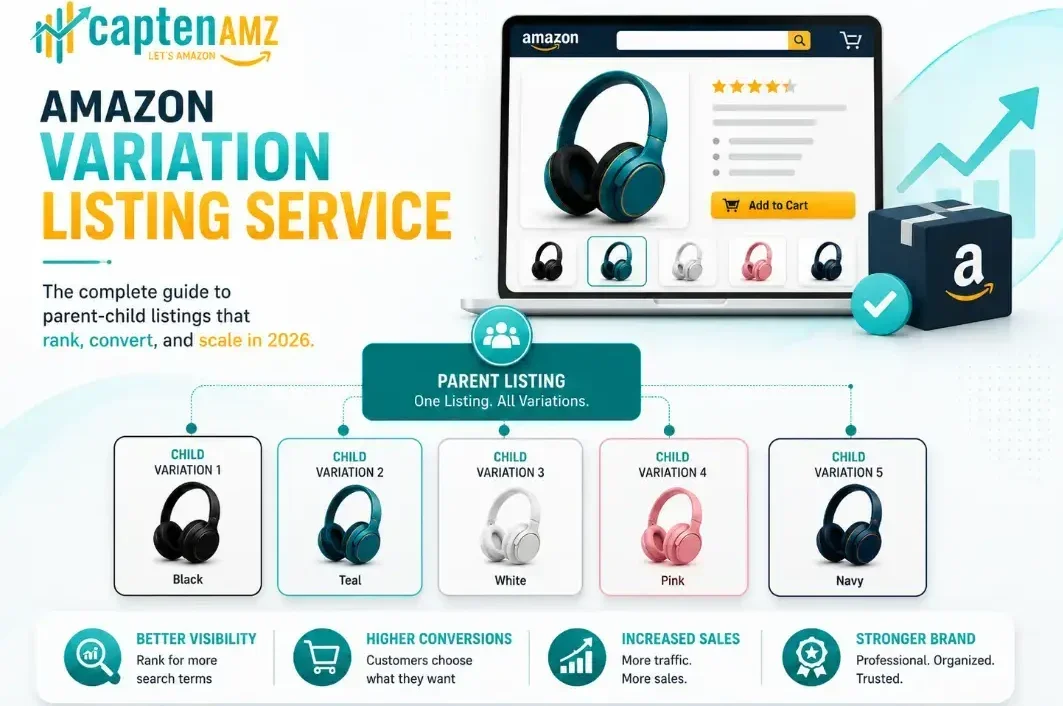
An Amazon variation listing is not just a convenience feature for shoppers. It is a ranking mechanism, a conversion engine, and a catalog health signal all rolled into one. When it is built correctly by a professional Amazon variation listing service, a single parent listing can consolidate hundreds of reviews, dominate multiple search queries simultaneously, and give every child ASIN the social proof needed to convert at a higher rate from day one.
When it is broken, the damage is invisible until it is not. Listings get suppressed. Reviews stop consolidating. Flat file uploads throw 5665 errors. PPC campaigns spend budget on child ASINs that carry no review weight. Sellers in New York, New Jersey, Texas, California, and across the UK and European markets lose thousands of dollars every month without ever understanding the root cause.
This guide explains exactly what a professional Amazon variation listing service does, why it matters more in 2026 than ever before, and how CaptenAMZ delivers variation setup, repair, and optimization that outperforms generic agencies across the USA and international markets.
What Is an Amazon Variation Listing Service?

An Amazon variation listing service is the professional setup, structuring, optimization, and ongoing management of parent-child product relationships within the Amazon catalog. It covers:
- Creating a compliant parent ASIN that ties all variants together
- Building individual child ASINs for each size, color, flavor, style, or configuration
- Selecting the correct variation theme that Amazon’s category allows
- Uploading structured flat files that avoid processing errors
- Distributing backend keywords strategically across parent and child listings
- Consolidating reviews under a single parent to strengthen social proof
- Maintaining catalog compliance as Amazon’s 2025 and 2026 enforcement rules evolve
This is distinct from basic listing creation. The Amazon product listing services CaptenAMZ provides cover single-ASIN optimization, but variation listing work requires a deeper layer of catalog architecture knowledge, flat file precision, and compliance awareness that most in-house teams and generic freelancers simply do not have.
The Parent-Child Structure Explained
In Amazon’s catalog system, a parent ASIN is a non-purchasable holding entity. Shoppers cannot buy the parent. They buy a child ASIN, which represents a specific variant such as Large Blue or 60-Count Vanilla. The parent groups all children together on one product detail page.
Every child ASIN can be distinguished from its siblings by a variation theme. Depending on the product category, the theme might be Color, Size, Flavor, Material, Style, Scent, Count, or a combination such as Size-Color. Amazon’s system is strict: if you select a variation theme that is not permitted in your category, the flat file will be rejected.
This structure provides three core benefits:
Review Consolidation: All reviews from every child ASIN contribute to a single rating displayed on the parent listing. A new color variant launching under an established parent immediately inherits the trust built by its siblings, rather than starting at zero.
Search Coverage: The parent title and shared attributes cover high-volume head terms, while each child ASIN can carry unique backend keywords targeting variation-specific long-tail searches. A Red Large variant owns different searches than a Navy Small variant, yet both drive traffic to the same listing family.
Conversion Efficiency: Shoppers who arrive on a variation listing can compare options without bouncing back to search results. The result is a lower exit rate, longer time on page, and higher conversion signals that feed the A9 and A10 algorithm’s ranking decisions.
To understand how variation structure connects to your full catalog health, review CaptenAMZ’s Amazon catalog management service which covers flat file management, suppressed listing recovery, and long-term catalog maintenance.
Why Variation Listings Break (And Why Most Sellers Never Fix Them Correctly)
The most common problems CaptenAMZ encounters when auditing variation catalogs for sellers in the USA, UK, and European markets include:
Incorrect Variation Theme: Using a theme that Amazon does not allow in a specific category causes the entire family to be rejected or suppressed. A seller in California listing athletic wear under a Color-only theme when Amazon requires Size-Color will see repeated upload failures without a clear error message explaining the root cause.
Flat File Formatting Errors: Amazon’s flat file templates are unforgiving. Missing mandatory attributes, incorrect column formatting, or attribute conflicts between parent and child rows trigger 5665 errors and prevent listings from going live. The Amazon flat-file listing creation service at CaptenAMZ validates every row before submission, eliminating the most common upload failure points.
Broken Parent-Child Relationships: When a parent ASIN is edited manually through Seller Central, the relationship between parent and children can break. Reviews scatter. Child ASINs appear as standalone listings. This is one of the most damaging catalog errors a brand can experience because it unwinds years of accumulated social proof overnight.
Variation Abuse Suppression: Amazon’s 2025 and 2026 AI-driven catalog enforcement actively scans for variation structures that violate policy, including grouping products that are not genuinely the same core item. Violations result in enforcement actions, often without warning. Compliant variation architecture from the start prevents this entirely.
Mobile UX Degradation: Variation families with more than 15 child ASINs create unreadable selectors on mobile, where the majority of Amazon traffic now originates. Sellers in competitive categories like health, beauty, and apparel routinely kill their own conversion rates by building mega-parent structures that work on desktop and fail on mobile.
These are structural problems that require structural solutions. Generic copywriting services, freelancers unfamiliar with flat files, and DIY approaches consistently fail at this level. This is exactly why sellers across New York City, New Jersey, Texas, and the UK turn to a dedicated Amazon variation listing service with proven catalog expertise.
CaptenAMZ’s Amazon Variation Listing Service: What Is Actually Delivered
CaptenAMZ approaches variation listing work as a catalog architecture project, not a one-time task. Here is what the end-to-end service covers.
Variation Theme Research and Category Validation
Before building anything, the CaptenAMZ team audits the product category, identifies which variation themes Amazon allows, and selects the structure that maximizes both compliance and conversion performance. This eliminates the guesswork that causes most variation uploads to fail.
Parent ASIN Creation and Optimization
The parent listing carries the brand name, core category keywords, and shared product attributes that anchor the entire family. CaptenAMZ’s Amazon listing optimization service principles apply directly here: the parent title is engineered for high-volume head terms, the description is structured to satisfy both the algorithm and the shopper, and backend attributes are mapped for maximum indexing coverage.
Child ASIN Creation with Keyword Distribution
Each child ASIN is created with its own variation-specific backend keywords. Rather than duplicating the same keyword string across all children, CaptenAMZ distributes unique long-tail terms across siblings. A 250-byte backend field per child becomes a powerful keyword surface area multiplier when used strategically across a 6 or 8-child variation family.
Flat File Preparation and Error-Free Upload
Every variation family is built and validated through properly structured flat files before submission. CaptenAMZ’s flat file specialists handle the technical formatting, attribute requirements, and relationship declarations that Seller Central’s manual interface cannot handle at scale. This is the same expertise behind CaptenAMZ’s Amazon bulk listing upload service which has resolved 5665 errors and suppression issues for sellers across the USA and UK.
Image Strategy for Each Variant
Variation listings require unique images for every differentiating attribute, particularly for color and style variants. CaptenAMZ structures the image stack for each child ASIN to communicate the specific variant’s value while maintaining visual consistency across the family. This connects directly to the Amazon A+ content services that reinforce variation listings with enhanced brand content below the fold.
Compliance Review and Policy Alignment
Amazon’s 2026 enforcement rules around variation integrity are stricter than in any prior year. CaptenAMZ reviews every variation family against current Amazon Seller Central guidelines, category-specific rules, and the platform’s AI-driven catalog quality systems. Sellers who have already received warnings benefit from CaptenAMZ’s Amazon catalog error fix expertise to remediate issues before they escalate.

Amazon Variation Listing Service for USA Markets: NJ, NYC, TX, California
Sellers based in or targeting consumers across the United States face some of the most competitive Amazon marketplaces in the world. Categories like supplements, apparel, home goods, and electronics carry dozens of variation-heavy listings competing for the same high-intent search terms.
CaptenAMZ serves US-based sellers across all major metro areas and states:
New Jersey and New York City sellers often manage high-SKU catalogs in fashion, beauty, and consumer goods. Variation listing errors in these categories are particularly costly because review consolidation is a primary conversion driver and competitor variation families are often already well-established.
Texas sellers frequently operate in home improvement, outdoor, and sporting goods categories where size and color variation themes are standard but where flat file formatting errors remain common due to category-specific attribute complexity.
California sellers in health, wellness, and apparel face the strictest variation compliance scrutiny because Amazon’s AI catalog systems flag policy violations at scale in these high-traffic categories.
CaptenAMZ’s Amazon brand management services support US-based brands across all these markets, providing a unified catalog strategy that connects variation structure to brand store design, PPC campaign architecture, and long-term ranking performance.
For USA sellers who need to understand how their variation catalog fits into a broader ranking strategy, CaptenAMZ’s professional catalog services guide explains the three-pillar framework of relevance, performance, and catalog health.
Amazon Variation Listing Service for UK and European Markets
UK and European Amazon sellers face additional complexity when managing variation listings because Amazon’s marketplace infrastructure, category rules, and compliance standards vary across Amazon.co.uk, Amazon.de, Amazon.fr, Amazon.it, and Amazon.es.
Key differences that affect variation listing setup in European markets include:
Marketplace-Specific Category Rules: A variation theme that works on Amazon.com may not be available in the same category on Amazon.co.uk. CaptenAMZ validates variation themes against each target marketplace before submission.
Multilingual Attribute Requirements: Listings on European marketplaces require category attributes and variation theme declarations in the local language. Incorrect language in backend attributes can trigger suppression without a clear error notification.
Pan-European FBA Compliance: Sellers using Pan-European FBA must ensure variation families are compliant across all active marketplaces simultaneously. A single attribute conflict in one marketplace can break the variation relationship across the entire European catalog.
CaptenAMZ’s expertise in international catalog management, combined with deep knowledge of Amazon listing SEO principles, makes it a reliable partner for UK and European sellers who need variation listing structures that work across multiple marketplaces without requiring duplicate management overhead.
When to Split a Variation Family vs. Keep It Together
One of the most strategically important decisions in variation listing management is knowing when to split a parent into multiple listing families and when to keep everything consolidated. Getting this wrong in either direction costs revenue.
Keep variants together when:
- All child ASINs share the same core product with only cosmetic or dimensional differences
- Review pools are consistent across variants (no single child dragging the parent average below 4.2 stars)
- The variation selector is readable with fewer than 15 child ASINs on mobile
- Keyword demand overlaps heavily across variants at the search stage
Split into separate parents when:
- One variant carries significantly lower ratings and is pulling the family average down
- Two variants target completely different customer segments with divergent search demand curves and seasonal patterns
- The mobile variation selector becomes unreadable due to too many child ASINs
- Different variants require different compliance statements or regulatory certifications
This strategic judgment is built into every CaptenAMZ variation listing engagement. The team does not just create the structure you ask for. It analyzes your catalog data, review distribution, conversion metrics, and PPC performance to recommend the variation architecture that will actually perform. This strategic layer is part of what separates a professional Amazon catalog management agency from a simple listing creation service.
How Variation Listing Quality Affects Your PPC Performance
There is a direct and underappreciated connection between variation listing architecture and Amazon PPC campaign performance. Sellers who run Amazon PPC campaigns without a well-structured variation foundation face three specific problems:
Ad Spend Fragmentation: When variation relationships are broken, Sponsored Products campaigns target individual child ASINs without shared review weight. Each child ASIN competes as a standalone listing, forcing you to bid defensively across a fragmented portfolio rather than leveraging the consolidated authority of a strong parent listing.
Keyword Coverage Gaps: A properly structured variation family distributes keywords across parent and child backend fields, expanding the total keyword surface area that organic and paid traffic can reach. Broken or improperly structured variations collapse this coverage, forcing PPC campaigns to compensate with higher bids on fewer keywords.
Conversion Rate Suppression: Shoppers landing on a child ASIN with zero reviews or a broken variation selector bounce back to search results, wasting ad spend and sending negative engagement signals to the algorithm. CaptenAMZ’s Amazon PPC management service addresses this by ensuring variation structure is resolved before PPC campaigns scale, protecting ACoS and ROAS metrics from catalog-driven conversion losses.
For sellers who want expert advice before committing to a full campaign rebuild, CaptenAMZ’s Amazon PPC consultation service provides a focused session to identify how variation listing gaps are affecting ad performance and what to fix first.
Variation Listings and A+ Content: The Conversion Stack
A well-built variation listing sets the foundation, but it does not finish the conversion job on its own. The combination of a properly structured parent-child relationship with premium visual content below the fold creates the full conversion stack that separates high-performing listings from average ones.
Amazon A+ content allows brand-registered sellers to add comparison charts, enhanced images, and brand storytelling modules that appear below the main listing content. For variation-heavy products, A+ comparison charts are particularly powerful: they let shoppers compare variants by size, weight, material, features, or any other relevant dimension on a single visual, reducing friction and decision fatigue.
CaptenAMZ integrates A+ content strategy directly into variation listing projects for brand-registered sellers. This means the variation structure, the child-specific bullet points, and the A+ modules are all designed as a single conversion system rather than separate deliverables assembled by different teams.
For sellers who have not yet completed Amazon Brand Registry, CaptenAMZ can guide you through the enrollment process as part of the Amazon brand management services offering, unlocking A+ Content, Brand Store access, and the additional protection tools that registered brands receive.
The CaptenAMZ Variation Listing Audit: Where to Start
If you are unsure whether your current variation listings are performing at their potential, a structured audit is the most efficient starting point. CaptenAMZ offers a free Amazon catalog audit that reviews:
- Parent-child relationship integrity across all active variation families
- Flat file formatting and attribute compliance against current Amazon standards
- Keyword distribution efficiency across parent and child backend fields
- Review consolidation status and variant rating distribution
- Mobile variation selector usability
- Suppression risk based on Amazon’s 2026 catalog quality enforcement patterns
This audit gives sellers in the USA, UK, and European markets a clear picture of exactly what is broken, what is at risk, and what the corrected architecture should look like. It is the same starting point CaptenAMZ uses for all new Amazon product listing service and catalog management engagements.
You can request a free audit directly through the CaptenAMZ homepage and receive a detailed report with actionable recommendations within a defined turnaround window.
Common Questions About Amazon Variation Listing Services
Can CaptenAMZ fix an existing broken variation family without losing reviews?
Yes. CaptenAMZ’s catalog specialists rebuild broken parent-child relationships using the correct flat file methodology that preserves existing review accumulation. This is a technically precise process and significantly more complex than creating a variation from scratch, but it is one of the most common repair services requested by sellers who have experienced relationship breaks after manual edits or policy enforcement actions.
How many child ASINs can be included in a single variation family?
Amazon does not publish a hard limit, but CaptenAMZ recommends keeping mobile UX in mind. Variation families with more than 15 child ASINs routinely experience conversion rate degradation on mobile because the selector becomes difficult to navigate. For catalogs with more than 15 variants, a strategic split into multiple parents by primary variation axis is typically the correct approach.
Does the variation listing service include backend keyword optimization for each child ASIN?
Yes. Backend keyword distribution across parent and child ASINs is a core deliverable in every variation listing engagement CaptenAMZ handles. The goal is to maximize the total keyword surface area of the variation family without duplicating terms that Amazon’s algorithm already picks up from the parent.
How does CaptenAMZ handle variation listings for European marketplaces?
The team manages marketplace-specific category rules, language requirements for attributes, and compliance checks across Amazon.co.uk and the major EU marketplaces. International variation listing projects are scoped based on the number of target marketplaces and the complexity of the variation structure.
What if my products are in a restricted category?
Restricted categories require category approval before any variation listing can be created. CaptenAMZ’s Amazon catalog management agency handles the category approval process as part of the broader listing project when needed.
Frequently Made Mistakes and How CaptenAMZ Prevents Them
The CaptenAMZ team has reviewed thousands of variation catalogs for sellers across the USA, UK, and European markets. These are the errors that appear most consistently and the specific ways they are prevented in every project.
Grouping products that are fundamentally different under a single parent to consolidate reviews is one of the most penalized practices in Amazon’s 2026 enforcement cycle. CaptenAMZ validates variation logic against Amazon’s product grouping rules before any parent is created, eliminating the compliance risk before it exists.
Using the wrong variation theme for a category is a structural error that cannot be corrected without rebuilding the entire family from scratch. CaptenAMZ’s category research step, completed before any flat file is touched, prevents this from occurring.
Failing to assign unique images to color and style variants is a common shortcut that Amazon’s catalog systems flag for quality review. Every variation project CaptenAMZ manages includes image stack planning for each child ASIN, aligned with the Amazon listing optimization framework the team applies to all listing work.
Letting a low-rated variant drag down the parent average is a conversion problem disguised as a catalog problem. CaptenAMZ’s variation audit identifies rating distribution issues and recommends strategic splits or variant-specific improvement plans before the family is rebuilt.
Why CaptenAMZ Outperforms Generic Variation Listing Services
Sellers researching Amazon variation listing services encounter a wide range of options, from offshore freelancers to large agencies offering hundreds of services. The difference with CaptenAMZ comes down to specificity, accountability, and the integration of variation work into a broader catalog and advertising strategy.
CaptenAMZ is a dedicated FBA agency focused exclusively on Amazon. The team does not manage Google Ads, Shopify stores, or social media campaigns. Every process, every workflow, and every tool has been developed specifically for the Amazon marketplace. This focus means variation listing projects benefit from institutional knowledge that a generalist agency simply cannot replicate.
The LowSolve AI system that CaptenAMZ uses for catalog monitoring sends real-time alerts when any ASIN is suppressed, delisted, or flagged for compliance. This proactive monitoring layer catches variation relationship breaks before they cause measurable revenue loss, which is a capability that reactive audit services cannot match.
Client results across the CaptenAMZ portfolio show ACoS reductions from 35% to 18%, conversion improvements from listing rebuilds, and catalog-level ranking gains attributed directly to correctly structured variation families. These outcomes are documented through transparent reporting and are consistent across USA, UK, and European market clients.
If you want to read about how CaptenAMZ’s catalog approach connects to broader ranking strategies, the team’s blog on how professional catalog services improve Amazon rankings is a detailed resource worth reviewing before your first consultation.
[Image Placeholder: CaptenAMZ client result graphic showing before/after metrics for a variation listing rebuild: reviews consolidated, ACoS reduced, conversion rate improved]
Outro: Build the Variation Foundation Your Amazon Catalog Deserves
Your Amazon variation listing is not a back-office detail. It is the structural core of your product’s search visibility, conversion performance, and PPC efficiency. Every day a variation listing runs with a broken parent-child relationship, a mismatched variation theme, or a fragmented keyword strategy is a day that revenue goes to competitors whose catalogs are built correctly.
CaptenAMZ delivers Amazon variation listing services that are built for performance, designed for compliance, and maintained for long-term catalog health. From sellers in New York City, New Jersey, Texas, and California to brands scaling across the UK and European markets, the CaptenAMZ team has the flat file expertise, category knowledge, and strategic depth to build variation families that rank, convert, and hold their position through Amazon’s evolving enforcement environment.
The starting point is a free Amazon catalog audit. It takes minutes to request, costs nothing, and gives you a clear view of exactly what your variation listings are doing well, where they are broken, and what the path forward looks like. Follow CaptenAMZ for more expert Amazon PPC Guides: LinkedIn | Instagram
Visit CaptenAMZ today to request your free audit and connect with an Amazon catalog specialist who understands the full complexity of variation listing architecture in 2026. Your product catalog is your most valuable asset on Amazon. Make sure it is built to perform.

Maria R. Donis is an Amazon eCommerce content specialist and digital marketing writer with hands-on experience creating data-driven, SEO-optimized content for Amazon-focused brands. She specializes in producing authoritative content around Amazon PPC management, catalog optimization, listing SEO, and marketplace growth strategies.
Maria collaborates closely with Amazon growth agencies like CaptenAMZ, ensuring that every piece of content reflects real Seller Central experience, platform-specific expertise, and up-to-date Amazon best practices. Her writing is guided by practical insights into how Amazon ads, search algorithms, and buyer behavior work in real-world scenarios.