If you are running Amazon ads and staring at your RoAS number wondering whether it is good, bad, or somewhere in between, you are not alone. Return on Ad Spend is one of the most searched metrics among Amazon sellers in the USA, UK, New Jersey, New York City, Texas, California, and across European markets. But here is the hard truth: there is no single universal answer.
A good RoAS for Amazon PPC depends on your product margin, category competition, fulfillment model, and the growth stage of your brand. At CaptenAMZ, we manage Amazon PPC campaigns for brands across the United States and global markets, and we see this question come up in almost every strategy session. This guide gives you the complete picture including formulas, 2026 benchmarks by category, the critical difference between RoAS and ACoS, and what actions to take when your numbers are off target.
What Is RoAS in Amazon PPC?
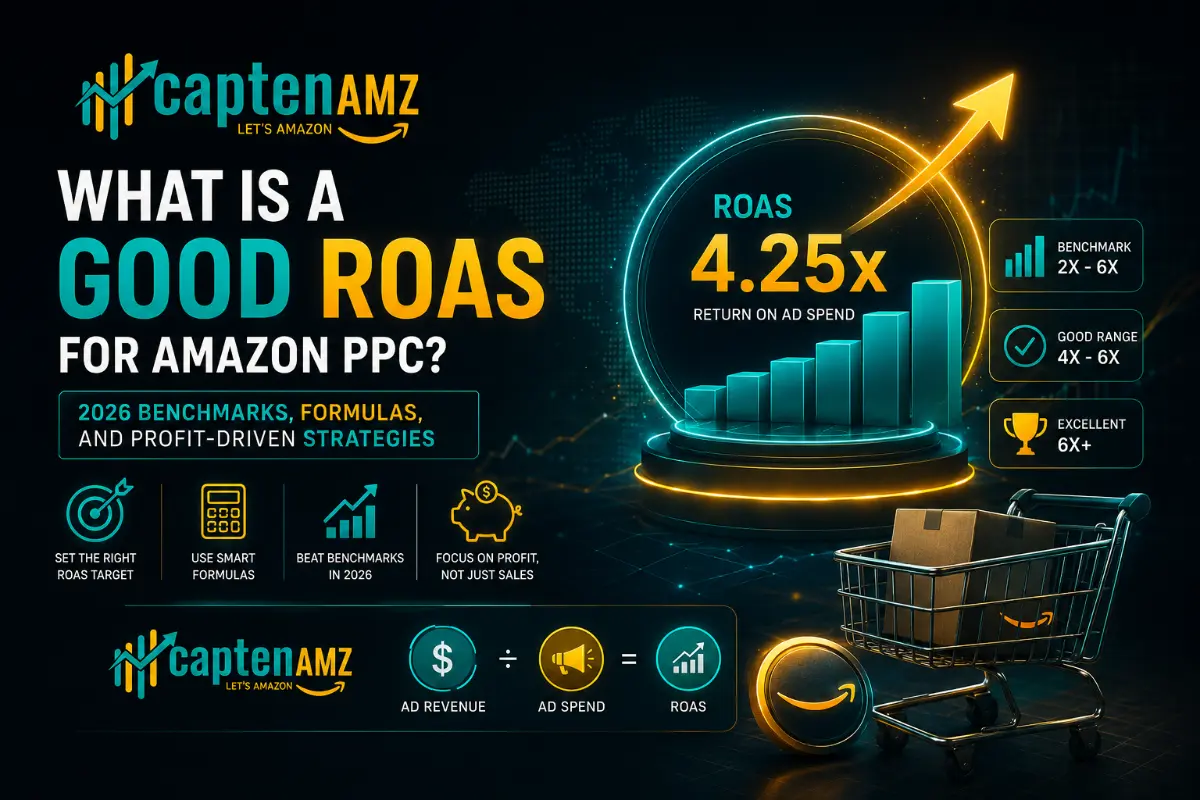
RoAS stands for Return on Ad Spend. It is the revenue your ads generate for every dollar you invest in Amazon advertising. The formula is straightforward:
RoAS = Total Ad-Attributed Revenue / Total Ad Spend
So if you spend $1,000 on Sponsored Products campaigns and generate $4,500 in attributed sales, your RoAS is 4.5. That means you are earning $4.50 for every $1.00 you put into ads.
This metric tells you how efficiently your Amazon PPC campaigns are converting ad budget into revenue. In 2026, with cost-per-click (CPC) rising across most categories and competition intensifying on high-intent search placements, understanding your RoAS is not optional. It is the cornerstone of any profitable advertising strategy.
At CaptenAMZ’s Amazon PPC Management Agency, we use RoAS alongside ACoS, TACoS, and contribution margin to give sellers a true picture of advertising health rather than a misleading single number.
RoAS vs ACoS: What Is the Difference and Which Should You Track?

Many sellers confuse these two metrics because they measure opposite sides of the same coin.
ACoS (Advertising Cost of Sales) = Ad Spend / Ad Revenue x 100
If your ACoS is 25%, you are spending 25 cents in ads for every dollar of ad-attributed revenue. ACoS and RoAS are mathematically inverse:
- RoAS of 4 = ACoS of 25%
- RoAS of 5 = ACoS of 20%
- RoAS of 3 = ACoS of 33%
So why does RoAS matter separately? Because RoAS scales better when comparing campaigns across different budgets, and it is also the metric used when reporting to external stakeholders or e-commerce investors. ACoS is the go-to metric inside Amazon Seller Central because it appears natively in campaign reporting.
Our Amazon PPC Services team monitors both because each tells a different part of the performance story. ACoS tells you how efficiently ad spend converts to revenue inside a campaign. TACoS (Total Advertising Cost of Sales) tells you the health of your overall account by dividing total ad spend by total store revenue, including organic sales.
What Is a Good RoAS for Amazon PPC in 2026?
Here is the benchmark data every Amazon seller needs to know heading into the second half of 2026.
Based on aggregated data from industry reports covering thousands of Amazon seller accounts:
General benchmarks for Sponsored Products (USA marketplace):
- Baseline acceptable RoAS: 3.0 to 5.0 for always-on campaigns
- High-margin categories (supplements, beauty, home decor): 5.0 to 8.0
- Launch campaigns and new product ads: 2.0 to 3.5 may be acceptable
- Branded keyword defense: RoAS as low as 2.0 can still be strategically justified
- Break-even RoAS for most established sellers: 2.8 to 3.5 depending on category and FBA fees
Average Sponsored Products global RoAS benchmark: 3.5x
Average ACoS across US marketplaces: 22% to 35% depending on category
These numbers reflect the current reality of Amazon advertising in 2026, where CPM costs have risen sharply year-over-year as the platform’s auction system matures. Higher CPMs mean that reaching customers costs more, and that puts even greater pressure on listing quality, conversion rate, and bid strategy.
Our PPC Consulting Services team helps sellers set RoAS targets that reflect actual margin requirements, not generic benchmarks pulled from a blog.
RoAS Benchmarks by Amazon Product Category (2026)
Different categories operate at very different margin profiles, which directly shapes what a “good” RoAS looks like. Here is a realistic breakdown by niche:
Beauty and Personal Care: High conversion rates support RoAS in the 4.0 to 7.0 range. CPC is elevated, but buyers in this category are highly intent-driven.
Supplements and Health Products: One of the strongest categories for RoAS when listings are optimized. Targets of 5.0 to 9.0 are achievable for established brands with strong review profiles.
Home and Kitchen: Mid-range margins mean sellers typically target 3.5 to 5.5 RoAS. Price-point sensitivity is high in this category.
Apparel and Accessories: Lower CPM but tighter margins and higher return rates. Apparel sellers often need 4.0 to 6.0 RoAS just to maintain profitability.
Electronics and Gadgets: Competitive bidding and thin margins make 3.0 to 4.5 a realistic target. Brands here often rely on TACoS rather than campaign-level RoAS.
Toys and Games: Seasonal volatility makes RoAS targets fluctuate. Q4 may demand aggressive spend at 2.5 to 3.5 RoAS to capture market share before the holiday window closes.
Pet Supplies: Loyalty-driven purchasing supports strong RoAS. Brands with Subscribe and Save integration can accept 3.0 RoAS on acquisition campaigns knowing lifetime value is high.
If your current RoAS sits below these ranges, the issue is rarely just your bids. It often points to listing quality, keyword targeting structure, or bid strategy alignment. Our Amazon PPC Optimization Techniques framework addresses each of these root causes systematically.
How to Calculate Your Target RoAS (The Margin-Based Formula)

Chasing a benchmark number without factoring in your actual margins is one of the most common mistakes Amazon sellers make. Here is how to calculate your own target RoAS with precision.
Step 1: Calculate your contribution margin.
Contribution Margin = Selling Price – COGS – FBA Fees – Referral Fees – Other Variable Costs
Example: A product sells for $35. COGS is $8. FBA fees are $5.50. Referral fee is $5.25 (15%). Contribution margin = $35 – $8 – $5.50 – $5.25 = $16.25.
Contribution margin percentage = $16.25 / $35 = 46.4%
Step 2: Calculate your Break-Even RoAS.
Break-Even RoAS = 1 / Contribution Margin Percentage = 1 / 0.464 = 2.16
At RoAS of 2.16, advertising breaks even. Any RoAS above this means you are generating net profit from ads. Any RoAS below this means every sale is costing you money.
Step 3: Set your Target RoAS based on profit goals.
If you want to maintain a 15% net profit on ad sales, your target contribution margin available for ads drops. Work backwards from your desired profitability floor to set a RoAS target that actually protects your margins.
This margin-based approach is what separates expert Amazon PPC consultants from those who simply chase low ACoS without understanding the underlying economics.
Why Your RoAS Might Be Lower Than Expected (And What to Do About It)
Low RoAS is rarely a bidding problem alone. In most cases, it is a symptom of structural issues across your Amazon presence. Here are the most common root causes our team identifies during Amazon PPC audits:
1. Weak Listing Quality Killing Conversion Rate
Amazon’s algorithm rewards listings that convert well with lower CPCs. If your listing has poor images, thin bullet points, or no A+ Content, traffic from ads will bounce without converting. The result is high spend with low returns.
Improving your Amazon Listing Optimization directly improves your PPC RoAS by raising conversion rate and lowering the effective cost per sale.
2. Poor Campaign Structure Causing Keyword Cannibalization
Running broad, phrase, and exact match keywords in the same ad group creates internal competition and wastes budget on irrelevant queries. A segmented campaign structure separating intent types is fundamental to efficient spend.
Our guide on Amazon PPC Optimization Techniques covers advanced campaign architecture that eliminates this wasted spend.
3. Targeting Competitor ASINs Without Margin Awareness
ASIN-level targeting can be powerful, but without margin-adjusted RoAS targets, it often bleeds budget. Competitor placements tend to have lower conversion rates and require careful bid-to-margin calibration.
4. No Negative Keyword Strategy
Without an active negative keyword list, your budget leaks into irrelevant search terms. This is one of the fastest ways to fix declining RoAS without changing bids. A 30-point PPC audit from CaptenAMZ identifies these gaps immediately.
5. Buy Box Loss Destroying Campaign Efficiency
You cannot win on ads if you do not own the Buy Box. Sellers losing Buy Box due to pricing or inventory issues will see ad spend continue while conversions drop to near zero.
RoAS Across Different Amazon Ad Types
Not all Amazon ad formats deliver the same RoAS, and understanding this prevents sellers from applying a single target across incompatible campaign types.
Sponsored Products typically deliver the highest direct RoAS because they appear at the highest-intent moments, when a shopper is actively searching. This is where most sellers should concentrate budget until RoAS targets are consistently hit.
Sponsored Brands (including video) deliver lower RoAS on a direct attribution basis but drive significant brand awareness and upper-funnel consideration. Sellers targeting RoAS here should use 14-day attribution windows and factor in halo effects on organic sales.
Sponsored Display operates with the lowest direct RoAS of the three because it targets shoppers who are browsing, not necessarily buying. It is most effective for remarketing to product page visitors and defending ASINs against competitor ads.
Our Amazon PPC Services team builds a full-funnel strategy that applies appropriate RoAS targets to each ad type rather than forcing every campaign to hit the same threshold.
Regional RoAS Considerations: USA, UK, and Europe
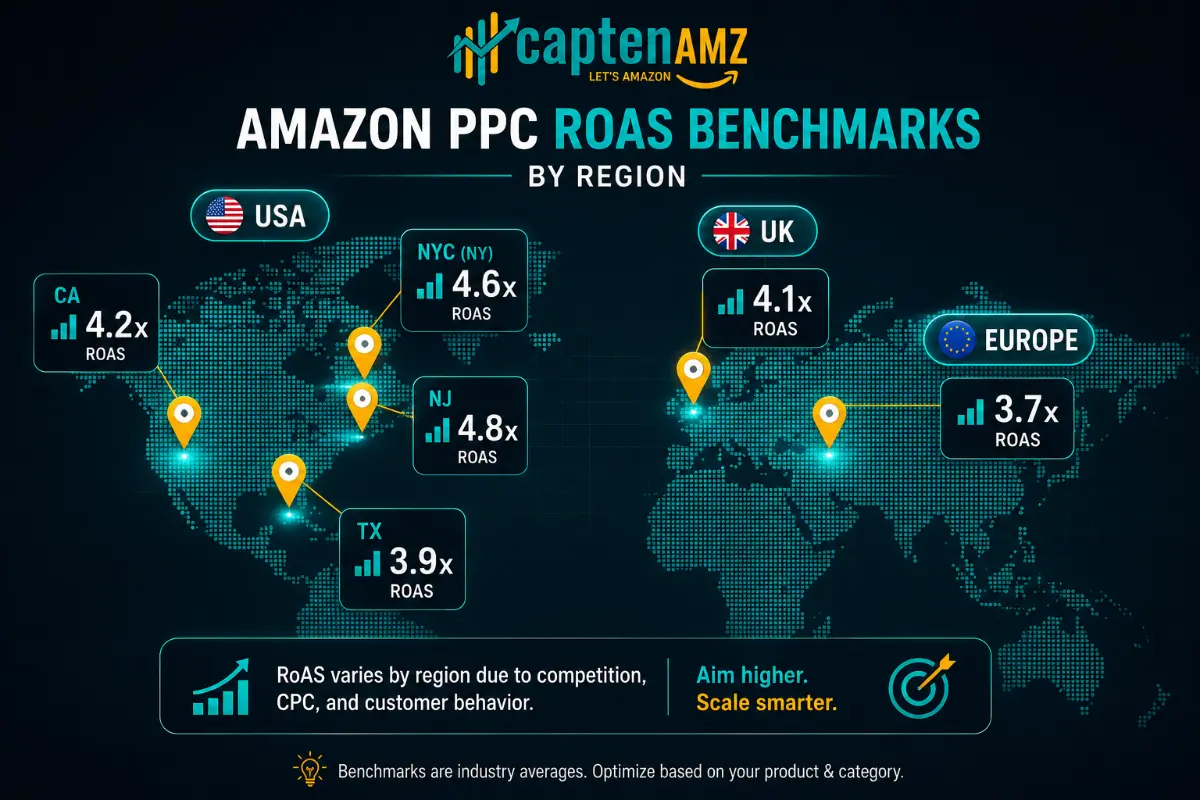
Sellers operating across multiple Amazon marketplaces need to understand that RoAS targets are not transferable between regions without adjustment.
USA Marketplace (Amazon.com)
The US marketplace is the most competitive and most expensive in terms of CPC. Sellers in New York, New Jersey, Texas, and California face higher logistics costs and more aggressive bidding on high-volume keywords. This means break-even RoAS calculations need to account for state-specific FBA fee variations and competitive CPC floors. CaptenAMZ specializes in Amazon PPC for USA-based sellers across these high-competition regions.
UK Marketplace (Amazon.co.uk)
UK sellers operate with a different referral fee structure and lower average CPCs in many categories. However, Brexit-related fulfillment costs have increased landed costs for many products, which compresses margins and raises the required RoAS for profitability. A RoAS of 3.0 on Amazon UK may be significantly less profitable than the same number on Amazon US if COGS and duties are higher.
European Marketplaces (DE, FR, IT, ES)
European marketplaces vary significantly by category. German shoppers (Amazon.de) tend to have high conversion rates for value-for-money products. French and Italian marketplaces have lower overall ad competition, meaning CPCs are lower and RoAS can be achieved more efficiently for sellers willing to localize their listings. VAT complexity and Pan-European FBA fee structures must be factored into any margin-based RoAS target.
Our Amazon Brand Management Services include cross-marketplace PPC strategy for sellers expanding beyond their home market.
How AI Is Changing Amazon PPC RoAS in 2026
Artificial intelligence is reshaping how sellers manage bids, budgets, and targeting. Amazon’s own AI-driven bidding adjustments (dynamic bids, rules-based automation) now play a significant role in campaign performance. Third-party tools using machine learning can improve RoAS by 25% to 40% when implemented within a well-structured campaign.
However, AI tools are only as effective as the campaign architecture they operate on. Poorly structured campaigns fed into automation will automate bad decisions at scale.
Our team covers the intersection of technology and strategy in our deep-dive guide on AI Tools for Amazon PPC, which walks through the best software options and where human judgment remains irreplaceable.
Improving Your Amazon PPC RoAS: 7 Actionable Tactics
These are the specific moves that consistently improve RoAS across accounts managed by CaptenAMZ:
1. Segment campaigns by match type and intent. Separate auto, broad, phrase, and exact into distinct campaigns so each can be optimized independently without cross-contamination.
2. Implement search term harvesting weekly. Mine your Search Term Reports to find converting terms for exact match promotion and irrelevant terms for negative exact exclusion.
3. Optimize your listing before scaling ad spend. Use Amazon Product Listing Services to maximize the conversion rate of every click your ads generate.
4. Use bid-by-placement adjustments strategically. Top-of-search placements often deliver the highest RoAS for branded and exact match campaigns. Product page placements often perform better for ASIN conquest targeting.
5. Build robust A+ Content and Brand Store pages. Shoppers who land on detailed, visually compelling product pages convert at higher rates, directly improving your RoAS. Explore Amazon A+ Content Services to see how this impacts campaign economics.
6. Align inventory health with ad spend. Never spend heavily on ads for ASINs with low inventory. Stockouts will spike your ACoS and destroy your RoAS by generating clicks on unavailable or restricted listings. Our Amazon Catalog Management Service keeps inventory and catalog health in sync with PPC performance.
7. Track TACoS alongside campaign RoAS. Total Advertising Cost of Sales is the truest profitability signal. Falling TACoS with stable or growing sales means PPC is driving organic ranking growth, which is the real long-term win.
When a “Low” RoAS Is Actually the Right Move
Not every low-RoAS campaign is a problem. Context matters enormously. Here are three scenarios where accepting a below-average RoAS is a deliberate and profitable decision:
Product launch phase: New ASINs need sales velocity to build ranking history. Accepting a 2.0 to 2.5 RoAS during launch is an investment in organic ranking, not a failure. Read more about this strategy in our overview of Amazon PPC Services.
Branded keyword defense: Bidding on your own brand terms to prevent competitors from stealing branded traffic often runs at lower RoAS because the buyer was already coming. The cost is the price of defending organic equity.
Subscribe and Save acquisition: A customer who subscribes delivers 6x to 12x the lifetime value of a one-time buyer. Accepting 3.0 RoAS on acquisition when the long-term LTV justifies it is a sound business decision, not a PPC failure.
CaptenAMZ: Your RoAS Optimization Partner Across the USA, UK, and Europe
CaptenAMZ is a specialized Amazon PPC management agency helping 7-figure sellers, private label brands, and growing Amazon businesses fix broken ad campaigns, eliminate wasted spend, and dominate high-intent search results. Our clients across New York, New Jersey, Texas, California, and international markets including the UK and Europe trust us to manage every layer of their Amazon advertising with full transparency and accountability.
Whether you need a complete Amazon PPC audit to diagnose what is pulling your RoAS down, or a full-service managed solution that handles campaign structure, keyword strategy, bid management, and listing optimization end to end, our team has the expertise to move the needle.
We have helped clients reduce ACoS from 35% to 18% while increasing sales by over 50% in as little as three months. Those results are not accidents. They come from a systematic approach that treats RoAS not as a vanity metric but as a reflection of the total health of your Amazon business.
Connect with us to get started with a free, no-obligation Amazon PPC audit. We will identify exactly what is holding your campaigns back and deliver a prioritized action plan with realistic, margin-based RoAS targets built for your specific product, category, and market.
Visit CaptenAMZ to book your free session today.
Finale: Your RoAS Is a Reflection of Your Entire Amazon Strategy
A good RoAS for Amazon PPC is not a fixed number. It is a dynamic target shaped by your product margins, competitive landscape, campaign structure, listing quality, and growth objectives. The sellers who consistently hit strong RoAS targets are not the ones who set the highest bids. They are the ones who build a complete Amazon presence where every layer, from catalog health to A+ Content to bid strategy, works together.
In 2026, the stakes are higher because CPCs are rising, competition is intensifying, and Amazon’s algorithm is rewarding brands that operate with precision. Generic advice and copy-paste strategies no longer work.
At CaptenAMZ, we treat your RoAS target as the output of a business model, not a lever to pull in isolation. When your Amazon listing optimization is strong, your catalog management is clean, your A+ Content builds trust, and your PPC campaigns are structured with intent-based segmentation, RoAS improves as a natural result.
Start with the foundation. Build the system. Let the RoAS follow.
Ready to see what your campaigns are actually capable of? Book your free Amazon PPC audit with CaptenAMZ and take the first step toward profitable, scalable advertising across the USA, UK, and Europe.

Maria R. Donis is an Amazon eCommerce content specialist and digital marketing writer with hands-on experience creating data-driven, SEO-optimized content for Amazon-focused brands. She specializes in producing authoritative content around Amazon PPC management, catalog optimization, listing SEO, and marketplace growth strategies.
Maria collaborates closely with Amazon growth agencies like CaptenAMZ, ensuring that every piece of content reflects real Seller Central experience, platform-specific expertise, and up-to-date Amazon best practices. Her writing is guided by practical insights into how Amazon ads, search algorithms, and buyer behavior work in real-world scenarios.