Most Amazon sellers are leaving serious money on the table. They invest heavily in PPC, listing optimization, and inventory management but completely overlook one of the most powerful, free tools Amazon provides: the Amazon Brand Store.
A professionally designed Amazon Brand Store is not just a pretty page. It is a full-funnel sales engine that builds brand authority, increases average order value, drives repeat purchases, and reduces your dependence on paid advertising. According to Amazon’s own advertising data, new-to-brand shoppers who visited a Brand Store were significantly more likely to purchase and when they did, they spent considerably more per order on average than those who didn’t visit a store.
Yet, the majority of sellers either skip building a Brand Store entirely, or they build one so generic and poorly structured that it adds zero value to their business.
This is where a professional Amazon brand store design service becomes your competitive advantage.
At CaptenAMZ, we design, optimize, and continuously improve Amazon Brand Stores for sellers and brands across the USA including New York City, New Jersey, Texas, California, and Florida as well as the UK and broader European markets. Our storefront designs are not templates. They are conversion-engineered, brand-aligned, and built for measurable growth.
This guide covers everything you need to know about Amazon Brand Store design in 2026: what it is, why it matters, what separates a high-performing store from a mediocre one, and how CaptenAMZ approach delivers results that generic agencies simply cannot.
What Is an Amazon Brand Store?
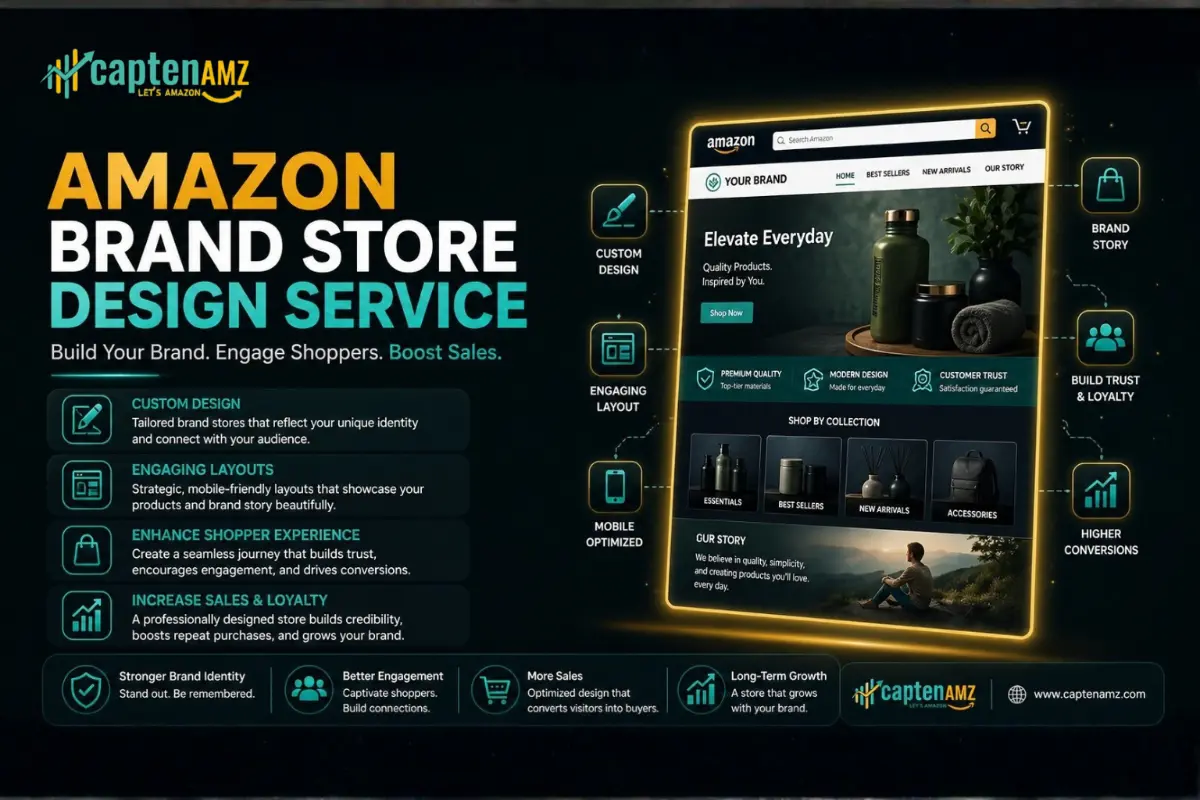
An Amazon Brand Store is a free, multi-page branded storefront available exclusively to sellers enrolled in Amazon Brand Registry. It gives your brand a dedicated URL on Amazon (e.g., amazon.com/yourbrandname) where shoppers can explore your full product catalog, watch videos, read your brand story, and navigate product collections all within Amazon’s ecosystem.
Think of it as a mini-website hosted directly inside Amazon. Unlike standard product listings, a Brand Store lets you:
- Showcase your complete catalog in one organized, branded experience
- Tell your brand story with lifestyle imagery, videos, and rich media
- Create dedicated category pages and subcategory collections
- Serve as the landing page destination for Sponsored Brands and Sponsored Display ad campaigns
- Drive organic traffic from Google, since Amazon Store pages are indexed by search engines
- Retarget shoppers who have visited your store through Amazon DSP campaigns
The result is a fully owned brand space within the world’s largest marketplace — one that directly supports your Amazon PPC management strategy, your Amazon A+ Content, and your Amazon brand management goals.

Why a Generic Brand Store Doesn’t Work Anymore
Amazon has evolved. Shopper expectations have risen. Your competitors — especially established brands in markets like New York, London, Los Angeles, and Texas — are investing in premium creative, strategic navigation, and mobile-first design.
A store built from a default Amazon template with stock imagery and unorganized product grids is no longer competitive. Here’s what a poor Brand Store design costs you:
High bounce rates. Shoppers who land on a disorganized, visually weak store leave immediately — and your advertising spend goes with them.
Lost cross-sell revenue. Without intuitive category navigation, customers buy one product and never explore your broader catalog.
Weak brand perception. A generic store signals low trust, hurting conversion rates even for shoppers already interested in your products.
PPC inefficiency. When you run Amazon Sponsored Brands campaigns to your Brand Store, a poorly converting store means your ad budget produces minimal returns.
Missed organic Google traffic. Your Brand Store meta description is indexed by Google. Without keyword optimization, you’re invisible to potential buyers searching from outside Amazon.
Professional Amazon brand store design services exist precisely to close these gaps — transforming your storefront from a digital placeholder into a revenue-generating brand asset.
What CaptenAMZ’s Amazon Brand Store Design Service Includes
At CaptenAMZ, our Amazon brand store design service is a comprehensive, strategy-first process — not a template-fill exercise. Here is exactly what we deliver:
1. Brand Store Audit and Competitive Analysis
Before we build or redesign anything, we conduct a deep audit of your existing store (if applicable), analyze your top 5–10 competitors’ storefronts, and benchmark against category best practices. This audit identifies structural issues, navigation gaps, underperforming category pages, and visual inconsistencies.
This same strategic rigor powers our Amazon catalog management service — because a Brand Store is only as strong as the catalog it showcases.
2. Storefront Architecture and Navigation Design
We design a logical, shopper-centric navigation structure that organizes your catalog into intuitive categories. Poor navigation is one of the most common conversion killers in Amazon storefronts. Our team builds page hierarchies that guide shoppers from discovery to purchase with zero friction.
3. Homepage Design with Hero Banners and Featured Collections
Your homepage is your brand’s first impression. We design scroll-optimized hero banners, featured product sections, bestseller highlights, and seasonal promotional modules — all aligned with your brand guidelines including colors, typography, and tone of voice.
4. Category Pages and Sub-Page Architecture
For brands with diverse catalogs — common among sellers expanding across US, UK, and EU marketplaces — we build dedicated category pages for each product line. This improves product discoverability, supports cross-selling, and increases average session depth within your store.
5. High-Quality Visual Assets and Lifestyle Imagery
Shoppers buy with their eyes first. Our design process incorporates premium lifestyle imagery, branded infographic tiles, product-in-use visuals, and video integration where available. Every visual element is optimized for both desktop and mobile — critical given that the majority of Amazon shoppers browse on mobile devices.
6. Brand Storytelling and Copywriting
Your Brand Store is one of the few places on Amazon where you can speak directly to your customer without algorithm restrictions. We craft brand narrative copy, value proposition messaging, and category descriptions that connect emotionally and convert rationally.
This complements our Amazon product listing optimization service — because your brand story must be consistent from your Brand Store all the way through to your individual product pages.
7. SEO Optimization for Amazon and Google
Your Brand Store is indexed by Google. We optimize your store’s meta descriptions, page titles, and alt text with high-intent keywords to attract organic traffic from outside Amazon — turning your storefront into a multi-channel traffic asset, not just an on-platform resource.
This aligns directly with our Amazon listing optimization and SEO approach, ensuring keyword consistency and maximum indexing across your full Amazon presence.
8. Mobile Optimization
We test and validate every store layout across mobile, tablet, and desktop views. Given Amazon’s mobile-first shopper behavior, every banner size, font, and module is designed to perform flawlessly on small screens.
9. Store Insights Setup and Performance Monitoring
After launch, we configure Store Insights tracking to monitor traffic sources, page views, conversion rates, and sales attribution by page. We use this data to inform ongoing optimization cycles — updating banners seasonally, testing new layouts, and refreshing content quarterly to sustain the documented visit-frequency benefits that regular updates produce.

How Amazon Brand Store Design Supercharges Your PPC Performance
One of the most underappreciated benefits of a professionally designed Brand Store is its direct impact on your advertising ROI. Here’s how:
When you run Sponsored Brands campaigns that point to your Brand Store instead of a single product listing, you enable multi-product discovery — shoppers can browse your full catalog from a single ad click. A well-structured Brand Store turns one ad impression into multiple potential purchase opportunities.
Additionally, Amazon allows you to retarget shoppers who have visited your Brand Store through DSP (Demand-Side Platform) campaigns. If your store is poorly designed and shoppers leave in seconds, your retargeting pool shrinks dramatically.
Finally, Sponsored Brands campaigns that link to a high-quality Brand Store consistently achieve better Quality Scores and stronger conversion rates — directly reducing your ACoS and improving the profitability of every dollar you spend on Amazon PPC services.
At CaptenAMZ, our Brand Store design process is fully integrated with our PPC strategy — the two are never siloed.
The Connection Between Brand Store Design and Amazon A+ Content
Your Amazon Brand Store and your Amazon A+ Content must work as a unified system. Shoppers who discover your brand through your storefront and then click through to individual product pages expect visual and messaging consistency.
If your Brand Store uses bold, premium lifestyle imagery and your product pages feature generic stock photos and unbranded text, you lose trust in the handoff — and trust is the primary conversion driver on Amazon.
CaptenAMZ designs Brand Stores and A+ Content simultaneously, ensuring visual continuity across every customer touchpoint: from the first brand impression on your storefront homepage to the purchase decision moment on your product detail page.
This full-funnel brand consistency is why our Amazon A+ Content services are most impactful when paired with a professionally designed Brand Store.
Amazon Brand Store Design for USA, UK, and European Markets
CaptenAMZ serves brands across multiple competitive geographies. Each market has distinct shopper behaviors, design expectations, and competitive dynamics that influence Brand Store strategy.
USA (NJ, NYC, TX, California, and nationwide): US shoppers respond strongly to social proof signals, urgency-driven creative, and clear value propositions. NYC and California brands often compete in premium and lifestyle categories where visual quality is the primary differentiator. New Jersey and Texas markets frequently include industrial, home goods, and consumer electronics sellers who benefit from organized catalog navigation and clear product comparison modules.
UK and Europe: UK shoppers prioritize trust signals, detailed product information, and clean, professional design. European sellers expanding across .co.uk, .de, .fr, and .it marketplaces benefit from storefronts that balance brand consistency with regional customization — something CaptenAMZ’s multi-market design framework supports.
Whether you are launching a new Brand Store or redesigning an existing one for better performance in any of these markets, our Amazon brand management services provide the strategic framework to scale your presence regionally and globally.

Common Amazon Brand Store Design Mistakes to Avoid
Even experienced sellers make these costly errors:
Ignoring mobile layout. Over 60% of Amazon shoppers browse on mobile. Stores designed only for desktop fail to convert the majority of their traffic.
Too many pages with too little content. Thin category pages with only 2–3 products signal a weak catalog and confuse shoppers. Structure pages around buyer intent, not internal product codes.
Inconsistent branding. Mixing font styles, color palettes, and image aesthetics across pages destroys brand coherence and reduces perceived professionalism.
No seasonal refresh strategy. Amazon data consistently shows that stores updated in the past 90 days attract significantly more repeat visitors and generate higher sales per visitor. Stale stores get stale results.
Skipping Google SEO. Not optimizing your Brand Store meta description means missing organic traffic from outside Amazon — a free acquisition channel most sellers completely ignore.
Disconnecting your store from your PPC campaigns. A Brand Store with no Sponsored Brands traffic is an asset running at minimal capacity.
All of these mistakes are avoided from day one when you work with CaptenAMZ. And because our team also handles your Amazon catalog management and listing optimization, every layer of your Amazon presence moves in sync.
Why Brands Choose CaptenAMZ for Amazon Brand Store Design
CaptenAMZ is not a generic creative agency applying Amazon templates. We are an Amazon-first growth agency founded in 2019, with a team of 20+ specialists who live and breathe Amazon’s evolving platform. Here’s what makes our Amazon brand store design service different:
Outcome-focused, not deliverable-focused. We measure success by conversion rates, sales attribution, and store traffic — not by how many slides look good in a presentation.
PPC-integrated design. Our Brand Store work is always aligned with your advertising strategy. Store structure, landing page selection, and campaign coordination are built together, never independently.
Transparent process, no hidden fees. Like all of our Amazon services, our Brand Store design pricing is clear upfront. No surprises, no upsell traps.
Proven track record. CaptenAMZ has helped brands achieve results including $1 million in monthly sales, 6x ROI increases, and ACoS reductions of over 39% — outcomes driven by integrated strategies that include storefront optimization.
Limited client roster. We take on a selective number of clients at any time, ensuring your brand receives the dedicated attention it deserves — not the watered-down service of an agency managing hundreds of accounts simultaneously.
Ready to Build an Amazon Brand Store That Actually Converts?
Your Amazon Brand Store is one of the few places on the platform where you own the narrative. When designed strategically, it becomes a brand equity engine, a conversion optimizer, and a traffic multiplier that works 24/7 — with or without ad spend.
Whether you are a brand launching your first store, a seller in New York, New Jersey, Texas, California, or a company expanding into UK and European Amazon markets, CaptenAMZ has the expertise, process, and creative capability to build you a store that outperforms your competitors.
Start with a free strategy call. Our team will review your current Amazon presence, analyze your competitive landscape, and propose a custom Brand Store design plan built around your catalog, your brand, and your growth goals.
Conclusion: Your Brand Store Is a Growth Engine — Build It Right
In 2026, an Amazon Brand Store is no longer optional for serious sellers. It is the foundation of your brand identity on Amazon, the hub of your advertising strategy, and the experience that determines whether shoppers become loyal customers or one-time buyers.
The difference between a Brand Store that generates consistent revenue and one that sits idle comes down to strategy, creative execution, and ongoing optimization — the exact combination that CaptenAMZ delivers through its professional Amazon brand store design service.
Brands across the USA, New Jersey, New York City, Texas, California, the UK, and European markets trust CaptenAMZ to build storefronts that are not just visually impressive but strategically engineered to convert, retain, and scale. See us on LinkedIn & Instagram.
Your competitors are investing in premium storefront design. The question is whether your brand will lead — or follow.
Get your free Amazon Brand Store strategy session with CaptenAMZ today.

Maria R. Donis is an Amazon eCommerce content specialist and digital marketing writer with hands-on experience creating data-driven, SEO-optimized content for Amazon-focused brands. She specializes in producing authoritative content around Amazon PPC management, catalog optimization, listing SEO, and marketplace growth strategies.
Maria collaborates closely with Amazon growth agencies like CaptenAMZ, ensuring that every piece of content reflects real Seller Central experience, platform-specific expertise, and up-to-date Amazon best practices. Her writing is guided by practical insights into how Amazon ads, search algorithms, and buyer behavior work in real-world scenarios.