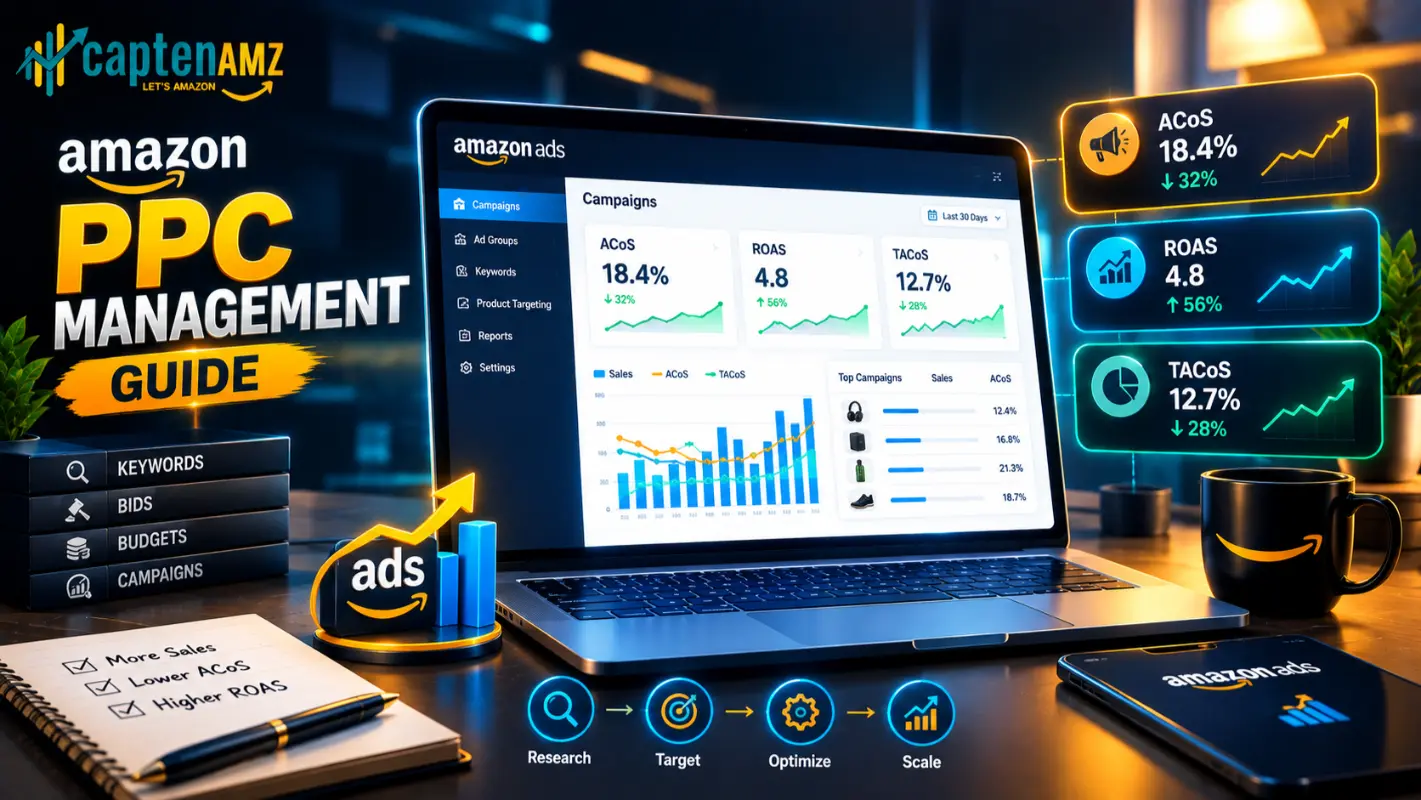
Amazon PPC management is the ongoing process of planning, launching, monitoring and optimizing Sponsored Products, Sponsored Brands and Sponsored Display campaigns so ad spend turns into profitable sales, not just clicks. Done well, it protects your margin, lifts organic rank and gives you a repeatable way to grow. Done badly, it quietly drains cash every day.
This Amazon PPC Management Guide walks through how professional Amazon PPC management actually works: the ad types, the campaign structure, the metrics that matter, the weekly routine and the mistakes that cost sellers the most. Whether you run ads yourself or plan to hire help, you will leave with a clear framework you can apply this week.
At CaptenAMZ, our team has managed Amazon advertising for 200+ brands, so everything below comes from live account work, not theory.
What Is Amazon PPC Management?
Amazon PPC (pay-per-click) management covers every decision that shapes how your ads perform: which products to advertise, which keywords and audiences to target, how much to bid, how to split budgets and when to cut waste. It is a loop of data, decisions and testing, not a one-time campaign setup.
Good Amazon PPC management has three jobs:
- Capture demand from shoppers already searching for what you sell.
- Protect margin by keeping ACoS below your break-even point.
- Feed organic growth so strong ad sales lift your overall ranking and total revenue.
If you are brand new to the channel, start with our Amazon PPC for beginners guide, then come back here for the management layer.
Why Amazon PPC Management Matters More in 2026
Shoppers see sponsored placements on the first screen of nearly every search, so paid visibility is now part of basic discoverability. At the same time, competition for the same keywords keeps pushing click costs up. That combination means guesswork gets expensive fast.
Three shifts make structured Amazon PPC management essential this year:
- More ad surfaces. Beyond classic search results, ads now appear on product pages, in brand experiences and alongside AI shopping features such as Rufus sponsored prompts.
- Margin pressure. Fees, shipping and tariffs squeeze profit, so every wasted click matters.
- Smarter automation. AI tools for Amazon PPC speed up routine work, but they still need human judgment on goals, structure and creative.
For a deeper look at the year ahead, read our Amazon PPC strategy for 2026.
The Three Amazon Ad Types You Need to Manage
Sponsored Products promote individual listings in search results and on product pages. They are the workhorse of most accounts because they target purchase intent directly.
Sponsored Brands feature your logo, a headline and multiple products, and they require Brand Registry. They build awareness and defend your brand terms.
Sponsored Display reaches shoppers on and off Amazon through product and audience targeting, including retargeting people who viewed your listing.
Most brands launch with Sponsored Products, add Sponsored Brands once creative and a Store are ready, and layer in Sponsored Display for defense and retargeting. Our comparison of Sponsored Products vs Sponsored Brands explains the right launch sequence.
Step Zero: Fix the Listing Before You Spend
Ads send traffic. Your listing converts it. If the title is weak, the images are poor or the price is off, even perfect Amazon PPC management will lose money because clicks will not turn into orders.
Before scaling spend, check four things:
- A keyword-rich, readable title (use our Amazon product title formula).
- Strong images and A+ content that answer buyer questions.
- Complete backend keywords.
- Healthy catalog data and variations through Amazon catalog management.
Not sure where you stand? Run your ASIN through our free Amazon Listing Score Calculator and fix the biggest gaps first. If a listing needs a rebuild, our listing optimization service handles it. <!– IMAGE 2 (after Step Zero): amazon-listing-ads-conversion-checklist.webp | ALT: Checklist of listing elements to fix before starting Amazon PPC management –>
The 7-Step Amazon PPC Management Workflow

Step 1: Set Goals and Know Your Break-Even ACoS
Every account needs a defined goal: launch, profit, rank or liquidation. Then calculate your break-even ACoS, which equals your profit margin before ad spend. If your margin before ads is 35 percent, an ACoS above 35 percent loses money on that sale unless the click brings long-term value such as rank or repeat purchases. Our guide to a good ACoS target shows how to set targets by goal.
Step 2: Research Keywords and Targets
Build your keyword universe from Amazon’s search suggestions, your own search term reports, competitor listings and Brand Analytics if you are brand registered. Group terms by intent: branded, competitor, high-intent generic and discovery. We cover the full process in Amazon keyword research for PPC.
Step 3: Build a Clean Campaign Structure
Structure is the backbone of Amazon PPC management. A simple, durable layout looks like this:
- Auto campaigns to discover search terms and product targets.
- Research campaigns using broad and phrase match to expand keyword coverage (see how to optimize research campaigns).
- Exact match performance campaigns for proven converters.
- Product targeting campaigns for competitor and complementary ASINs.
- Brand defense campaigns to protect your own terms.
Keep one product theme per campaign so budgets and bids stay controllable.
Step 4: Use Match Types on Purpose
Broad match explores, phrase match refines and exact match scales. Move winning search terms upward into exact campaigns and add them as negatives in the discovery campaigns to prevent overlap. Our breakdown of exact match vs broad match shows the funnel in detail.
Step 5: Set Bids, Budgets and Placements
Start from a bid that fits your target ACoS and conversion rate, then adjust with data. Choose a bidding strategy (down only, up and down or fixed) based on how aggressive you want to be, and use placement adjustments for top of search when it converts well. Give strong campaigns enough budget to stay live all day; capped campaigns lose the best traffic first. For tactics that reduce wasted spend, see Amazon PPC optimization techniques.
Step 6: Harvest and Negate Every Week
Review the search term report weekly. Promote converting terms to exact match, and add clicks without sales as negatives. A disciplined negative keyword process is one of the fastest ways to cut waste without losing sales.
Step 7: Review on a Fixed Cadence
Make decisions on a schedule, not on emotion. A practical rhythm:
- Daily: check budget caps, stock levels and sudden spend spikes.
- Weekly: harvest, negate and adjust bids.
- Monthly: review structure, creative and profitability by product.
- Quarterly: run a full PPC audit, using our PPC audit checklist.
Give new campaigns time to gather data before judging them. Early changes on thin data usually do more harm than good. The full routine is explained in how to optimize your Amazon PPC campaigns. <!– IMAGE 3 (after the 7 steps): amazon-ppc-management-7-step-workflow.webp | ALT: Seven step Amazon PPC management workflow from goals to weekly review –>
The Metrics That Matter in Amazon PPC Management
| Metric | What it tells you | How to read it |
|---|---|---|
| ACoS | Ad spend divided by ad sales | Compare against break-even |
| ROAS | Ad sales divided by ad spend | The inverse of ACoS |
| TACoS | Ad spend divided by total sales | Shows ad dependence and organic lift |
| CTR | Clicks divided by impressions | Measures title, image and price appeal |
| CVR | Orders divided by clicks | Measures listing and offer strength |
ACoS alone can mislead. A launch campaign may run above break-even on purpose to build rank, and a lower TACoS over time proves that ads are feeding organic sales. Read the two together using our guide to ACoS vs TACoS, and learn how to lower TACoS without cutting ad spend. For target setting, see what is a good ROAS for Amazon PPC. <!– IMAGE 4 (inside the metrics section): acos-roas-tacos-relationship-diagram.webp | ALT: Diagram showing how ACoS, ROAS and TACoS relate in Amazon PPC management –>
Advanced Amazon PPC Management Tactics
Once the basics run smoothly, these tactics add efficiency:
- Dayparting. Shift budget toward the hours that convert best. See our Amazon dayparting guide.
- Seasonal planning. Raise budgets before peak events instead of reacting during them. Read our PPC hacks for 2026.
- Scaling carefully. Increase spend in steps and watch margins. Our guide to scaling Amazon PPC covers the pacing.
- Campaign refinement. Revisit structure as your catalog grows, using Amazon PPC campaign optimization.
For a full list of growth levers, browse the 15 best Amazon PPC strategies to drive more sales.
Common Amazon PPC Management Mistakes
- Running ads on weak listings. Traffic cannot fix poor conversion.
- Mixing everything in one campaign. You lose control of budget and bids.
- Ignoring negatives. Irrelevant clicks add up quietly.
- Chasing ACoS only. Cutting spend to hit a number can shrink total revenue.
- Changing too much too soon. Constant edits reset the learning signal.
- Skipping reviews. Without a routine, small leaks become large ones.

Your Amazon PPC Management Checklist
Use this list to audit your own account today. If you cannot tick most of these boxes, your Amazon PPC management has room to improve:
- Every product has a written goal (launch, profit, rank or clear-out) and a break-even ACoS.
- Listings pass a quality check before ads go live.
- Campaigns are split by match type and intent, with one product theme each.
- Search term reports are reviewed weekly, with winners promoted and losers negated.
- Budgets rarely run out before the end of the day on your best campaigns.
- TACoS is tracked monthly next to ACoS, so you see the organic effect of paid traffic.
- A full audit happens every quarter, and every change is logged so you can learn from it.
- Someone owns the account and can explain every major spend decision in plain language.
Treat this as a living document. As your catalog, margins and competitors change, your Amazon PPC management routine should change with them.
Who Should Handle Your Amazon PPC Management?
You have four realistic options.
In-house. You keep full control, but you carry hiring, training and tool costs. Our comparison of an advertising consultant vs an in-house PPC manager helps you decide.
Software. Tools automate bids and reporting, though they still need a strategist behind them. Read how AI tools compare with human PPC experts before you commit.
Consultant. Ideal when your team needs direction, training or an expert review. Explore PPC consultation and our overview of Amazon PPC consultant services.
Agency. A dedicated team handles strategy, execution and reporting. Our Amazon PPC management service and Amazon ads management cover the full scope, and our guide to the best Amazon PPC agency for 7-figure brands shows what to look for. You can also compare Amazon PPC agencies in the USA.
Brands that want expert guidance close to home can work with our Amazon advertising consultant in the USA or regional teams in New York and Seattle.
Amazon PPC Management Across the USA, UK and Europe
Each marketplace has its own language, currency, buying habits and competition level. Translating a US keyword list word for word rarely works in Germany or the UK. Local keyword research, native-language creative and marketplace-specific budgets are essential. Our teams support UK brands and German sellers, and our EU PPC case study shows the approach in practice.
Real Results From Professional Amazon PPC Management
Structure and discipline produce measurable outcomes. A few examples from our PPC case studies:
- A toy brand improved ROI by 131 percent while cutting ACoS by 39 percent.
- A supplement brand grew ROI sixfold in its first three months.
- A clothing brand stabilized ACoS at 27 percent and TACoS at 13 percent.
- A lighting brand reached seven-figure monthly sales by pairing catalog fixes with PPC restructuring.
Across accounts, CaptenAMZ has helped reduce average ACoS by 38 percent. Because we run catalog and advertising from one team, listing issues get fixed alongside ad issues instead of being passed between vendors. <!– IMAGE 5 (results section): captenamz-amazon-ppc-case-study-results.webp | ALT: CaptenAMZ Amazon PPC case study results showing lower ACoS and higher ROI –>
Frequently Asked Questions About Amazon PPC Management
What does Amazon PPC management include?
It includes goal setting, keyword and target research, campaign structure, bid and budget control, negative keyword work, reporting and regular audits across Sponsored Products, Brands and Display.
How much time does Amazon PPC management take?
A healthy account needs a few focused check-ins each week plus deeper monthly and quarterly reviews. Larger catalogs need more.
How long before PPC shows results?
Expect a learning period of a few weeks before performance stabilizes, since campaigns need data before decisions are reliable.
What is a good ACoS on Amazon?
It depends on your margin and goal. Compare ACoS to your break-even point, then judge launch and profit campaigns separately.
Should I use software or an agency?
Software speeds up routine work, while an agency adds strategy, accountability and creative judgment. Many brands use both.
Can PPC fix a listing that does not sell?
No. Ads bring traffic, but the listing must convert it. Fix the listing first. <!– IMAGE 6 (before the outro): amazon-ppc-free-audit-cta-banner.webp | ALT: CaptenAMZ banner offering a free Amazon PPC audit and strategy call –>
Final Thoughts: Turn Amazon PPC Management Into a Growth Engine
Strong Amazon PPC management is not about spending more. It is about spending with intent: a healthy listing, a clean structure, a clear break-even target and a steady review routine. Brands that treat advertising as a system, rather than a switch, grow faster and keep more of every sale.
If your ACoS is stubborn, your TACoS is climbing or your ads simply feel like a black box, a second pair of eyes helps. Start with a full Amazon PPC audit to see exactly where budget is leaking, explore Amazon PPC optimization to fix it, and learn how our wider seller account management and FBA management support your growth. Ready to talk? Book a free strategy call with CaptenAMZ and let us show you what profitable Amazon advertising looks like for your brand.
Follow CaptenAMZ for more expert Amazon PPC/Catalog Guides: LinkedIn | Instagram

Maria R. Donis is an Amazon eCommerce content specialist and digital marketing writer with hands-on experience creating data-driven, SEO-optimized content for Amazon-focused brands. She specializes in producing authoritative content around Amazon PPC management, catalog optimization, listing SEO, and marketplace growth strategies.
Maria collaborates closely with Amazon growth agencies like CaptenAMZ, ensuring that every piece of content reflects real Seller Central experience, platform-specific expertise, and up-to-date Amazon best practices. Her writing is guided by practical insights into how Amazon ads, search algorithms, and buyer behavior work in real-world scenarios.