Every dollar you lose in Amazon PPC traces back to one root cause: the wrong keywords. Bid on terms that are too broad, and you bleed budget on shoppers who will never buy. Ignore high-intent long-tail terms, and your competitors quietly capture your most profitable traffic at a fraction of your CPC. The brands winning on Amazon in 2026 — across New Jersey, New York City, Texas, California, the United Kingdom, and across European marketplaces — are not bidding more than their competitors. They are bidding smarter, on better keywords, built through a more rigorous research process.
Amazon keyword research for PPC is not a one-time task. It is an ongoing intelligence operation that feeds your campaign structure, shapes your bid strategy, powers your listing optimization, and ultimately determines whether your advertising spend builds compounding organic growth or simply subsidizes your competitors. This guide walks you through the exact keyword research framework that the CaptenAMZ Amazon PPC management team applies across every client account we onboard, from single-product launches to enterprise catalogs with thousands of ASINs.
CaptenAMZ Fast Answer: The best Amazon PPC keywords combine high purchase intent, sufficient search volume, manageable CPC relative to your margin, and direct relevance to your product. Finding them requires mining four data sources: Amazon Brand Analytics, your PPC search term reports, reverse ASIN competitor analysis, and AI-assisted search query data. Most sellers only use one or two of these. That gap is where your keyword advantage lives.
Why Amazon Keyword Research Is the Foundation of Every PPC Decision You Make
Before building a single campaign, structuring a single bid, or writing a single ad headline, your keyword research must be complete. This is the foundational principle behind every Amazon PPC strategy that actually scales. The reason is structural: your keyword selection determines which shoppers see your ads, which auction pools you participate in, what you pay per click, and whether the traffic you generate converts at a rate that supports your margins.
Amazon’s A10 algorithm evaluates your ads not just on bid price, but on relevance. A campaign built on well-researched, intent-matched keywords earns better placement at a lower effective CPC than a poorly researched campaign bidding at the same level. This relevance premium is one of the most powerful and least understood advantages in Amazon PPC optimization: when your keyword matches what the shopper actually typed, your Quality Score equivalent rises, your CPC falls, and your conversion rate climbs simultaneously.
Poor keyword research causes every downstream problem: high ACoS, low ROAS, wasted impressions, budget exhaustion without sales, and organic ranking stagnation. Strong keyword research, applied through the right campaign architecture, is what drives the compounding cycle in the opposite direction. This is why our Amazon PPC audit service always begins with a full keyword architecture review before touching a single bid.
The Three Types of Amazon PPC Keywords (And What Each One Does for Your Account)
Not all keywords serve the same purpose in your account. One of the most expensive mistakes sellers make is treating all keywords as interchangeable, running the same match type strategy and the same bid logic regardless of keyword type. Before you build your keyword list, you need to understand what each keyword tier is supposed to do, and where in your campaign architecture each tier belongs.
TIER 1
Head Keywords
1 to 2 words. Massive search volume. Extremely high competition. Low purchase intent per impression. Example: “yoga mat,” “protein powder.” Used for visibility and discovery, rarely for direct ROAS.
TIER 2
Modifier Keywords
3 to 4 words. Medium volume, medium competition. Higher purchase intent. Example: “non-slip yoga mat thick.” Core of any profitable phrase match campaign. Best balance of reach and conversion efficiency.
TIER 3
Long-Tail Keywords
5+ words. Lower individual volume but highest purchase intent per click. Example: “non-slip yoga mat 6mm thick for beginners.” The secret profit layer in every well-structured Amazon PPC account.
Your Amazon PPC campaign structure should reflect these three tiers explicitly. Head keywords belong in broad match discovery campaigns with controlled budgets. Modifier keywords belong in phrase match campaigns that you optimize weekly. Long-tail keywords belong in exact match campaigns where you concentrate your highest bids, because these shoppers convert at the highest rate and generate the most profitable revenue per click. The common mistake of mixing all three tiers in one campaign prevents you from ever seeing clean performance data for any of them.
Understanding Amazon exact match versus broad match is inseparable from understanding keyword tiers. The match type you assign to each keyword directly determines which shopper searches actually trigger your ad, and getting that pairing wrong wastes budget regardless of how good your keyword research is.
Amazon Keyword Research for PPC: The 7-Step Framework CaptenAMZ Uses for Every Account
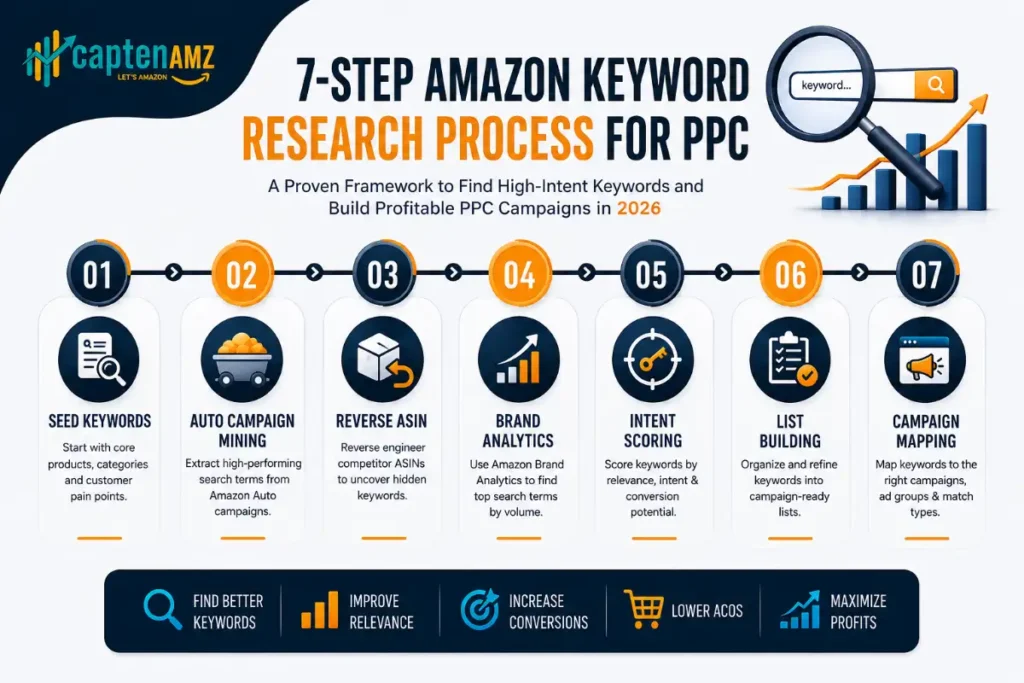
📸 IMAGE — 7-STEP KEYWORD RESEARCH FRAMEWORK INFOGRAPHICSuggested visual: Horizontal numbered step flow — Step 1 through Step 7 as connected nodes with icons. Step labels: Seed Keywords → Auto Campaign Mining → Reverse ASIN → Brand Analytics → Intent Scoring → List Building → Campaign Mapping. CaptenAMZ orange accent nodes on navy background.
File name: captenamz-amazon-ppc-keyword-research-7-step-framework-2026.webp
Step 1: Build Your Seed Keyword List
What it is: Your seed keyword list is the starting point of all research. It includes the most obvious 10 to 20 terms a shopper might type to find your product. For a stainless steel insulated water bottle, seeds include “insulated water bottle,” “stainless steel water bottle,” “vacuum water bottle,” and “leak proof water bottle.”
How to build it: Start with your product’s primary function, material, and use case. Type each seed into the Amazon search bar and capture the autocomplete suggestions — these are real, high-volume queries Amazon surfaces based on actual shopper behavior. Also scan your product title, bullet points, and competitor listings for language patterns that shoppers actually use, not just technical product descriptions. The gap between how a brand describes its product and how a shopper searches for it is where most keyword research fails at this first step. Our Amazon product title formula guide shows how buyer language and product language should align across all listing fields.
Step 2: Launch an Auto Campaign to Mine Real Shopper Data
What it is: An Amazon automatic targeting campaign is not a shortcut for lazy advertisers. It is your single most powerful keyword discovery mechanism because it uses Amazon’s own algorithm to match your product to the search queries of real shoppers based on your listing content and category context. No third-party tool can replicate that data source.
How to use it: Launch an auto campaign with a controlled daily budget of $20 to $50 and a flat bid of $0.50 to $0.80, depending on your category’s average CPC. Run it for a minimum of two to three weeks without optimization. Then download the Search Term Report from Seller Central → Reports → Advertising Reports → Search Term. Every search term that generated a click is a real shopper query with real volume. Filter by conversion first: any term that generated a sale at an acceptable ACoS goes directly into your manual exact match campaign. Any term that generated clicks but no sales gets reviewed for relevance before being added to phrase match for further testing. This auto-to-manual harvesting loop is the backbone of every Amazon PPC management engagement at CaptenAMZ.
Step 3: Reverse ASIN Analysis of Your Top Competitors
What it is: Reverse ASIN research reveals which keywords your top-ranking competitors are already indexed and ranking for, both organically and through paid campaigns. Instead of guessing which terms drive traffic in your category, you can see exactly which terms are working for the best-performing ASINs and target those same keywords faster, without the months of organic ranking work they invested.
How to do it: Identify your top three to five competitors by searching your primary category keyword on Amazon and noting the top organic and sponsored results. Run each competitor ASIN through a keyword research tool such as Helium 10 Cerebro or Jungle Scout Keyword Scout. Export the keyword list, sort by search volume, and filter for terms where your competitor ranks in the top 20 positions. These are your highest-priority gaps: keywords with proven shopper demand where a competitor already validates commercial viability. Add them to your seed list and test through manual phrase match campaigns before committing budget to exact match. The Amazon PPC hacks guide covers how CaptenAMZ layers ASIN conquesting campaigns on top of competitor keyword intelligence for maximum market share capture.
Step 4: Mine Amazon Brand Analytics for First-Party Search Data
What it is: Amazon Brand Analytics is the most underused keyword data source available to brand-registered sellers. Unlike third-party tools that estimate search volume based on scraped data, Brand Analytics shows you actual shopper search behavior inside Amazon’s own ecosystem, including the Search Query Performance dashboard, which reveals the exact queries driving impressions, clicks, and purchases in your category.
How to use it: Access Brand Analytics in Seller Central → Brands → Brand Analytics → Search Query Performance. Filter by your ASIN or category. Look at your Top Search Query report to see which terms generate the most impressions for your product and your competitors. Any high-impression, high-click-share term where your conversion rate is lower than your competitors’ is an immediate optimization priority: it tells you that shoppers are finding you but choosing someone else. That signals a listing issue first, and a bid issue second. Cross-reference these Brand Analytics terms with your auto campaign search term report for the most reliable keyword universe you can build from native Amazon data. If you want our team to run this analysis for your account, our Amazon PPC audit service includes a full Search Query Performance review as a standard deliverable.
Step 5: Score Every Keyword on a Three-Factor Matrix
What it is: Keyword qualification. Not every keyword you discover during research belongs in your campaigns. Adding unqualified keywords inflates your keyword list, dilutes your budget, and contaminates your performance data. You need a systematic way to decide which keywords to pursue and at what match type.
The three-factor matrix:
Factor 1 — Relevance (1 to 5): Does this keyword exactly describe what your product is and does? A score of 5 means perfect alignment. A score of 1 means peripheral association at best.
Factor 2 — Purchase Intent (1 to 5): Does the language signal readiness to buy? “Best yoga mat reviews” has low purchase intent. “Buy non-slip yoga mat 6mm thick” has maximum purchase intent. Intent score determines your match type and bid priority.
Factor 3 — Profitability (1 to 5): Can you afford to win this keyword at its current CPC relative to your product margin? If your product sells for $25 with a 35 percent margin and the estimated CPC for a keyword is $3.50, you need a conversion rate of roughly 40 percent to break even on that keyword alone. Most categories convert at 8 to 15 percent. That keyword likely destroys margin regardless of relevance. Score accordingly.
Keywords scoring 10 or above go into exact match campaigns immediately. Keywords scoring 7 to 9 go into phrase match for testing. Keywords scoring below 7 are either added to broad match discovery or rejected entirely. This scoring approach is part of the keyword architecture framework our Amazon PPC consultation service delivers for brands who want to build their own internal capability.
Step 6: Build Your Negative Keyword List Simultaneously
What it is: Negative keywords are the other half of keyword research, and treating them as a separate cleanup task instead of part of the research process is one of the most common structural mistakes in Amazon PPC account management. While you are building your positive keyword list, you are simultaneously identifying every irrelevant, low-intent, and margin-destroying term that your broad and phrase match campaigns might accidentally trigger.
How to build it: As you research seed keywords and competitor terms, note every modifier that makes a keyword irrelevant to your product: size ranges you do not carry, material types you do not use, use cases your product cannot serve, and price-anchored terms like “cheap” or “free” that signal shoppers outside your target price point. Add these as exact match negative keywords across all campaign types before launch. Post-launch, review your Search Term Report weekly and add any search term with three or more clicks and zero conversions to your negative keyword list. Aggressive negative keyword management can reduce wasted ad spend by 20 to 35 percent within the first 60 days. Our full breakdown of Amazon negative keyword strategy covers the exact architecture for building and maintaining your negative keyword firewall across all campaign types.
Step 7: Map Keywords to Campaign Structure Before Launch
What it is: The final step before spending any budget. Every keyword on your list must be mapped to a specific campaign, ad group, and match type before launch. Keyword mapping prevents cannibalization between campaigns, keeps performance data clean by separating intent tiers, and ensures your budget flows predictably toward your highest-value traffic. Running campaigns without a keyword map is like opening multiple funnels and watching budget drain into whichever one happens to win the auction, with no visibility into why.
How to do it: Create a simple spreadsheet with four columns: Keyword, Match Type, Campaign Assignment, and Rationale. Assign every exact match converter to a dedicated Exact Match campaign. Assign phrase match expansion terms to a Phrase Match campaign segmented by product subcategory or intent cluster. Assign broad match discovery terms to your auto campaigns or a dedicated Broad Match discovery campaign with strict negative keyword controls. Never put more than 5 to 10 keywords per ad group. This map also protects against keyword cannibalization, where two campaigns bid against each other on the same term, artificially inflating your own CPC. Our Amazon PPC campaign architecture guide covers the exact three-layer structure we apply to every account we manage across USA and European marketplaces.
How Amazon Keyword Research Differs Across USA, UK, and European Markets
One of the most common and costly keyword research mistakes we see from sellers expanding beyond their home market is applying a US keyword list directly to UK or EU campaigns, or vice versa. Amazon keyword research is market-specific at every level.
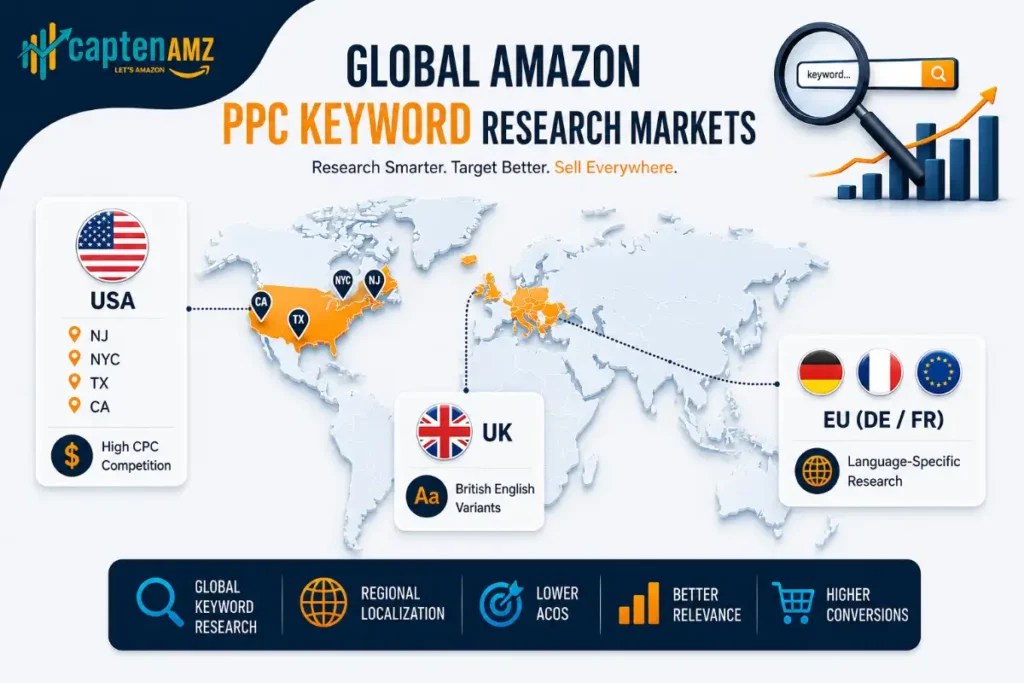
USA Market (Amazon.com)
The US Amazon marketplace is the most competitive in the world, with CPCs consistently higher than any other marketplace across most categories. For sellers based in or targeting buyers in New Jersey, New York City, Texas, and California, keyword competition is especially intense in consumer electronics, home goods, health and beauty, and fitness. Your keyword research for the US market must account for the CPC ceiling imposed by your margin structure before committing budget to any head keyword. Long-tail exact match terms are disproportionately profitable in the US because they consistently deliver lower CPC and higher CVR than the head terms that most sellers fight over. Our US-focused Amazon PPC management service applies region-specific bid and keyword strategy for brands competing across all major American markets.
UK Market (Amazon.co.uk)
Amazon keyword research for the UK marketplace requires a fundamental reset of your language assumptions. British English spelling (colour vs color, organise vs organize), terminology preferences (taps vs faucets, nappies vs diapers, cupboard vs cabinet), and shopping intent phrasing all differ from US equivalents. Directly transplanting your US keyword list into UK campaigns results in low relevance scores, missed search volume, and suppressed ad placement. UK market keyword research must be conducted natively, using UK-specific seed terms, UK Brand Analytics data if available, and UK-specific competitor ASIN analysis. CaptenAMZ manages UK Amazon PPC campaigns as part of our broader multi-marketplace PPC management service.
European Markets (Germany, France, Italy, Spain)
European marketplace keyword research requires native-language research for each country, not machine-translated keyword lists. German shoppers search in German. French shoppers search in French. A keyword that converts profitably on Amazon.de will not exist at all as an English phrase on Amazon.fr. Additionally, category saturation varies dramatically across European markets. Categories that are hypercompetitive on Amazon.com are often substantially more accessible on Amazon.de or Amazon.fr, creating keyword opportunities with meaningful search volume and no established competitor bidding infrastructure. Our Amazon PPC consultation service includes market-by-market keyword strategy for brands expanding into European Amazon marketplaces.
The Critical Link Between Keyword Research and Amazon Listing Optimization
Amazon keyword research for PPC does not happen in isolation from your listing content. In 2026, with Amazon’s Rufus AI interpreting queries based on semantic intent rather than just keyword presence, the alignment between the keywords in your campaigns and the language throughout your listing is more consequential than at any previous point in the platform’s history.
Your title carries the highest keyword weight in Amazon’s indexing algorithm. If the primary keyword you are bidding on in your Sponsored Products campaign does not appear in your listing title, your ad relevance score suffers, your CPC rises, and your conversion rate falls because the shopper who clicks the ad finds a product page that does not immediately confirm relevance. Our Amazon product title formula guide shows exactly how to structure your title to support both your primary PPC keywords and your organic ranking objectives simultaneously.
Your bullet points and A+ Content carry secondary keyword weight and primarily affect conversion rate. When the language in your bullets mirrors the search terms shoppers used to find your product, purchase confidence rises and bounce rate falls, both of which send positive conversion signals back to Amazon’s algorithm and reduce your effective CPC over time. This is why Amazon listing optimization and PPC keyword research are planned together at CaptenAMZ, never as separate workstreams. Our Amazon A+ Content optimization guide covers how module-level language choices align with keyword intent to maximize conversion rates on paid traffic.
Backend search terms are your secondary keyword layer — the place to capture long-tail variants, alternate spellings, and use-case phrases that do not fit naturally in your title or bullets. With the current 249-byte limit, backend optimization requires the same rigor as your PPC keyword list: every byte counts, no duplication with frontend content, and no prohibited terms. Our Amazon catalog management team handles backend keyword architecture for multi-ASIN catalogs as part of our full catalog optimization service, often recovering 15 to 25 percent of lost indexing that sellers discover after a flat file audit.
9 Amazon PPC Keyword Research Mistakes That Kill Profitability
| Mistake | What It Costs You | The Fix |
|---|---|---|
| Chasing high-volume head terms only | Sky-high CPC, low CVR, ACoS above breakeven | Balance head terms with Tier 2 and Tier 3 long-tail clusters |
| Skipping auto campaigns | Keyword list built on guesses, not shopper data | Run auto campaigns for 3+ weeks before building manual |
| Mixing all match types in one campaign | Dirty data, impossible to optimize bids accurately | Separate campaigns by match type and intent tier |
| Ignoring negative keywords at setup | Budget bleeds on irrelevant search terms from day one | Build negative keyword list before launch, mine STR weekly |
| No reverse ASIN research on competitors | Missing the keyword terms already proven in your category | Run Reverse ASIN on top 3-5 competitors before launch |
| Never using Brand Analytics | Keyword strategy based on estimates instead of Amazon’s real data | Use Search Query Performance report for every brand-registered ASIN |
| Applying US keywords to UK/EU campaigns unchanged | Low relevance, missed volume, wasted international budget | Research each marketplace independently, in local language |
| Bidding keywords your listing is not optimized for | Poor CVR from misaligned shopper expectations | Align listing title, bullets, and backend to your top PPC keywords |
| Treating keyword research as a one-time task | Keyword decay, rising CPCs, missed new search terms over time | Monthly STR review and quarterly full keyword refresh |
Want CaptenAMZ to Do Your Amazon Keyword Research?
Our PPC team builds complete keyword universes for brands across the USA, UK, and European marketplaces — then maps them to campaign architectures that scale profitably.Get a Free PPC Audit Book a Strategy Call
How Amazon’s Rufus AI Is Changing Keyword Research in 2026
Amazon’s Rufus AI — the conversational shopping assistant embedded into the search experience — has fundamentally changed the relationship between keyword research and PPC performance in 2026. Traditional keyword research assumed that shoppers typed precise product terms into the search bar: “non-slip yoga mat 6mm.” Rufus has accelerated a shift toward conversational, intent-based queries: “what yoga mat is best for beginners who need extra cushioning.”
These conversational queries do not contain the exact keyword strings that appear in most sellers’ keyword lists. Sellers who are only targeting traditional exact-match phrases are structurally invisible to a growing segment of shopper traffic, because Rufus interprets intent and surfaces products based on semantic relevance, not keyword presence alone. This has two direct implications for keyword research.
First, your keyword list must include natural-language, benefit-focused, and problem-solving phrases, not just product descriptor terms. “Best yoga mat for bad knees” does not contain “yoga mat” as a clean keyword phrase, but it signals extremely high purchase intent and should appear in your broad and phrase match campaigns to capture Rufus-influenced traffic. Second, your listing content — title, bullets, A+ Content — must use the same natural language your target shoppers use to describe their problem, not just the engineering language of your product specifications. The alignment between conversational search intent and your listing’s natural language is what determines whether Rufus AI routes shopper queries to your product or to a competitor.
At CaptenAMZ, we have updated our keyword research framework to include an AI query layer: mapping conversational, problem-based, and comparison-based search phrases alongside traditional product descriptor terms. This extends the keyword universe and captures traffic that never appeared in historical search term reports. For a full breakdown of how Rufus affects your Amazon PPC strategy and ad visibility, our 2026 PPC hacks guide covers the full tactical framework.
How CaptenAMZ Builds Keyword Universes for USA and UK Amazon Brands
Every Amazon PPC management engagement at CaptenAMZ begins with a multi-source keyword universe build that combines all four primary data layers: auto campaign search term data, Brand Analytics Search Query Performance, reverse ASIN competitor analysis, and our proprietary AI intent query framework. The resulting keyword list is scored, tiered, and mapped to a campaign architecture before any live spend is committed.
For brands launching in the USA, particularly in high-competition markets like New Jersey, New York City, Texas, and California, we apply regional bid intelligence to the keyword map: adjusting CPC targets based on category-level CPC data for each state market, and dayparting bids to the specific conversion windows active for each geographic buyer demographic. A supplement brand targeting California wellness buyers has a different peak conversion window than a home goods brand targeting New Jersey and New York City suburban households, and our keyword bidding reflects those differences.
For UK and European market expansions, our keyword research process starts from zero in each market, building native-language keyword lists from UK and EU-specific Brand Analytics data and competitor ASIN lookups on the local marketplace. We do not translate US keyword lists. We research each market independently, then cross-validate performance through auto campaign launches before scaling manual campaigns on proven terms. View our full service offerings and client results through our Amazon PPC case studies, including how our keyword strategy drove $1 million per month in sales for one lighting brand and 6x ROI growth in three months for a supplement brand.
If your current keyword architecture was built more than six months ago, or if your ACoS has risen without a clear explanation, the problem is almost certainly in your keyword list. CPCs shift, new competitors enter categories, and shopper query patterns evolve — especially with Rufus AI accelerating semantic search changes. A comprehensive Amazon PPC audit from our team maps every keyword efficiency gap in your account and delivers a rebuilt keyword architecture within five business days.
Keyword Research Is Never Finished: The Ongoing Maintenance Framework
The single most common reason a well-built Amazon PPC account degrades over 6 to 12 months is keyword decay: keywords that converted profitably at launch stop converting as competition increases, as shopper behavior shifts, and as the category evolves. Without a proactive keyword maintenance schedule, the best keyword research in the world becomes obsolete, and ACoS climbs while ROAS falls without any obvious cause visible at the campaign level.
- Weekly: Download the Search Term Report. Add new converting search terms to manual exact match campaigns. Add non-converting terms with 3+ clicks to negative keyword lists. Check for budget cannibalization between campaigns targeting the same keywords
- Monthly: Review keyword-level ACoS for every exact match term. Pause or reduce bids on terms whose 30-day ACoS exceeds your breakeven by more than 20 percent. Harvest new terms from auto campaigns that have accumulated enough data. Check ROAS benchmarks against your category standard for each keyword cluster
- Quarterly: Rebuild your seed keyword list from scratch. Run a fresh reverse ASIN on your current top 5 competitors — the competitive landscape has changed. Pull a new Brand Analytics Search Query Performance export and identify any new high-volume terms that have emerged. Reassess your keyword tiers and reallocate budget between head terms, modifier terms, and long-tail clusters based on trailing 90-day performance data
- After any major listing change: A title rewrite, bullet update, or A+ Content refresh changes your listing’s indexing profile. Re-run your full keyword relevance check to confirm that your primary PPC keywords are still present in your listing’s most-weighted fields. Review our A+ Content optimization guide for how content changes affect keyword indexing
For brands managing this internally, the time requirement of a proper keyword maintenance schedule is significant: typically four to eight hours per week for a mid-sized catalog, and 20 to 40 hours per week for large accounts with hundreds of active ASINs. For brands that want this handled without the internal resource commitment, our Amazon PPC optimization service covers the full keyword maintenance cycle as an ongoing managed service.
Frequently Asked Questions: Amazon Keyword Research for PPC
How do I find the best keywords for Amazon PPC campaigns?
The best Amazon PPC keywords come from four data sources used together: your own auto campaign search term reports which show real shopper queries that triggered your ads and converted; Amazon Brand Analytics Search Query Performance which shows how shoppers in your category search and click; reverse ASIN analysis on your top competitors which reveals proven high-traffic terms in your category; and AI intent query research to capture the conversational search patterns now driven by Amazon’s Rufus AI. No single data source is sufficient on its own. The sellers with the most profitable keyword lists use all four and cross-validate results before committing budget.
How many keywords should I target in an Amazon PPC campaign?
There is no fixed number, but a functional starting architecture typically uses 5 to 15 exact match keywords per ad group, organized into tightly themed clusters by intent and product attribute. The total keyword count across a full campaign structure for a single ASIN might range from 50 to 200 terms across auto, phrase, and exact match campaigns. Avoid adding hundreds of keywords into a single campaign — this destroys data clarity and makes bid optimization impossible. Add keywords based on performance evidence, not volume, and maintain negative keyword lists to prevent irrelevant matches from diluting your data.
What is the difference between Amazon SEO keywords and Amazon PPC keywords?
Amazon SEO keywords are placed in your listing’s title, bullets, and backend search terms to build organic ranking over time. Amazon PPC keywords are the terms you bid on in advertising campaigns to generate paid traffic immediately. The research process is largely the same, but the application differs. For SEO, you prioritize keywords with high search volume where organic ranking is achievable given your review count and sales velocity. For PPC, you prioritize keywords with high purchase intent and a CPC you can afford relative to your margin, regardless of organic competitiveness. The most profitable Amazon accounts use PPC keyword data to inform SEO priorities and vice versa, creating a unified keyword strategy rather than two separate lists.
How often should I update my Amazon PPC keyword list?
Keyword maintenance should happen at three time horizons: weekly for Search Term Report mining and negative keyword additions, monthly for keyword-level performance reviews and bid adjustments on underperforming exact match terms, and quarterly for a full keyword universe refresh that includes new competitor reverse ASIN analysis and a fresh Brand Analytics export. Any significant listing change — title rewrite, A+ Content update, or flat file attribute change — should also trigger an immediate keyword relevance audit to confirm your primary PPC terms are still indexed correctly.
Can I use the same Amazon PPC keywords for USA and UK marketplaces?
No. US and UK keyword lists must be researched independently. British English spelling, terminology preferences, and shopper intent phrasing differ enough from US English that a directly copied keyword list will miss significant search volume and create low-relevance matches in the UK marketplace. For European marketplaces including Germany, France, Italy, and Spain, keyword research must be conducted in the local language of each marketplace. CaptenAMZ manages multi-marketplace keyword research for brands expanding from the USA into UK and European Amazon markets as part of our international PPC management service.
What are long-tail keywords and why do they matter for Amazon PPC?
Long-tail keywords are specific, multi-word phrases such as “non-slip yoga mat 6mm thick for beginners” that have lower individual search volume than head terms but significantly higher purchase intent per click. They matter for Amazon PPC because they typically deliver lower CPC, higher conversion rates, and more predictable ACoS than broad head terms, because the shopper using a long-tail phrase has already narrowed their consideration to exactly the type of product you sell. In aggregate, a well-managed long-tail keyword cluster can drive 40 to 60 percent of an account’s profitable revenue at a fraction of the CPC budget that head terms require.
Does CaptenAMZ do Amazon keyword research as part of its PPC management service?
Yes. Keyword research and keyword architecture building are foundational deliverables in every CaptenAMZ Amazon PPC management engagement. Our process uses Amazon Brand Analytics, auto campaign search term mining, reverse ASIN competitor analysis, and AI intent query research to build comprehensive keyword universes. We score and tier every keyword by relevance, purchase intent, and profitability before mapping them to campaign structure. For brands that want a standalone keyword audit without full management engagement, our Amazon PPC audit service delivers a complete keyword architecture review and rebuild within five business days. CaptenAMZ serves brands in the USA including New Jersey, New York City, Texas, and California, as well as the UK and European Amazon marketplaces.
Your Amazon PPC Performance Is Only as Strong as Your Keyword Foundation
Amazon keyword research for PPC is not a tool exercise. It is a strategic discipline that determines how visible your product is, how much you pay for every click, and whether your advertising spend generates compounding organic growth or simply finances a cycle of wasted impressions. The sellers scaling profitably on Amazon in 2026 — across New Jersey, New York City, Texas, California, the United Kingdom, and European markets — have built their competitive advantage on better keyword foundations than their competitors, not larger budgets.
The seven-step framework in this guide — seed keywords, auto campaign mining, reverse ASIN research, Brand Analytics analysis, three-factor intent scoring, negative keyword building, and campaign keyword mapping — is the exact process applied by the CaptenAMZ PPC team across every account we manage. It is not theoretical. It is the operational system that has produced results including $1 million per month in sales for a lighting brand, 6x ROI growth for a supplement brand, and consistent ACoS reductions of 30 to 50 percent across accounts in competitive categories. You can see these results in detail in our Amazon PPC case studies.
Keyword research also does not exist in isolation. Your Amazon listing optimization must align with your primary PPC keywords. Your Amazon A+ Content and Brand Store must convert the traffic your keywords generate. Your catalog management must ensure every ASIN in your keyword map is fully indexed and search-visible. When all of these elements connect, the impact of great keyword research compounds over time: lower CPCs, higher conversion rates, stronger organic rank, and a TACoS that trends downward even as revenue grows.
If you want to explore further, our Amazon PPC strategy guide for 2026 covers the full campaign architecture that your keyword research feeds into. Our exact match vs broad match guide explains how to assign match types to your keyword tiers correctly. Our Amazon negative keywords guide covers the full negative keyword architecture that protects your keyword investment. And our Amazon ACoS target guide gives you the profitability benchmarks that your keyword scoring matrix needs to remain grounded in real margin math.
CaptenAMZ is based in Trenton, New Jersey, and manages Amazon PPC campaigns including full keyword research, campaign architecture, and ongoing optimization for brands across the United States, United Kingdom, and European Amazon marketplaces. To get started with a keyword universe build for your account, contact our team or book a free discovery call today.
Follow CaptenAMZ for more expert Amazon PPC strategies: LinkedIn | Instagram
Stop Guessing on Keywords. Let CaptenAMZ Build Your Winning Keyword Universe.
Our Amazon PPC team builds complete, scored keyword architectures for brands in the USA, UK, and Europe — starting with a free PPC audit that reveals every keyword gap in your current account.

Maria R. Donis is an Amazon eCommerce content specialist and digital marketing writer with hands-on experience creating data-driven, SEO-optimized content for Amazon-focused brands. She specializes in producing authoritative content around Amazon PPC management, catalog optimization, listing SEO, and marketplace growth strategies.
Maria collaborates closely with Amazon growth agencies like CaptenAMZ, ensuring that every piece of content reflects real Seller Central experience, platform-specific expertise, and up-to-date Amazon best practices. Her writing is guided by practical insights into how Amazon ads, search algorithms, and buyer behavior work in real-world scenarios.