If you have ever stared at your Amazon Advertising console and wondered where your budget should actually go — Sponsored Products or Sponsored Brands — you are not alone. It is one of the most searched questions among Amazon sellers across the USA, UK, and European markets in 2026, and the answer is more strategic than most guides make it out to be.
The wrong allocation will quietly drain your ad spend for months. The right one compounds. A seller in New Jersey spending $3,000 per month with a smart Sponsored Products and Sponsored Brands split will outperform a California brand spending $8,000 with a misaligned strategy every single time.
This guide gives you the full picture: what each ad type actually does, how they differ in targeting, placement, cost behavior, and ROAS, when to use each, how to structure your budget, and the exact framework that CaptenAMZ’s Amazon PPC management team applies across client accounts in New York, New Jersey, Texas, California, the United Kingdom, and across the EU.
CaptenAMZ Fast Answer: Sponsored Products drives high-intent conversions at the bottom of the funnel. Sponsored Brands builds awareness, captures new customers, and defends your brand at the top of search. Most sellers need both, run in the right sequence, not chosen between.
What Are Amazon Sponsored Products and Sponsored Brands?
Before comparing them, it is critical to understand what these two ad types are actually built to do. Confusing their objectives is the root cause of most Amazon PPC budget waste.
Amazon Sponsored Products (SP)
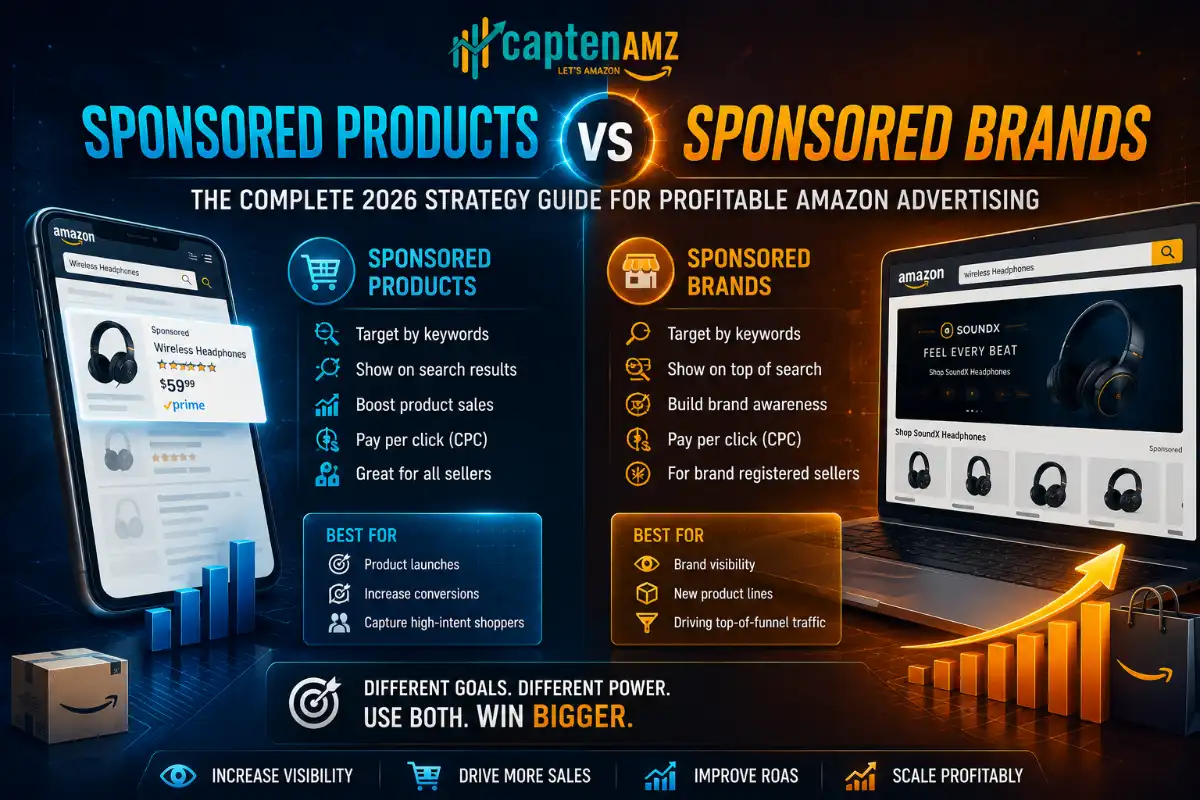
Sponsored Products are the most widely used Amazon ad format, accounting for roughly 80 percent of all Amazon ad spend across the platform. They are keyword-targeted or ASIN-targeted ads that promote individual product listings. When a shopper searches for a product on Amazon, Sponsored Products ads appear directly inside the search results, blending with organic listings, and on product detail pages of related ASINs.
The critical insight: a shopper who clicks a Sponsored Product ad already knows what they are looking for. They are in purchase mode. That intent gap between browsing and buying is why Sponsored Products consistently deliver the highest conversion rates and the lowest ACoS of any Amazon ad format. It is the foundation of every Amazon PPC optimization strategy we build at CaptenAMZ.
Amazon Sponsored Brands (SB)
Sponsored Brands are banner-style ads that appear at the top of Amazon search results, above organic listings and above Sponsored Products ads. They feature your brand logo, a custom headline of up to 50 characters, and up to three products or a short auto-play video. Sponsored Brands require enrollment in Amazon Brand Registry and are available only to registered brand owners.
When a shopper sees a Sponsored Brands ad, they have typically just typed a category or product search query and are still in discovery mode — comparing options, forming preferences, not yet committed to a specific ASIN. That is a different buyer stage, and it requires a different creative strategy, a different budget expectation, and a different success metric than Sponsored Products.
There is also a third format — Sponsored Display — which targets shoppers based on behavior and audience data both on and off Amazon. For a complete breakdown of all three ad types together, see our Amazon PPC strategy guide for 2026.

Sponsored Products vs Sponsored Brands: 8 Key Differences That Determine Your Strategy
Sponsored Products SP
- Promotes individual product ASINs
- Appears inside search results + PDPs
- No Brand Registry required
- Bottom-funnel: captures existing demand
- Keyword + ASIN targeting
- Lower CPCs in most categories
- Higher direct conversion rates
- First ad type all sellers should launch
Sponsored Brands SB
- Promotes brand identity + multiple ASINs
- Appears above search results (premium)
- Brand Registry enrollment required
- Top/mid-funnel: builds awareness + NTB
- Keyword + product targeting
- Higher CPCs, premium placements
- Higher new-to-brand customer rate
- Layered on after SP is profitable
1. Placement and Visibility
Sponsored Products blend into organic search results and product detail pages. They are high-intent interceptions — appearing exactly when a shopper is ready to evaluate options. Sponsored Brands, by contrast, command the most premium real estate on Amazon: the banner position at the very top of the search results page, above every organic listing and above every Sponsored Products ad. The visibility is unmatched, but the shopper intent at that moment is less defined. Understanding this difference is the core of knowing how to run Amazon PPC campaigns profitably in 2026.
2. Brand Registry Requirement
Sponsored Products are available to any seller with a Professional selling plan, Buy Box eligibility, and ASINs in eligible categories. You do not need to be brand-registered to run them. Sponsored Brands require active Amazon Brand Registry enrollment. If you are not yet brand-registered, your advertising roadmap must start with Sponsored Products. Our Amazon PPC consultation service covers exactly how to structure your advertising roadmap based on your current registration status and catalog maturity.
3. Creative Format and Customization
Sponsored Products use your existing listing data automatically: your main product image, title, price, and review count. There is no custom creative. Sponsored Brands offer creative control: your logo, a custom headline, a choice of products to feature, and three format options — Product Collection, Store Spotlight, and Sponsored Brands Video. In 2026, Sponsored Brands Video has become the dominant format, with video ads delivering on average 1.6 times higher CTR than static Sponsored Brands headline ads and around 1.3 times higher conversion rates.
4. Targeting Options
Both ad types support keyword targeting across Broad, Phrase, and Exact match types, as well as product/ASIN targeting. However, they differ in available targeting layers. Sponsored Products support automatic campaigns, where Amazon’s algorithm matches your ad to relevant searches automatically — this is your most powerful keyword discovery mechanism. Sponsored Brands do not support automatic targeting, requiring all campaigns to be built on manual keyword or product targeting from the start. Understanding Amazon exact match vs broad match is essential to structuring both ad types efficiently.
5. CPC Behavior and Cost Efficiency
Sponsored Products generally deliver lower cost-per-click than Sponsored Brands for comparable keywords, because the shopper intent signal is more specific and the bidding environment, while competitive, is less saturated with brand-level competition. Sponsored Brands CPCs have risen 22 to 31 percent in the past 12 months in competitive categories, driven by brands aggressively defending their branded search terms. This rise makes structured budget allocation — not equal splitting — essential. Our Amazon PPC audit service identifies exactly where CPC inefficiency is costing your account by ad type and keyword cluster.
6. ROAS and Performance Attribution
Sponsored Products typically deliver higher direct ROAS than Sponsored Brands, which leads many sellers to undervalue or cut Sponsored Brands budget. This is a structural measurement error. Sponsored Brands ROAS should never be evaluated in isolation because it delivers significant halo effects: increased branded search volume, higher organic conversion rates from shoppers who saw your banner but clicked an organic result, and new-to-brand customer acquisition that compounds over time. The correct evaluation is multi-touch portfolio ROAS, not last-click direct ROAS per ad type.
7. New-to-Brand (NTB) Customer Acquisition
Sponsored Brands drives a dramatically higher new-to-brand customer rate than Sponsored Products. Across managed accounts in 2026, Sponsored Brands campaigns average approximately 38 percent NTB rate versus roughly 22 percent for Sponsored Products on comparable keywords. If your growth strategy involves acquiring new customers rather than just re-converting existing ones — which it must if you intend to build a sustainable brand on Amazon — Sponsored Brands is non-negotiable. This is especially true for sellers expanding into new markets, including UK and European Amazon marketplaces, where brand recognition is lower and NTB acquisition is the primary growth driver.
8. Brand Defense Value
If you are not running Sponsored Brands on your own brand name keywords, your competitors are. In 2026, aggressive ASIN conquesting and branded keyword bidding by competitors has made brand defense campaigns a revenue protection mechanism, not a vanity spend. Every time a shopper searches your brand name and sees a competitor’s ad above your organic result, you are paying a silent tax. Sponsored Brands campaigns on branded keywords typically deliver the highest ROAS in the entire account, often exceeding 8x, because the shopper is already looking for you. This is a core element of the Amazon PPC management strategy we apply for every brand-registered client.
When to Use Sponsored Products vs Sponsored Brands: The Decision Framework
The question is not “which one is better.” The question is “which one is right for my account stage and growth objective right now.” Here is the framework the CaptenAMZ PPC team uses during onboarding for new accounts, whether they are launching their first ASIN in New Jersey or scaling a 500-product catalog across the UK and Germany.
Stage 1: New Seller or New ASIN Launch — Start With Sponsored Products Only
When: You have fewer than 10 reviews, no conversion history, or are launching a new product. Your first job is to validate that your product converts at all, and to discover which keywords your shoppers actually use to find and buy it.
What to do: Launch Sponsored Products with an automatic targeting campaign alongside a broad match manual campaign. Run both for a minimum of two to three weeks and analyze your search term report before touching any Sponsored Brands. The auto campaign data becomes the foundation of every future manual and Sponsored Brands campaign you build. Without this data, Sponsored Brands keyword selection is guesswork — expensive guesswork.
Stage 2: Established SP Performance — Layer In Sponsored Brands
When: Your Sponsored Products campaigns have a stable ACoS at or below your break-even point, you have confirmed converting keywords, and you have at least 10 to 15 reviews on your product. You are brand-registered.
What to do: Add Sponsored Brands campaigns targeting your proven converting keyword clusters. Start with a branded defense campaign on your own brand name first — this costs almost nothing and protects the revenue you have already built. Then add a category keyword campaign and a competitor conquesting campaign. This is the sequencing framework used for every brand CaptenAMZ manages across USA and European marketplaces. See our full Amazon PPC strategy guide for how these campaign layers connect.
Stage 3: Scaling Phase — Optimize Both, Add Sponsored Brands Video
When: Both SP and SB campaigns are generating consistent, measurable returns. Your TACoS is trending downward as organic sales grow alongside paid traffic. You have a catalog of multiple products that can be cross-promoted.
What to do: Migrate your highest-performing Sponsored Brands campaigns to the video format (Sponsored Brands Video). Launch Store Spotlight campaigns to drive shoppers from search results directly to your Amazon Brand Store, increasing basket size and removing competitor ad placements from the experience. Use advanced Amazon PPC techniques like dayparting and placement bid adjustment across both SP and SB simultaneously. Review what a good ROAS looks like for Amazon PPC and set your portfolio-level targets accordingly.

How to Split Your Budget Between Sponsored Products and Sponsored Brands in 2026
Budget allocation is the most common question sellers ask when managing both ad types simultaneously. There is no universal percentage that works across all categories and account stages. However, there are data-backed ranges that serve as reliable starting points before your own performance data dictates the optimal split.
| Account Stage | Sponsored Products SP | Sponsored Brands SB | Sponsored Display SD |
|---|---|---|---|
| New seller / product launch | 90–100% | 0–10% | 0% |
| Growing brand (10–50 reviews, stable ACoS) | 65–75% | 20–30% | 0–10% |
| Established brand (100+ reviews, multiple SKUs) | 50–65% | 25–35% | 10–15% |
| Scaling / aggressive growth phase | 45–55% | 30–40% | 10–20% |
CaptenAMZ Budget Rule: Never split budgets evenly before you have conversion data. Start SP-heavy, build the data, then shift budget toward SB as you confirm your top-converting keywords, your brand defense gap, and your NTB growth targets. The budget table above is directional, not fixed. Revisit allocation monthly, not quarterly. In competitive categories across New York, Texas, and California where CPCs shift weekly, monthly rebalancing is non-negotiable.
The minimum viable monthly budget to run meaningful campaigns across both SP and SB is roughly $2,000 to $3,000 total, split with at least $1,500 to $2,000 going to Sponsored Products and $500 to $1,000 going to Sponsored Brands. At lower total budgets, stay with Sponsored Products only until conversion performance validates an expansion. Our Amazon PPC consultation service helps sellers identify the right budget architecture for their specific category and margins.
How to Measure Sponsored Products vs Sponsored Brands Performance Correctly
One of the most expensive mistakes sellers make is applying the same success metric to both ad types. They compare Sponsored Products ROAS against Sponsored Brands ROAS, see that SP “wins,” and cut SB budget — destroying the very awareness funnel that was quietly driving new customers and protecting organic rankings.
Here is the correct measurement framework:
Metrics That Matter for Sponsored Products
- ACoS (Advertising Cost of Sales) — your primary efficiency metric. Target varies by margin, but most categories aim for 15 to 30 percent. Learn what a good ACoS target looks like for your category
- TACoS (Total Advertising Cost of Sales) — the real profitability indicator. Tracks ad spend against total revenue including organic sales. TACoS should trend downward over time as organic rank builds
- Conversion Rate (CVR) — if CVR drops below 8 to 10 percent on a product with healthy traffic, the problem is your listing, not your campaign. Fix the listing first
- ROAS (Return on Ad Spend) — use 14-day or 30-day rolling ROAS, never single-day snapshots, to evaluate campaign health
- Search Term Report efficiency — the ratio of converting search terms to total search terms shows how well your match type architecture is filtering irrelevant traffic
Metrics That Matter for Sponsored Brands
- New-to-Brand (NTB) rate — the percentage of orders from customers who have not purchased from your brand on Amazon in the past 12 months. Healthy SB NTB rate: 35 to 50 percent
- Branded search lift — monitor weekly branded keyword search volume in Brand Analytics. SB campaigns should produce a measurable increase in shoppers searching your brand name organically
- Store visit rate and basket size — if you are running SB to your Brand Store, measure how many products per order shoppers purchase. Healthy stores produce 1.5 to 2.5 items per basket
- Portfolio ROAS — not just SB ROAS. Measure total account ROAS before and after SB activation to capture halo effects that last-click attribution misses
- Brand impression share — how visible your brand is across your category’s top keywords. Rising impression share with flat SP spend indicates SB is doing its awareness job correctly
If you are not tracking these separately, your performance data is misleading your decisions. Our Amazon PPC audit rebuilds your reporting architecture so that every dollar of ad spend is accounted for correctly, by ad type, by keyword cluster, and by funnel stage.
What Changed in Amazon Advertising in 2026 That Affects Your SP vs SB Strategy
Rufus AI Is Reshaping Which Ads Get Shown
Amazon’s Rufus AI now interprets shopper queries based on intent, not just keyword presence. This has direct implications for both SP and SB targeting. Keyword strategies that relied on exact phrase matching alone are underperforming in categories where Rufus is active, because the algorithm is now matching ads to conversational queries that may not contain your exact target term. Building an Amazon PPC strategy in 2026 means accounting for Rufus AI’s influence at every campaign layer, not just for broad match campaigns.
Sponsored Brands Video Is Now the Default Format
As of Q1 2026, Sponsored Brands Video accounts for the majority of total SB spend across most well-managed accounts. Static SB headline ads still serve a function for category keyword exploration and desktop placements, but SBV outperforms static on CTR and conversion rate across virtually every competitive category. If your Sponsored Brands campaigns are still running static creative from 2024, you are leaving measurable performance improvement on the table. Video creative for SBV should be refreshed every 60 to 90 days to prevent ad fatigue in competitive niches.
Branded Keyword CPCs Have Surged
Branded search CPCs jumped 22 to 31 percent in the 12 months leading into mid-2026, as competitors in every category aggressively bid on rival brand names. This means brand defense via Sponsored Brands is no longer optional for any brand-registered seller. If you are not running SB campaigns on your own brand keywords, you are silently funding competitor traffic at your expense. The Amazon PPC optimization process at CaptenAMZ always includes a branded keyword audit as step one before any other campaign restructuring.
NTB Attribution Now Available at SKU Level
Amazon expanded Sponsored Brands attribution to include new-to-brand metrics by individual SKU, not just by campaign. This makes it possible, for the first time, to identify exactly which products are driving the most new customer acquisition through SB campaigns and to reallocate creative and budget accordingly. Sellers who are not yet using SKU-level NTB data are allocating SB budgets based on incomplete information.
7 Costly Mistakes Sellers Make With Sponsored Products and Sponsored Brands
- Running Sponsored Brands before Sponsored Products is profitable. SB amplifies what SP has already validated. It cannot compensate for a product that does not convert, a listing that does not close, or keywords that have not been proven by SP data
- Measuring SB success with direct ROAS alone. Sponsored Brands drives halo effects, branded search lift, and NTB acquisition that last-click attribution never captures. Cutting SB because its standalone ROAS looks lower than SP is one of the most expensive mistakes a seller can make
- Ignoring branded keyword defense. If you are not running SB on your own brand name, competitors are buying that traffic. This is especially critical for sellers in competitive categories across New York, Texas, and California, where ASIN conquesting campaigns are aggressive
- Using generic landing pages for Sponsored Brands. Sending SB traffic to your Amazon Store’s homepage instead of a campaign-specific page or product selection results in a 35 to 55 percent conversion gap in most categories. Match the landing destination to the search intent of the campaign
- Never refreshing Sponsored Brands Video creative. SBV creative that has been running for more than three months sees significant CTR and CVR degradation due to ad fatigue. Refresh video assets every 60 to 90 days, especially in beauty, fitness, and home categories
- Stacking SP and SB on identical keyword lists without negative keyword firewalls. Without separating keyword pools and installing negative keyword architecture, SP and SB campaigns cannibalize each other’s impressions, inflate your internal CPCs, and corrupt performance data. Our Amazon negative keywords guide covers the exact architecture needed to prevent this
- Treating SP and SB as independent rather than integrated. The most profitable Amazon advertising accounts in 2026 are those where SP generates conversion data that feeds SB keyword selection, SB awareness campaigns drive branded search volume that lowers SP CPCs on branded terms, and both ad types are managed against unified TACoS and portfolio ROAS targets. Siloed management of the two formats guarantees underperformance in at least one
How CaptenAMZ Manages Sponsored Products and Sponsored Brands Together for USA and UK Brands
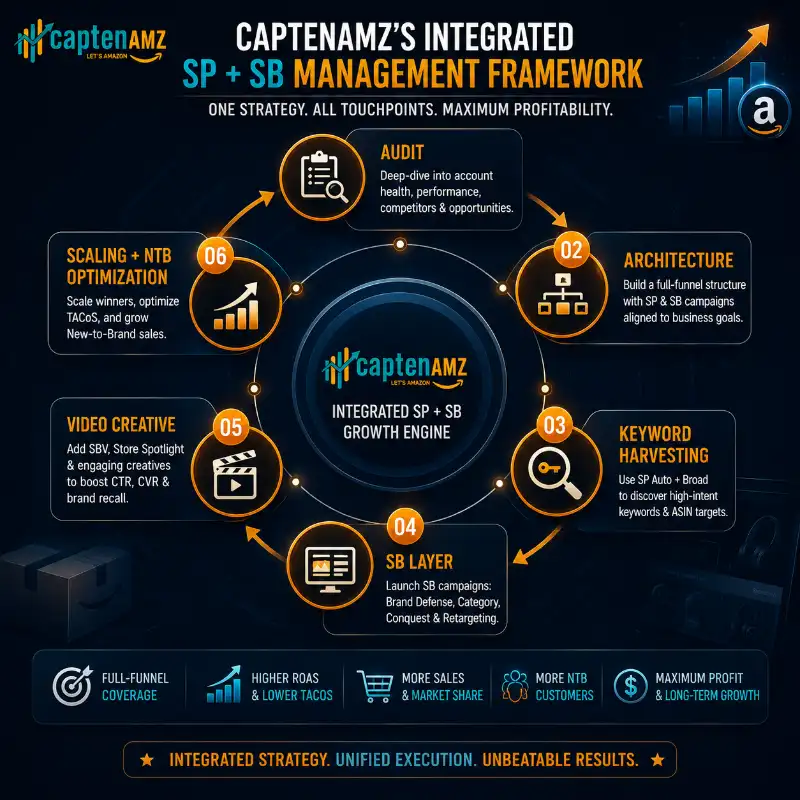
At CaptenAMZ, we do not manage Sponsored Products and Sponsored Brands as separate campaigns managed by separate teams. They are managed as a single integrated advertising system, where every decision in one ad type is informed by the data flowing from the other.
Every account engagement starts with a full Amazon PPC audit that diagnoses the current state of both SP and SB performance, identifies which keywords are driving profitable conversions, where branded keyword gaps exist, and how much revenue is being lost to competitor conquesting. We audit TACoS, not just ACoS, because TACoS is the only metric that shows whether advertising is building sustainable organic growth or just buying short-term visibility.
Once the audit is complete, we rebuild campaign architecture from the ground up, applying the three-layer SP structure — exact match converters, phrase match expansion, broad match discovery — alongside a four-campaign SB architecture: branded defense, category exploration, competitor conquest, and seasonal or promotional campaigns.
For clients in high-competition markets including New Jersey, New York City, Texas, California, and across the UK and EU, we apply region-specific bid adjustments and dayparting windows calibrated to when your buyers in those markets are most actively purchasing. A supplement brand in California does not have the same peak conversion hours as a home goods seller in London, and our Amazon PPC management service accounts for that at the campaign level.
We also integrate listing quality into every PPC decision. A Sponsored Products campaign running against a listing with a weak main image, thin bullets, or poor conversion rate is not a campaign problem — it is a listing problem dressed up as a PPC problem. Our teams coordinate directly with our Amazon listing optimization specialists and Amazon A+ Content team to ensure every listing is conversion-ready before ad spend is increased. You can see real examples of this integrated approach in our lighting brand case study ($1M/month in sales) and our supplement brand case study (6x ROI in three months).
Frequently Asked Questions: Amazon Sponsored Products vs Sponsored Brands
Should I use Sponsored Products or Sponsored Brands first?
Always start with Sponsored Products. SP validates that your product converts, generates the search term data you need to build effective Sponsored Brands campaigns, and delivers the most direct return on initial ad spend. Launch Sponsored Brands only after your SP campaigns have produced stable, profitable conversion data and you have confirmed your top-performing keywords. Without that foundation, SB keyword selection is guesswork.
Do I need Amazon Brand Registry to run Sponsored Brands ads?
Yes. Sponsored Brands require active Amazon Brand Registry enrollment. Sellers who are not yet brand-registered can only run Sponsored Products and Sponsored Display campaigns. If you sell on Amazon and are not yet registered, applying for Brand Registry is one of the highest-leverage steps you can take — it unlocks Sponsored Brands, A+ Content, the Amazon Brand Store, and Brand Analytics, all of which directly improve both organic ranking and advertising performance.
Which ad type has a better ROAS — Sponsored Products or Sponsored Brands?
Sponsored Products typically shows higher direct ROAS because it targets high-intent shoppers who are ready to buy. However, comparing SP and SB on direct ROAS alone is a measurement error. Sponsored Brands drives significant halo effects — branded search volume lift, new-to-brand customer acquisition, and organic conversion rate improvements — that last-click attribution never captures. The correct approach is portfolio-level ROAS that accounts for all of these downstream effects, not a head-to-head direct ROAS comparison.
What is a good budget split between Sponsored Products and Sponsored Brands?
For most growing brands with 10 to 100 reviews and stable SP performance, a starting split of 65 to 75 percent Sponsored Products and 20 to 30 percent Sponsored Brands is a reasonable baseline. Established brands with large catalogs typically shift toward 50 to 55 percent SP and 30 to 40 percent SB as brand awareness investment grows. New sellers should allocate 90 to 100 percent to Sponsored Products until they have confirmed conversion data. These are directional ranges, not fixed rules. Monthly rebalancing based on actual performance data is essential.
Can I run the same keywords in both Sponsored Products and Sponsored Brands campaigns?
Yes, and for most accounts you should — both ad types together maximize your visibility across the full search results page, appearing at the top (SB) and within results (SP) simultaneously. However, running the same keywords across both ad types without negative keyword firewalls creates internal cannibalization, where SP and SB campaigns compete against each other in the same auction, inflating your CPC and corrupting performance data. Proper negative keyword architecture across both ad types is essential to prevent this.
Is Sponsored Brands Video worth the investment in 2026?
Yes. In 2026, Sponsored Brands Video is the highest-performing SB format across most competitive categories, delivering approximately 1.6 times higher CTR and 1.3 times higher CVR compared to static Sponsored Brands headline ads. Video creative should be 15 to 30 seconds, with the product visible in the first three seconds, a clear benefit-led hook, and no reliance on audio since most Amazon shoppers browse with sound off. SBV creative should be refreshed every 60 to 90 days to prevent ad fatigue in competitive niches.
Does CaptenAMZ manage both Sponsored Products and Sponsored Brands for sellers in the UK and Europe?
Yes. CaptenAMZ manages Amazon Sponsored Products, Sponsored Brands, and Sponsored Display campaigns across all major marketplaces, including the USA, UK, Germany, France, and other EU markets. Based in Trenton, New Jersey, our PPC team serves brands across the USA — including clients in NJ, NYC, Texas, and California — as well as UK and European Amazon marketplaces. We apply region-specific bidding, dayparting, and keyword strategy to account for differences in buyer behavior, peak shopping hours, and CPC competitiveness across markets. Contact us for a free PPC audit to see how your current campaigns compare.
Sponsored Products and Sponsored Brands: Two Ad Types, One Unified Growth System
Amazon Sponsored Products and Sponsored Brands are not competing choices — they are complementary tools that serve different stages of the buyer journey and different dimensions of your growth strategy. Getting the sequencing right, the budget split right, the measurement right, and the creative right is what separates Amazon brands that scale profitably from those that scale spend without scaling margins.
The sellers winning on Amazon in 2026 — across competitive markets in New York City, New Jersey, Texas, California, the United Kingdom, and Germany — are not running more ads. They are running smarter systems. Sponsored Products as the data-generating, conversion-capturing foundation. Sponsored Brands as the brand-building, customer-acquiring, and brand-defending layer on top. Both measured at the portfolio level, not in isolation.
If your current advertising strategy does not reflect this structure, the good news is that the fix is not complicated — it just requires the right audit, the right architecture, and the right expertise. That is exactly what the CaptenAMZ Amazon PPC management team delivers for brands across the USA and Europe, starting with a no-obligation Amazon PPC audit that maps every gap in your current campaign structure.
To go deeper on specific elements of your PPC strategy, explore our related guides: our complete Amazon PPC strategy for 2026 covers the full campaign architecture framework, our Amazon exact match vs broad match guide breaks down keyword targeting in detail, our Amazon negative keywords guide covers how to prevent SP and SB cannibalization, and our Amazon ROAS benchmarks guide tells you exactly what performance you should be targeting by ad type and category.
For listings that are not converting despite well-structured campaigns — which makes all PPC investment less efficient — our Amazon listing optimization service and Amazon A+ Content and Brand Store service rebuild your product pages from the ground up for both organic ranking and conversion performance. The CaptenAMZ A+ Content optimization guide shows how A+ Content lift directly reduces your ACoS by raising the conversion rate that your ad spend has to work against.
CaptenAMZ is based in Trenton, New Jersey and manages Amazon PPC campaigns — including Sponsored Products, Sponsored Brands, and Sponsored Display — for brands across the United States, United Kingdom, and European Amazon marketplaces. If you are ready to stop guessing and start building a PPC system that actually compounds, contact our team today or book a free discovery call to get started. See us on LinkedIn & Instagram.
Ready to Build a Profitable SP + SB Strategy That Actually Scales?
CaptenAMZ’s Amazon PPC specialists manage Sponsored Products and Sponsored Brands as one unified growth system — for brands across the USA, UK, and Europe. Start with a free audit today.

Maria R. Donis is an Amazon eCommerce content specialist and digital marketing writer with hands-on experience creating data-driven, SEO-optimized content for Amazon-focused brands. She specializes in producing authoritative content around Amazon PPC management, catalog optimization, listing SEO, and marketplace growth strategies.
Maria collaborates closely with Amazon growth agencies like CaptenAMZ, ensuring that every piece of content reflects real Seller Central experience, platform-specific expertise, and up-to-date Amazon best practices. Her writing is guided by practical insights into how Amazon ads, search algorithms, and buyer behavior work in real-world scenarios.