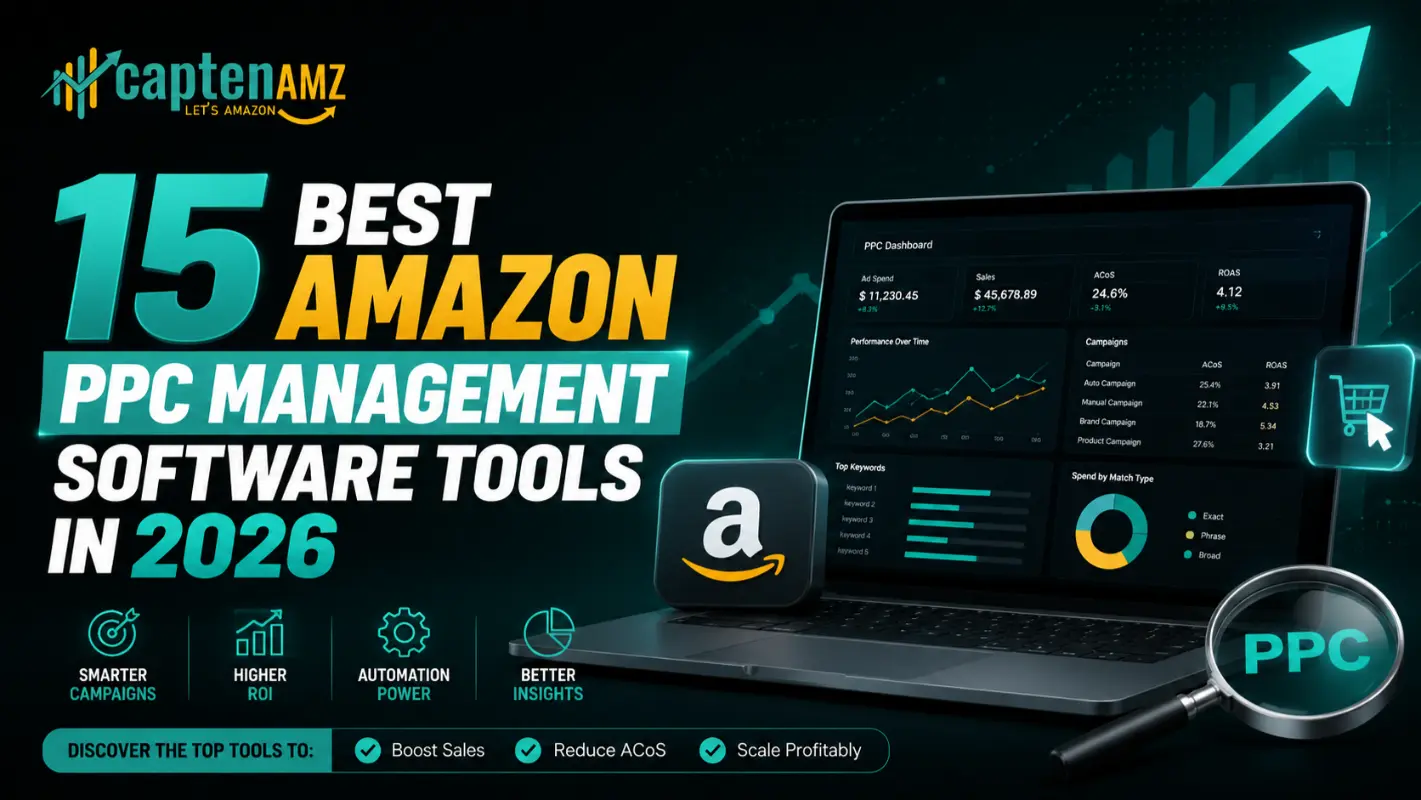
Amazon sellers spend an average of 12-15% of revenue on advertising, and a growing share of that spend is now steered by software instead of a human clicking through Campaign Manager. Searches for Best amazon ppc management software tools are rising because sellers want a faster answer to one question: which tool actually protects ad spend without babysitting it every day?
This guide compares 15 of the leading Amazon PPC campaign management software platforms on the market in 2026 — what each one automates, who it fits, and where it typically falls short. It also covers the question most software reviews skip: what happens when the bidding is perfect but the listing, category, or catalog underneath it is broken. That’s the gap where Amazon PPC management from a hands-on agency tends to outperform software running alone.
What Is Amazon PPC Management Software?
Amazon PPC management software is a third-party platform that connects to your Seller Central or Vendor Central account through Amazon’s Advertising API. Instead of manually adjusting bids inside Campaign Manager, the software automates:
- Bid adjustments based on ACoS, ROAS, or profit targets
- Keyword and search-term harvesting from customer search reports
- Budget pacing and dayparting across Sponsored Products, Sponsored Brands, and Sponsored Display
- Negative keyword and negative ASIN discovery
- Cross-campaign reporting, often layered with Amazon Marketing Cloud (AMC) data
Some tools are purely rule-based (you set the logic, the software executes it). Others use machine learning to predict bid changes. A newer category sometimes called “retail-aware” software also factors in inventory, pricing, and margin data, not just ad metrics. Understanding what a good ACoS target actually looks like and how ROAS differs from ACoS matters before choosing any tool, because the software only optimizes toward the target you give it.
Software, Agency, or Both? A Quick Decision Framework
Before comparing tools, it helps to know which category of help actually fits your situation:
- You have a clean catalog, stable listings, and just want bid mechanics automated → software alone can work.
- You’re losing sales to suppressed listings, category errors, or weak content alongside PPC waste → software cannot fix that. You need Amazon catalog management and listing optimization running in parallel with advertising.
- You want strategic decisions made for you, not just bids adjusted → an Amazon PPC consultation or full PPC audit will tell you which gap is actually costing you money before you pay for any software subscription.
With that framework in mind, here’s how the market’s leading tools stack up.
The 15 Best Amazon PPC Management Software Tools in 2026
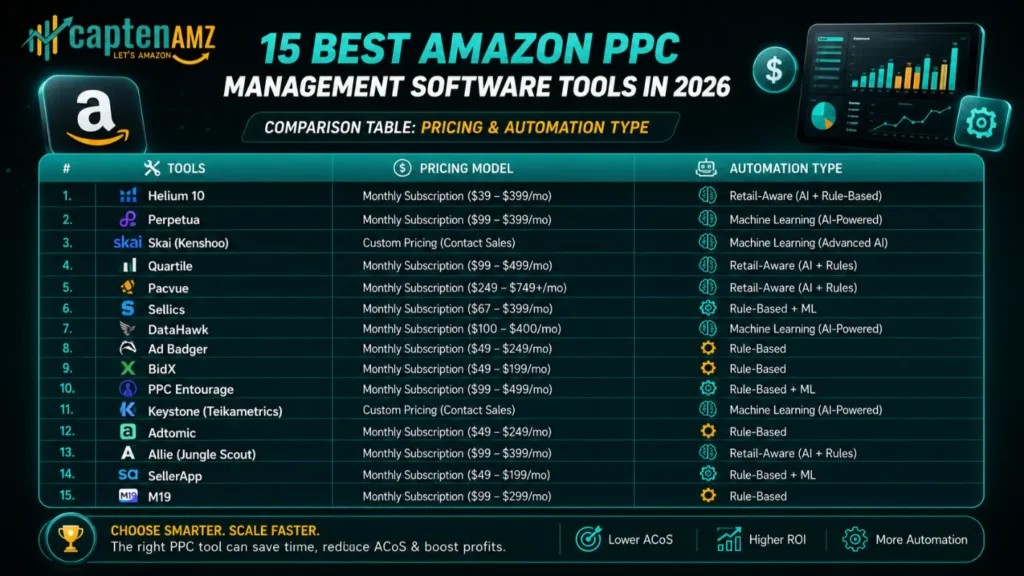
1. Perpetua — Best for Hands-Off Machine-Learning Bidding
One of the most established names in amazon ppc automation software, Perpetua uses ML bid engines across Sponsored Products, Brands, and Display, with keyword harvesting set to fully automated, conversion-gated, or manual-approval modes. Pricing typically starts around $695+/month. Best for: established brands wanting minimal manual intervention.
2. Pacvue — Best for Enterprise & Multi-Retailer Agencies
Pacvue serves teams managing advertising across Amazon and other retail media networks at once, starting near $500+/month, with strong dashboards and rules-based automation. It’s often overkill for single-marketplace sellers. Best for: agencies and enterprise brands running Amazon plus other retailers.
3. Quartile — Best for Enterprise Hourly Bid Automation
Quartile adjusts bids on an hourly basis using patented algorithms, starting around $895+/month — one of the pricier options here, reflecting its enterprise focus. Best for: large catalogs where hourly bid precision meaningfully moves the ACoS needle.
4. Teikametrics — Best Budget-Friendly ML Bidding
Teikametrics offers ML bid optimization from around $149+/month, making it one of the more accessible amazon ppc automation software picks for growing brands that still want machine-learning bidding over static rules.
5. Helium 10 Adtomic — Best for Sellers Already in the Helium 10 Ecosystem
Bundled inside Helium 10’s Diamond plan (roughly $229/month), Adtomic gives sellers rules-based PPC management alongside keyword research and listing tools they may already use. Best for: sellers who want PPC handled inside a broader Amazon toolset. Pairing its keyword harvests with proper Amazon keyword research still matters — software finds keywords, but it doesn’t judge brand fit.
6. atom11 — Best Retail-Aware Automation
atom11 pulls in inventory, pricing, and profitability signals — not just ad data — before adjusting bids and budgets, with a Root Cause Analyzer flagging why performance shifted. Best for: FBA sellers burned by software that overspends on out-of-stock or low-margin SKUs.
7. Profasee Marko — Best for Margin-Coordinated PPC
Priced around $399/month, Marko coordinates bidding with real-time pricing and inventory data instead of treating advertising as an isolated data stream — answering a question most best amazon ppc management software lists skip: does the tool know your margins before it spends?
8. SellerStack — Best Flat-Fee, Transparent Rule Engine
SellerStack runs on a flat fee (around $239/month) instead of a percentage of spend, with editable, readable rules rather than a black box, plus Amazon Marketing Cloud and profit-level reporting. Best for: sellers who want to see every rule the software runs and spend enough ($8,000+/month) that flat-fee beats percentage-of-spend.
9. AdBrew — Best for Amazon + Walmart Multi-Marketplace Reporting
AdBrew handles Sponsored Ads automation across Amazon and Walmart, with Amazon Marketing Cloud reporting and digital shelf analytics built in. Best for: agencies and brands managing more than one marketplace who want unified reporting.
10. Sellozo — Best Flat-Fee Option With a Visual Campaign Builder
Sellozo runs flat-fee (roughly $149-$299/month depending on SKU count and marketplace), with a drag-and-drop Campaign Studio, bid automation, dayparting, and a bundled repricer. Best for: sellers wanting predictable costs and a visual way to map campaign structure.
11-15. Also Worth Shortlisting
Rounding out the top 15: Ad Badger pairs rule-based bid and dayparting automation with human PPC oversight for a visible audit trail on every change. Trellis connects bid automation to content and pricing intelligence, useful for testing how listing changes affect ad efficiency. Intentwise leans analytics-first, popular with agencies that want custom dashboards over a vendor’s default view. Zon.Tools is typically the lowest-cost rules-based entry point for sellers testing automation for the first time. Ryze AI is a newer AI-assisted workflow tool worth a cautious trial, given its still-limited independent user feedback.
Best Amazon PPC Management Software for FBA Sellers
FBA sellers face a problem pure ad-data tools can’t see: a campaign can look great the moment a SKU goes out of stock or hits a storage limit. That’s why the best amazon ppc management software for fba sellers in 2025 and 2026 tends to be retail-aware rather than purely ad-metric driven — atom11 and Profasee Marko lead here by connecting inventory and pricing signals directly to bid decisions, while SellerStack’s Inventory Protection addresses the same gap flat-fee. If your bigger issue is variation errors, flat-file conflicts, or suppressed ASINs, that’s a catalog management and FBA management problem no PPC software solves alone.
Best Amazon PPC Management Software for USA, UK & European Sellers
Multi-marketplace support is where most comparison articles go quiet, but it matters if you sell across the USA, the UK, and Europe at once. Check before subscribing:
- Marketplace coverage: confirm Amazon.de, Amazon.fr, Amazon.it, and Amazon.es are included, not just Amazon.co.uk and Amazon.com.
- Currency and VAT-aware reporting: ACoS and TACoS should reflect local currency and VAT, not a USD-converted approximation.
- Timezone-based dayparting: bid schedules built for EST won’t translate cleanly to GMT or CET peak hours.
- Support hours: enterprise tools built around US hours can leave UK and EU managers without live support when it matters.
Brands running PPC across New York, Seattle, the UK, and Germany often find a locally aware Amazon PPC agency in New York, Seattle, the UK, or Germany closes this gap faster than software alone, since a human account manager reconciles nuances a single dashboard tends to flatten.
Key Features to Look For in Amazon PPC Management Software
Whichever platform you’re evaluating, run it through this checklist first:
- Automation depth — does it just adjust bids, or also handle budget pacing, keyword harvesting, and negative discovery?
- Transparency — can you see and edit the actual rule logic, or is it a black box?
- Retail-awareness — does it factor in inventory, margin, and pricing, or only ad-platform data?
- Pricing model — flat-fee vs. percentage-of-spend changes the math significantly once you’re spending $8,000+/month.
- Multi-marketplace support — critical if you sell in the USA, UK, and EU simultaneously.
- Reporting depth — does it connect to Amazon Marketing Cloud, or stop at standard campaign metrics?
- Support model — self-serve dashboard only, or access to a human account manager when something breaks?
The Software Gap: Why Tools Alone Don’t Fix Amazon PPC Performance
Every tool above is genuinely good at its job: adjusting bids and budgets faster than a person clicking through Campaign Manager. But none of them fix the reasons PPC often underperforms in the first place:
- A suppressed or miscategorized listing sends paid clicks to a page that can’t convert.
- A weak product title or image set caps click-through no matter how well the bid is tuned — this is where Amazon product title strategy and stronger A+ Content directly affect the ROI of every dollar the software spends.
- Flat-file or variation errors can silently suppress the exact ASIN your campaign is driving traffic to.
- Poor keyword-to-category alignment means even perfect bid automation optimizes toward the wrong searches — see our guides to exact match vs broad match and negative keyword strategy.
This is the software gap, and it’s why our best Amazon PPC agencies in the USA roundup and our AI tools vs. human Amazon PPC experts breakdown reach the same conclusion: automation software is a tool a strategist uses, not a replacement for one.
How CaptenAMZ Combines Automation With Human Strategy
CaptenAMZ doesn’t sell PPC software — we run the strategy, catalog health, and account oversight that determines whether any automation tool pays off. Our PPC management team layers PPC optimization and structured PPC audits on top of execution, while our catalog management and listing optimization teams fix what software can’t see.
The results speak for themselves:
- A lighting brand scaled to $12 million in annual sales through combined catalog and PPC work.
- A supplement brand achieved a 6x ROI increase in three months.
- A toy brand cut ACoS by 39% while growing ROI by 131%.
- A clothing brand stabilized ACoS at 27% and TACoS at 13% through structured spend control.
- Multiple EU accounts saw measurable gains in our European PPC case study.
Browse the full library of PPC case studies and catalog case studies to see the same approach across categories. Prefer a conversation to a software trial? An Amazon PPC consultation is a lower-risk way to find out what’s actually holding your account back.
Frequently Asked Questions
What is Amazon PPC management software?
A third-party platform connected to Seller Central or Vendor Central via Amazon’s Advertising API that automates bid changes, keyword harvesting, budget pacing, and reporting across Sponsored Products, Brands, and Display.
What is the best Amazon PPC management software?
There’s no universal winner. Perpetua and Quartile lead in ML-driven bidding, Pacvue and AdBrew lead for enterprise reporting, and SellerStack and Sellozo lead for flat-fee, transparent automation. Fit depends on ad spend, catalog size, and whether you need retail-aware signals.
Is Amazon PPC automation software worth it for small sellers?
Below roughly $3,000-$5,000/month in ad spend, percentage-of-spend tools can cost more than they save. A flat-fee tool or a managed service tends to make more sense at that stage.
Can PPC software replace an Amazon PPC agency? “
No. Software automates bid mechanics but can’t fix a weak listing, a suppressed ASIN, or a flawed campaign structure — that layer still needs a human or an agency.
What is the best Amazon PPC management software for FBA sellers in 2026?
Retail-aware tools like atom11 and Profasee Marko, which factor in inventory and margin data, generally outperform pure ad-metric tools for FBA sellers managing restock cycles and storage limits.
Does Amazon PPC management software work for UK and European sellers?
Most enterprise tools cover UK and EU marketplaces, but currency handling and timezone-based dayparting vary by vendor — confirm this before subscribing, especially across the UK and continental Europe.
The Bottom Line
Amazon PPC management software has genuinely gotten better in 2026 — ML bidding, retail-aware automation, and flat-fee transparency are real improvements over manually adjusting bids in Campaign Manager. But every tool here shares the same ceiling: it can only optimize the account you hand it. If the catalog underneath is broken or the strategy driving the bids is unclear, no automation will out-earn the waste. See us on LinkedIn & Instagram.
Book a free discovery call with CaptenAMZ, and we’ll walk through your PPC and catalog data together — no software trial required — so you know exactly where the next ad dollar should go.

Maria R. Donis is an Amazon eCommerce content specialist and digital marketing writer with hands-on experience creating data-driven, SEO-optimized content for Amazon-focused brands. She specializes in producing authoritative content around Amazon PPC management, catalog optimization, listing SEO, and marketplace growth strategies.
Maria collaborates closely with Amazon growth agencies like CaptenAMZ, ensuring that every piece of content reflects real Seller Central experience, platform-specific expertise, and up-to-date Amazon best practices. Her writing is guided by practical insights into how Amazon ads, search algorithms, and buyer behavior work in real-world scenarios.