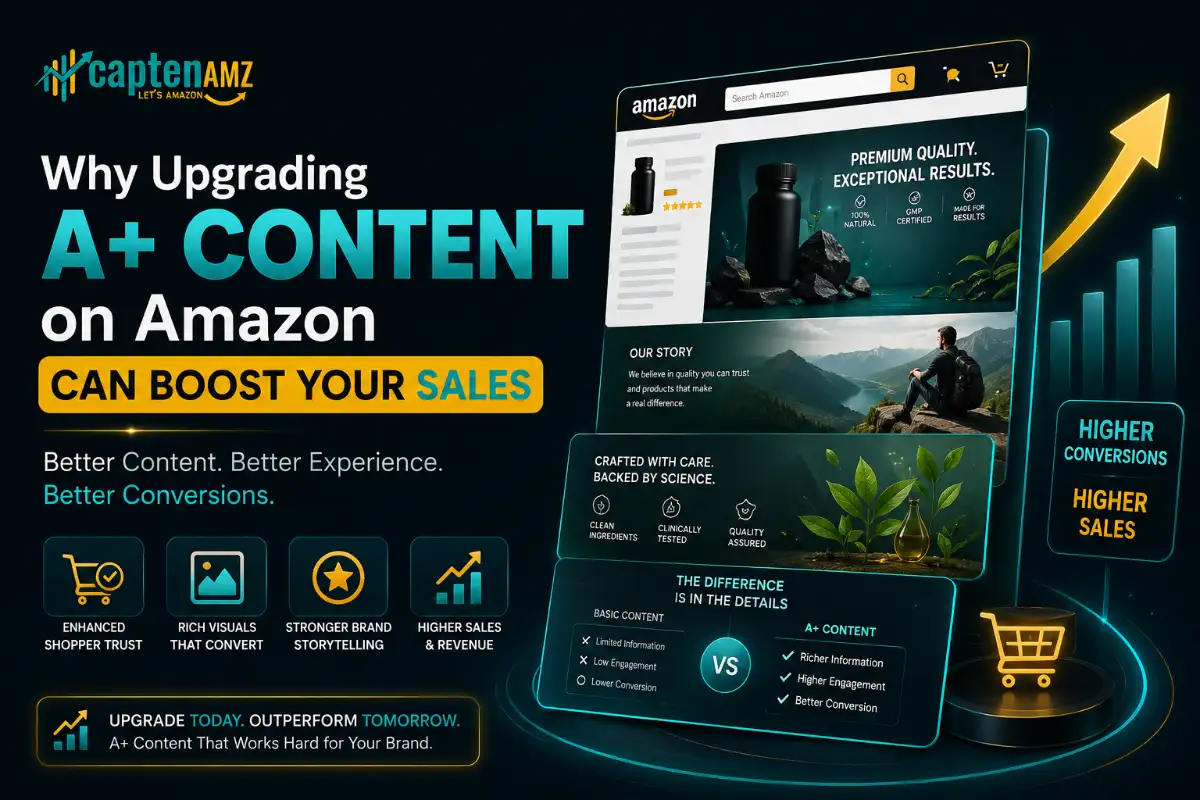
Every Amazon seller wants more sales. Most chase that goal by increasing ad spend, tweaking bids, or chasing the lowest price. But there is a high-converting lever sitting right on your product page that the majority of sellers either ignore or seriously underuse and it costs nothing extra to activate.
That lever is Amazon A+ Content and when it is properly optimized, it does not just make your listing look polished. It closes sales. It removes doubt. It answers the questions your buyer is silently asking before they decide whether to trust you with their money or scroll to the next result.
This guide is built specifically for Amazon sellers and brand owners competing in the USA including New Jersey, New York City, Texas, and California as well as UK and European markets, where listing quality is increasingly the deciding factor between a conversion and a lost sale. Whether you are running aggressive Sponsored Products campaigns, scaling a private label catalog, or managing an established brand on Amazon, your A+ Content is either working for you or working against you. There is no neutral ground.
The data is unambiguous. Strategically structured Enhanced Brand Content can lift conversion rates by 10 to 30 percent without a single dollar of additional ad spend, without changing your price, and without touching your PPC campaigns. The same product. The same traffic. A dramatically different outcome driven entirely by what happens on the page after the click.
At CaptenAMZ, we have seen this play out across hundreds of accounts across competitive US and global marketplaces. Sellers who treat A+ Content as a decorative afterthought are quietly subsidizing the conversions of sellers who treat it as the strategic sales tool it actually is. This guide breaks down every layer of Amazon A+ Content optimization to boost sales from module structure and mobile performance to keyword strategy, Premium A+ eligibility, and the direct connection between your listing content and your PPC efficiency. By the end, you will know exactly what needs to change on your product page, and why fixing it is the highest-ROI move you can make right now.
What Is Amazon A+ Content And Why Most Sellers Are Getting It Wrong
Amazon A+ Content (formerly Enhanced Brand Content or EBC) is the visual and informational section that appears below the bullet points and Buy Box on your product detail page. It lets brand-registered sellers add high-quality imagery, formatted text, comparison charts, lifestyle visuals, and brand storytelling modules.
Here is the problem: the majority of Amazon sellers either leave this section empty, use basic templates, or fill it with generic stock images and duplicate copy from their bullets. That approach is not just neutral it actively costs you conversions.
At CaptenAMZ, we see this every week across accounts in competitive US and UK marketplaces. Sellers with perfectly structured PPC campaigns lose sales at the listing level because their A+ Content fails to close the deal.
Explore our Amazon A+ Content & Brand Store Services to see exactly how we fix this for brands.

The Real Role of A+ Content in Your Sales Funnel
Think of your Amazon listing as a layered sales conversation:
- Main image → Earns the click
- Title → Qualifies the shopper
- Bullet points → Builds initial confidence
- A+ Content → Closes the sale
By the time a shopper reaches your A+ section, they are already interested. They have not bounced. They are evaluating whether to trust you enough to buy. This is the most conversion-sensitive moment in their journey — and your A+ Content is either sealing the deal or leaking it.
Amazon’s own data indicates that strategically optimized A+ Content can increase conversion rates by up to 10–30%. Sellers who implement structured, benefit-led, objection-handling A+ pages consistently see measurable lifts in reven often without changing a single thing about their PPC campaigns or pricing.
That is not a coincidence. That is content doing the job of a trained salesperson, 24 hours a day, 7 days a week.
Our Amazon Listing Optimization service works in tandem with A+ Content to ensure the entire listing funnel is aligned and conversion-ready.
Amazon A+ Content Optimization to Boost Sales: 7 Proven Strategies
1. Lead With Buyer Pain Points, Not Product Features
One of the biggest mistakes we see — especially from sellers in competitive categories like health, fitness, home goods, and electronics — is leading their A+ Content with generic product features.
Buyers do not buy features. They buy solutions to problems.
Your opening A+ module should immediately speak to the shopper’s core concern. If you are selling a knee brace, do not open with “Premium neoprene construction.” Open with “End the guesswork about your knee support.” When your content mirrors what the buyer is feeling, trust forms instantly.
This is part of the buyer psychology framework we apply to every project at our Amazon Brand Management Services practice.
2. Structure Your Modules to Mirror the Decision-Making Journey
A+ Content is not a brochure. It is a structured decision support tool. Each module should serve a specific purpose in moving the buyer from interest to purchase:
- Module 1 — Hook: Address the core problem or aspiration
- Module 2 — Proof: Use lifestyle imagery showing the product in real-world use
- Module 3 — Features with Benefits: Explain what it does AND why it matters to them
- Module 4 — Objection Handling: Answer the 3 most common reasons buyers hesitate
- Module 5 — Comparison Chart: Show why your product wins vs. alternatives
- Module 6 — Brand Trust: Tell your brand story in 2–3 sentences
- Module 7 — Final CTA Alignment: Reinforce the value and prompt the decision
This exact framework is how our team at CaptenAMZ structures A+ Content for brands selling in the USA, NJ, NYC, TX, California, UK, and European markets. Learn more about our full-service approach on our Amazon A+ Content Services page.
3. Use Comparison Charts to Defeat Competitor Listings Without Mentioning Them
The comparison chart module is one of the most underused and highest-converting elements in the entire A+ toolkit. Brands that add structured comparison tables — comparing their product line, sizes, variants, or feature tiers — see meaningful lifts in both conversion rate and cross-sell performance.
This works for two reasons. First, it keeps the shopper on YOUR listing rather than sending them to evaluate competitor products. Second, it builds the perception of authority — brands that clearly know their product space earn trust faster.
Our Amazon Catalog Management service is specifically designed to ensure your comparison architecture is built cleanly across your full ASIN catalog.
4. Optimize Every Image for Mobile — Or Lose Half Your Buyers
More than 60% of Amazon shoppers in the US, UK, and Europe now browse and purchase via mobile devices. This is not a future trend — it is the current reality of the marketplace.
Standard A+ modules are auto-reformatted by Amazon for mobile viewing, but that does not mean they are optimized for mobile. Text that is legible at desktop resolution becomes unreadable at 375px. Images with complex infographic overlays lose their hierarchy on a small screen.
Best practices for mobile-optimized A+ Content:
- Keep text overlays to a maximum of 6–8 words per line
- Use vertically stacked, single-column module layouts for complex information
- Ensure CTA-like phrases are large enough to read on a 5-inch screen
- Preview every module in Amazon’s mobile simulator before submitting
This is a technical discipline, not a creative one — and it directly impacts your conversion rate in every geography you sell in.
Our Amazon Listing Optimization & SEO service includes mobile-first content reviews to protect your performance on all devices.
5. Embed Keyword Strategy in Alt Text and Module Headers
Here is a dimension of Amazon A+ Content optimization that most sellers completely overlook: while the body text of A+ modules is not directly indexed by Amazon’s A9/A10 algorithm for keyword ranking, there are two places where keyword strategy absolutely matters.
Alt text on images: Amazon does index image alt text. Adding one or two carefully chosen keywords to each image’s alt text improves both Amazon indexing and Google visibility — since Google also crawls A+ Content on product pages.
Module headers (H2/H3 equivalent text): Headers within A+ modules carry structural SEO weight. Integrating natural-language versions of your focus keyword — such as “Amazon A+ Content optimization to boost sales” or “Enhanced Brand Content strategy” — in these headers reinforces your topical relevance.
This is part of the integrated Amazon SEO and listing strategy we deploy at CaptenAMZ across accounts in competitive US and UK markets.
6. Use Premium A+ Content If You Qualify — The Conversion Gap Is Real
Premium A+ Content (previously known as A++ Content) is available to sellers who have published a Brand Story module and meet certain eligibility thresholds. For brands that qualify, the conversion advantage is significant.
Premium A+ unlocks:
- Interactive hotspot modules — Highlight specific product features on hover
- Video integration — Embed product demonstration videos directly in the page
- Image carousels — Let shoppers swipe through multiple lifestyle angles
- Enhanced comparison charts — With richer visual formatting
- Large banner modules — For immersive brand storytelling
A 20–30 second product demonstration video inside Premium A+ Content can do more for buyer confidence than any combination of static images. Shoppers who cannot physically touch or test your product rely on visual authenticity — and video delivers that in a way text and images simply cannot.
If you are selling in the USA, NJ, NYC, TX, or California markets where category competition is at its fiercest, Premium A+ is not optional — it is your competitive necessity. Our team at CaptenAMZ handles the full design and submission process for Premium A+ through our A+ Content & Brand Store service.
7. Treat A+ Content as a Living Asset — Not a One-Time Upload
This is perhaps the most strategic insight in this entire guide: your A+ Content should be reviewed, tested, and refreshed regularly — not set once and forgotten.
Amazon’s marketplace shifts constantly. Customer language evolves. Your product reviews reveal new objections. Seasonal events like Prime Day, Black Friday, and Q4 create opportunities to align your A+ messaging with buyer intent patterns.
Brands that proactively update their A+ Content — particularly heading into high-traffic events — consistently maintain conversion rates that passive sellers cannot match.
This ongoing optimization mindset is exactly why CaptenAMZ focuses on long-term partnerships rather than one-time projects. Our Amazon PPC Management Agency and content teams work together to align listing performance with advertising performance — because when A+ Content converts better, your PPC ACoS drops naturally.

How A+ Content Directly Impacts Your Amazon PPC Performance
This connection is rarely discussed, but it is critical for sellers running paid advertising.
When a shopper clicks your Sponsored Product ad and lands on a high-converting product page, that conversion signals quality to Amazon’s algorithm. A higher conversion rate on paid traffic improves your listing’s organic ranking, improves your Quality Score in Amazon Advertising, and directly reduces your Advertising Cost of Sale (ACoS).
Inversely, if your A+ Content is weak and shoppers bounce after clicking your ads, you are paying for traffic that does not convert — a double loss of ad spend and missed sales velocity.
This is why at CaptenAMZ, we always align our Amazon PPC optimization strategy with our content and listing work. They are not separate functions — they are two sides of the same performance equation.
You can also learn more about our PPC Consultation Services to understand how advertising strategy and listing quality work together.
A+ Content and Your Amazon Brand Store: The Ecosystem Play
Your A+ Content does not operate in isolation. For brands that have built an Amazon Brand Store, A+ Content and the storefront work together as a conversion ecosystem.
When shoppers click “Visit the [Brand Name] Store” from your product detail page, they land on your Amazon storefront — which should reinforce exactly the messaging, visual language, and product positioning you established in your A+ Content. Disjointed experiences kill conversions. Cohesive ones compound them.
Our team at CaptenAMZ designs both A+ Content and Amazon Brand Stores as integrated visual systems — not separate deliverables. This ensures that every touchpoint in the buyer journey — from search results to the product page to the brand store — tells a consistent, trust-building story.
Learn how we approach this end-to-end on our Amazon A+ Content & Brand Store service page, and explore how our Amazon Listing Creation & Flat File service ensures the foundational listing structure is built correctly before A+ is layered on top.
If you are newer to storefront setup, our detailed guide on How to Set Up a Successful Amazon Storefront walks through each step of the process.
A+ Content for Multi-Market Sellers: USA, UK, and European Considerations
If you sell across Amazon.com, Amazon.co.uk, Amazon.de, Amazon.fr, or other European marketplaces, your A+ Content strategy needs to account for regional differences.
Key multi-market A+ considerations:
- Language localization: A+ Content in German, French, or Italian markets must be fully translated — not machine-translated. Credibility collapses when copy feels foreign.
- Cultural visual preferences: UK and German buyers tend to respond to clean, information-dense layouts. US buyers typically respond to bold lifestyle imagery and emotional storytelling.
- Market-specific objections: Product concerns differ by region. Reviews in each marketplace reveal different objection patterns that your A+ should address locally.
- Compliance differences: Some claims acceptable on Amazon.com are restricted on Amazon.co.uk and European marketplaces, particularly in health, supplement, and beauty categories.
CaptenAMZ works with brands selling across USA, NJ, NYC, TX, California, UK, and European markets. Our Amazon PPC Audit service also identifies cross-market content performance gaps that affect advertising efficiency.
Common A+ Content Mistakes That Are Costing You Sales Right Now
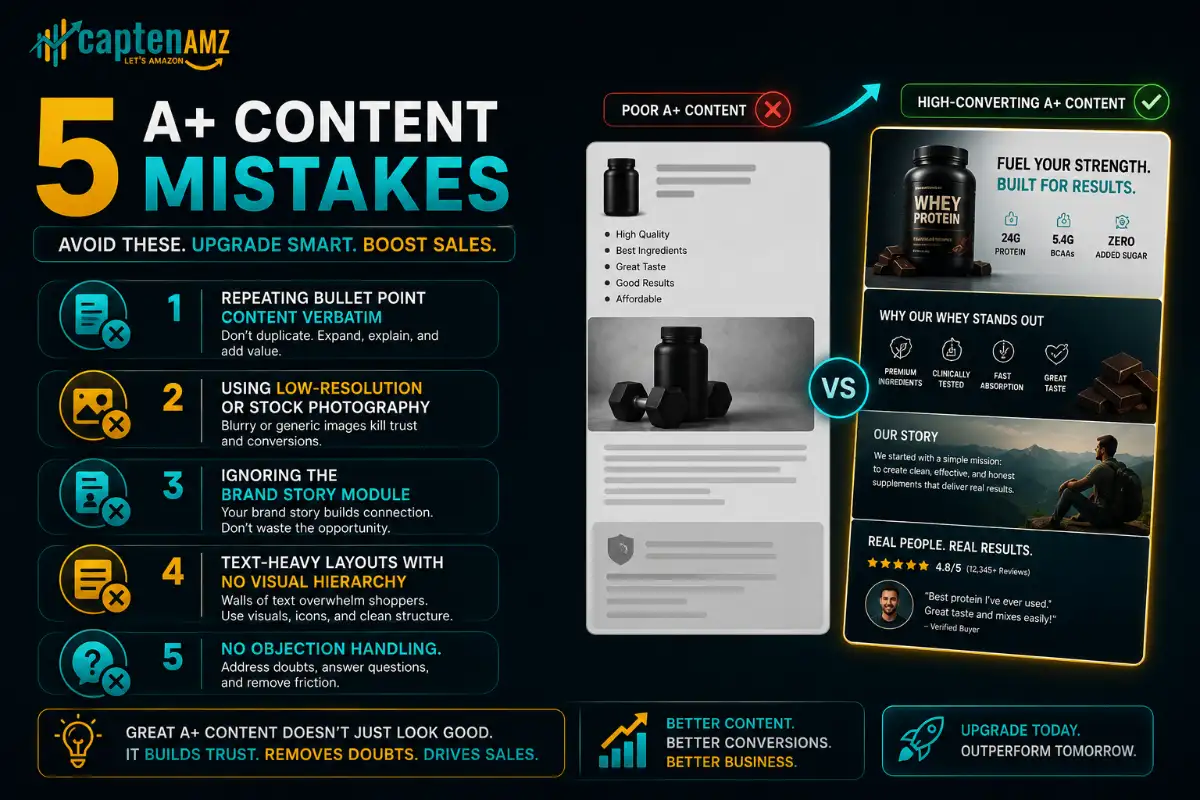
1. Repeating bullet point content verbatim. A+ Content should expand on and visually demonstrate what bullets summarize — not repeat them word-for-word.
2. Using low-resolution or stock photography. Shoppers interpret visual quality as a proxy for product quality. Blurry or generic images signal low trust instantly.
3. Ignoring the Brand Story module. The Brand Story module appears across all your ASINs and directly contributes to Premium A+ eligibility. Leaving it blank is leaving potential on the table.
4. Text-heavy layouts with no visual hierarchy. Dense paragraphs in A+ Content are ignored. Structure information with clear visual hierarchy — short headers, icons, and benefit-led micro-copy.
5. No objection handling. If your product has a common concern — price, size, durability, compatibility — and your A+ Content does not address it, you are allowing doubt to win.
For a technical deep-dive into how listings and catalog data quality support A+ performance, explore our guide on Amazon Brand Management Services.
How CaptenAMZ Approaches A+ Content Optimization for Brands in the USA & UK
At CaptenAMZ, Amazon A+ Content optimization is not a design service — it is a conversion strategy. Every project begins with:
- Competitive audit — We analyze top-performing competitor A+ Content in your category across Amazon.com and Amazon.co.uk
- Review mining — We extract the most common buyer questions and objections from your and your competitors’ reviews
- Keyword alignment — We identify which LSI and long-tail keywords belong in headers and alt text
- Module architecture — We plan each module’s purpose before a single image is designed
- Mobile preview validation — Every module is previewed and adjusted for mobile rendering before submission
- Storefront alignment — We ensure the visual language matches your Amazon Brand Store
This is the same disciplined framework we apply to Amazon PPC campaign management — data first, execution second.
Whether you are a growing seller in New Jersey, an established brand scaling in Texas or California, or a UK/European seller expanding into the US market, our process is built to deliver measurable conversion improvements — not just prettier pages.
Explore our PPC Case Studies and Catalog Case Studies to see the kind of results this integrated approach produces.
Frequently Asked Questions About Amazon A+ Content Optimization
Q: Does A+ Content directly improve Amazon search ranking?
The body text of A+ modules is not indexed for keyword ranking by Amazon’s algorithm. However, image alt text is indexed, and higher conversion rates (driven by strong A+ Content) do positively influence organic ranking signals.
Q: How often should I update my A+ Content?
We recommend reviewing A+ Content at least quarterly, and specifically ahead of major sales events like Prime Day and Q4. If you launch a new product variant or rebrand, update immediately.
Q: Is Premium A+ Content worth the investment?
For established brands in competitive categories, yes emphatically. The interactive modules, video integration, and expanded visual canvas measurably improve dwell time and conversion rates.
Q: Can I use the same A+ Content across multiple ASINs?
Module layouts can be reused, but text, imagery, and messaging should be customized per ASIN to reflect each product’s specific value proposition and target buyer.
Q: How does A+ Content affect my Amazon PPC results?
Higher converting listings improve ad efficiency. When paid traffic converts better, your ACoS improves naturally making every advertising dollar work harder. Read our guide on How to Optimize Amazon PPC Campaigns for a full breakdown.
Conclusion: Your A+ Content Is Either Winning Sales or Losing Them There Is No Middle Ground
Every day your A+ Content section is weak, generic, or missing, you are funding competitor sales. Shoppers who reach the bottom of your listing and do not find a compelling, trust-building, objection-resolving visual experience will bounce and Amazon’s algorithm will notice.
The good news is that Amazon A+ Content optimization to boost sales is one of the highest-ROI improvements any seller can make. No additional ad spend. No price changes. No new inventory. Just a smarter, more strategic use of the conversion real estate Amazon already gives you for free.
At CaptenAMZ, we have helped brands across USA, NJ, NYC, TX, California, UK, and European markets turn underperforming listings into high-converting sales assets — by treating A+ Content as the strategic tool it truly is. See us on LinkedIn & Instagram.
Ready to upgrade your A+ Content and start converting at a higher rate?
Book a Free Strategy Call with CaptenAMZ — and let’s audit your current listings, identify the conversion leaks, and build a content strategy that makes your listing do the selling for you.

Maria R. Donis is an Amazon eCommerce content specialist and digital marketing writer with hands-on experience creating data-driven, SEO-optimized content for Amazon-focused brands. She specializes in producing authoritative content around Amazon PPC management, catalog optimization, listing SEO, and marketplace growth strategies.
Maria collaborates closely with Amazon growth agencies like CaptenAMZ, ensuring that every piece of content reflects real Seller Central experience, platform-specific expertise, and up-to-date Amazon best practices. Her writing is guided by practical insights into how Amazon ads, search algorithms, and buyer behavior work in real-world scenarios.