An Amazon Brand Store is the one place on Amazon where shoppers see your products, your story and your brand with no competitor ad sitting beside it. Most stores are built once, never measured and quietly forgotten. The wrong Amazon storefront design agency makes that worse: you pay for polished banners, get a layout that breaks on phones, and learn six months later that nobody set up tracking.
This guide shows you how to choose an Amazon storefront design agency without guessing. You get a weighted scorecard, a DIY vs freelancer vs agency comparison, the factors that drive cost, red flags, twelve questions for the first call, a realistic timeline and the metrics that prove the store is working.
Quick answer: The right Amazon storefront design agency shows live Brand Stores (not mockups), plans structure before visuals, designs mobile-first, knows Amazon’s review rules, connects the store to your listings and ads, reports on Store Insights data and hands over every file you paid for. Score each candidate on those eight points before you sign.
What Does an Amazon Storefront Design Agency Do?
An Amazon storefront design agency plans, designs and publishes your Amazon Brand Store, the multi-page branded destination available to sellers enrolled in Amazon Brand Registry. Building in Amazon’s Store Builder is free, so you are not paying for the tool. You are paying for the thinking and craft around it. (Do not confuse it with an influencer storefront, which is a different Amazon program.)
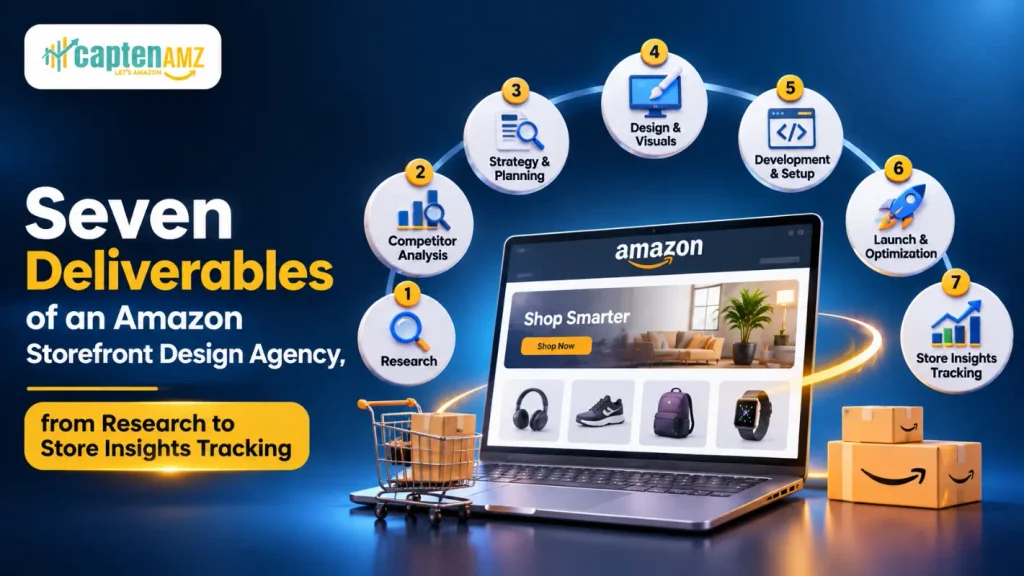
A complete project should include:
- Research: brand guidelines, best sellers, shopper behavior and competitor stores.
- Structure: page hierarchy, navigation and product groupings that follow how customers shop, not how your spreadsheet is organized.
- Mobile-first layouts: readable text, clear images and sections that stack logically on a phone.
- Visuals and copy: hero banners, lifestyle imagery and short benefit-led text in one consistent brand voice.
- Interactive modules: shoppable images, video and product grids used with purpose.
- Publishing and approval: building in Store Builder, submitting for Amazon’s review and handling resubmissions.
- Tracking and updates: Store Insights setup, reporting and seasonal refreshes.
A store should never live alone. It has to match your listing images, your A+ Content and the creative running through Sponsored Brands campaigns. To see how this works as a service, read what our Amazon Brand Store design service includes, or use the DIY storefront setup guide if you plan to build in-house.
Why Your Storefront Matters More in 2027
Shoppers rarely land in a store by accident. They arrive from a branded search, a Sponsored Brands ad, a social post or an email, and the next ten seconds decide whether they buy one item or three.
- Ad traffic needs a landing page. Sending Sponsored Brands clicks to a well-structured store keeps the shopper inside your brand. Compare Sponsored Products vs Sponsored Brands before deciding which store pages to build first.
- Off-Amazon traffic needs a home. Creator, social and email traffic can be tagged and tracked. Our breakdown of off-Amazon creator placements shows why measuring it matters.
- AI shopping assistants reward clarity. Consistent naming, clean categories and accurate content make your brand easier to interpret, part of how Rufus and sponsored prompts are reshaping discovery.
- Bigger baskets protect profit. A store that turns ad clicks into multi-item orders improves the revenue side of TACoS vs ACoS.
One warning most agencies skip: a storefront pulls from your catalog. If variations are broken or duplicates exist, the store showcases broken products. Fix the foundation first with proper Amazon catalog management, clean variation listings and a plan to fix duplicate Amazon listings. Strong Amazon listing optimization should come before store polish.
DIY vs Freelancer vs Amazon Storefront Design Agency
| Option | Strategy depth | Design consistency | Speed | Main risk | Best fit |
|---|---|---|---|---|---|
| DIY in Store Builder | Depends on you | Basic | Depends on your time | Weak structure and visuals | Small catalog, tight budget |
| Freelancer | Usually limited | Varies widely | Often fast | Uneven quality, little follow-up | Simple, clean store |
| Storefront design agency | Strong when chosen well | Consistent | Planned timeline | Quality varies between agencies | Growing brands, large catalogs, ad-driven brands |
DIY works for a small range and strong design instincts. A freelancer suits a simple catalog. An agency makes sense when the store must support advertising, a large catalog or a premium position. For the same decision on the ads side, see our guide to Amazon PPC consultant vs agency.
The 8-Point Scorecard for Choosing an Amazon Storefront Design Agency
Score every candidate from 1 to 5 on each criterion, convert the score to a share of its weight (a 4 on a 15 point criterion earns 12 points) and add up the results. Anything under 70 out of 100 is a pass.
| # | Criterion | What good looks like | Weight |
|---|---|---|---|
| 1 | Live store portfolio | Real stores that are easy to shop on mobile | 15 |
| 2 | Strategy before design | Research and structure before visuals | 15 |
| 3 | Mobile-first proof | Phone layouts shown at every review stage | 15 |
| 4 | Catalog, listing and ad alignment | Store matches listings, A+ Content and ads | 15 |
| 5 | Amazon rules and approval | Knows content rules and handles resubmissions | 10 |
| 6 | Measurement | Store Insights reporting and an improvement plan | 15 |
| 7 | Deliverables and timelines | Pages, assets, revisions and dates in writing | 10 |
| 8 | File and access ownership | You own the files, access is by permission | 5 |
1. Live store portfolio (15). Ask for links to live Brand Stores, then open them on your phone. Mockups hide problems that live stores expose, from slow modules to confusing navigation.
2. Strategy before design (15). A strong agency asks about goals, best sellers, margins and customers before opening a design tool. If the first deliverable is a banner, expect decoration.
3. Mobile-first proof (15). Many shoppers browse on phones, so insist on mobile and desktop designs side by side at every review.
4. Catalog, listing and ad alignment (15). Store visuals should echo your product title formula, your listing images and your ad creative. Keep the 75 character title limit in mind when naming products in store modules. Creative gaps also inflate spend, which is why ACoS issues often start with bad creatives.
5. Amazon rules and approval (10). Every store is reviewed before it goes live. Ask how the agency avoids claims and imagery that trigger rejection and who handles resubmissions. Policy awareness also protects the wider account, as covered in our guide to Amazon seller account protection.
6. Measurement (15). The agency should name the Store Insights metrics it will track and how often it reports. Pair that with your Amazon PPC management data so store and ad performance are read together.
7. Deliverables and timelines (10). Get page count, assets, revision rounds and dates in writing. Vague scopes become extra invoices.
8. File and access ownership (5). You should own final designs, images and source files, and the agency should work through user permissions, never your main login. Not sure where your listings stand today? Run the free Amazon Listing Score Calculator before you brief anyone.
What Drives the Cost of Storefront Design?
Quotes vary widely because scope varies widely, so a fair price depends on what is included. Pricing models you will meet include per page, full store package, redesign and monthly upkeep. Compare quotes line by line against these cost drivers:
- Number of pages and size of the catalog
- New photography, video or copywriting versus using your existing assets
- Strength of your brand guidelines
- Shoppable and interactive features
- Number of marketplaces and languages
- Rush delivery
Store design also competes with ad budgets, so read our guide to Amazon advertising cost before you split spend, then contact our team for a scoped recommendation.
8 Red Flags to Avoid
- Templates sold as custom work. If portfolio stores look nearly identical, yours will too.
- Desktop-only mockups. Phone layouts are where weak work shows.
- Heavy stock imagery. Generic visuals weaken brand trust.
- Vague revision limits. Unclear terms lead to surprise charges.
- No talk of data. An agency that never mentions Store Insights is selling design, not results.
- Nothing after launch. Stores go stale fast without updates.
- Guaranteed sales increases. Results depend on traffic, pricing, reviews and products.
- Requests for your main login. Access should run through user permissions, as set out in our Amazon seller account management approach.
12 Questions to Ask Before You Hire
- Can you share links to live Brand Stores you have built?
- Have you worked with brands in my category?
- What does your process look like from research to launch?
- Will I see mobile designs at every stage?
- How many pages, revisions and assets does the price include?
- Do you create new images, video and copy, or use mine?
- How do you handle Amazon’s review if the store is rejected?
- How will you align the store with my listings, A+ Content and ads?
- What will you track after launch and how will you report it?
- Who owns the final designs and source files?
- What support do you offer for launches and seasonal updates?
- Which marketplaces can you adapt the store for?
If you are comparing agency types more broadly, our guide to the best full-service Amazon agency in 2027 shows what complete coverage looks like.
Design Process and Timeline
- Discovery: brand guidelines, goals, catalog, customers and competitor stores.
- Structure: page map, navigation and product groupings for your approval.
- Design: mobile and desktop layouts, banners, copy and product sections.
- Revisions: feedback within the agreed rounds.
- Publishing and approval: build in Store Builder, submit to Amazon and resubmit if changes are requested.
- Optimization: performance review and updates based on data.
A multi-page store built on existing assets often takes a few weeks. New photography, video or a large catalog takes longer, so ask for dated milestones. Plan launches ahead of peak season, as our Amazon Q4 inventory planning guide explains.
How to Measure Storefront Success After Launch
Store Insights shows how shoppers use your store. Track visitors, page views, attributed sales and units, sales per visitor, traffic sources and engagement by page. Then build a routine:
- Review performance monthly and flag weak pages.
- Refresh for Prime Day, Black Friday and the holiday season.
- Add new products and collections as they launch.
- Update visuals and layout once or twice a year.
- Remove out-of-stock or discontinued products quickly.
When store sales per visit are weak while ad spend is high, read how to lower ACoS on Amazon and book an Amazon PPC audit. Keep your Amazon SEO fundamentals strong too, because search traffic feeds the store.
How CaptenAMZ Approaches Storefront Projects
CaptenAMZ is an Amazon PPC and catalog agency based in Trenton, New Jersey, serving brands across the USA, UK and Europe. We have scaled 200+ brands, generated $50M+ in client sales, cut ACoS by 38% on average and solved 500+ catalog cases. Our Beyond Average framework fixes listings and ads together, and we bring the same logic to store design: structure first, creative second, measurement always.
Those results come from PPC and catalog work rather than storefront-only projects, and they matter because a store only performs when the catalog beneath it is clean and the ads feeding it are efficient. Browse our case studies, the PPC case studies, the catalog case studies and the lighting brand scaling story. Read what clients say and meet the team on our about us page.
Scaling brands can start with our Amazon agency for 7 and 8 figure brands. US teams can compare the best Amazon PPC agencies in the USA or our New York page. UK and EU sellers can see Amazon PPC management for UK brands and our Germany page. For ongoing brand support, read about Amazon brand management services.
Frequently Asked Questions
What does an Amazon storefront design agency do?
It plans, designs and publishes your Amazon Brand Store. That covers research, structure and navigation, mobile-first layouts, brand visuals and copy, shoppable modules, submission for Amazon’s review and post-launch tracking in Store Insights.
Do I need Brand Registry to build an Amazon storefront?
Yes. A Brand Store requires enrollment in Amazon Brand Registry. Brand Registry also unlocks tools such as A+ Content and Sponsored Brands ads, so complete it before any design work starts.
How long does it take to design an Amazon storefront?
A multi-page store built on existing assets often takes a few weeks, including revisions and Amazon’s review. New photography, video or a large catalog extends the timeline, so request a dated plan in writing.
Is a freelancer or an agency better for storefront design?
A freelancer can suit a small catalog that needs a simple, clean store. An agency is usually better for larger catalogs, ad-driven brands and teams that want strategy, mobile-first design, tracking and ongoing updates from one accountable partner.
How often should I update my Amazon storefront?
Review performance monthly, refresh for major sales events and seasons, add new products as they launch and update visuals and layout once or twice a year.
Does CaptenAMZ offer Amazon Brand Store design?
Yes. CaptenAMZ offers Amazon Brand Store design alongside catalog, listing and advertising work, so your store, listings and ads stay consistent. Book a free audit to scope your project.
Final Thoughts: Choose Proof, Process and Follow-Through
Choosing an Amazon storefront design agency comes down to three things: proof you can verify on live stores, a process that puts strategy before banners, and follow-through after launch. Use the scorecard to compare agencies on the same footing, ask the twelve questions, and walk away from templates, desktop-only designs and guaranteed results.
Your next three steps:
- Run the free Amazon Listing Score Calculator so your store is built on strong listings.
- Score your shortlist with the scorecard above.
- Book a free account audit and we will review your catalog, listings and ads together.
Need help beyond the store? Explore our Amazon A+ Content services, Amazon ads management, advertising consultant for USA brands and Amazon seller consulting services. One team, one plan, a store that sells. See us on LinkedIn & Instagram.