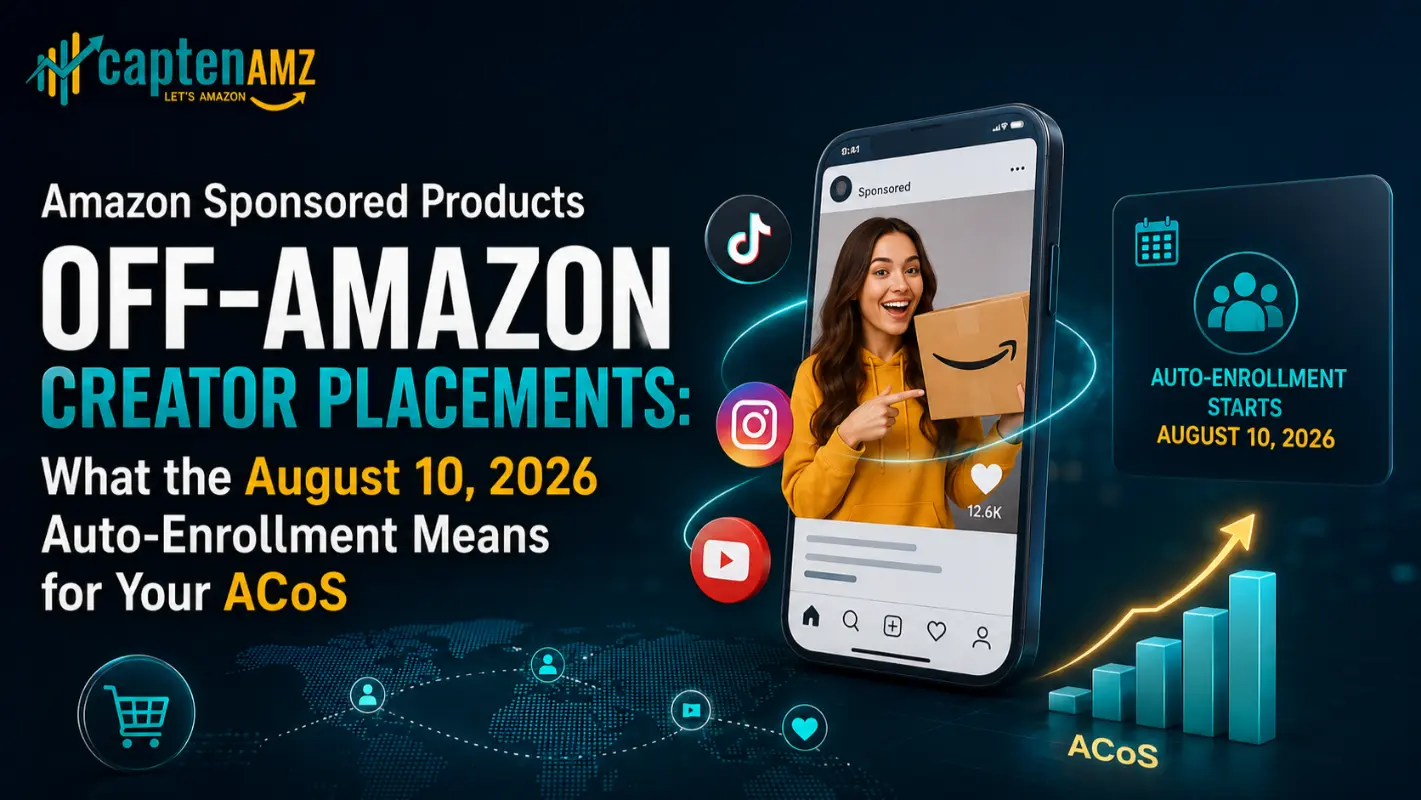
If you manage Sponsored Products campaigns in the United States, something changed in your account on August 10, 2026, and you were never asked for permission. Amazon Ads quietly extended Sponsored Products inventory to off-Amazon creator placements — ads served inside content published by creators in the Amazon Influencer Program, on reviews, buying guides, and editorial roundups that live off the Amazon domain entirely.
No opt-in screen appeared. No campaign paused. Every eligible campaign already running under the “Increase reach” setting was automatically enrolled at its existing bids and budgets the moment the clock struck August 10. Amazon updated its support documentation, ” Understanding Sponsored Products Off-Amazon Creator Placements 2026,” on August 4, 2026, and followed with an advertiser notice confirming the date. Most sellers found out from a placement report, not a notification.
Sponsored Products is the format most US advertisers depend on to move product, and it just gained an entirely new distribution surface with the bid logic your account was built around only partially carrying over. Here’s what changed, why it matters for your ACoS and attribution data, and the exact steps to audit it this week — the same framework we walk brands through inside our Amazon PPC audit process at CaptenAMZ.
What Exactly Changed on August 10, 2026
Before this update, off-Amazon Sponsored Products inventory meant premium publisher sites and apps — properties like Pinterest, BuzzFeed, and Ziff Davis brands, a program Amazon had run since 2023. The August 4 documentation revision added a new inventory class: creator content from the Amazon Influencer Program.
The mechanics, per Amazon’s support page, work like this:
- Amazon recommends advertised products to creators based on relevance and engagement history.
- Creators self-select which products to feature inside their reviews, buying guides, and editorial content.
- A shopper clicking that placement lands on the standard Amazon product detail page.
- The click bills against the same campaign budget, at the same maximum bid, as every other Sponsored Products click.

Two settings govern this at the campaign level, grouped under “Settings for ads served off Amazon.” The default is “Increase reach,” which lets the campaign serve across premium sites, apps, and now creator content. The alternative is “Limit off-Amazon spend,” which restricts delivery to Amazon’s own properties — with Amazon noting this may reduce impressions and sales opportunities. Because “Increase reach” is the default, doing nothing before August 10 was itself a decision that let creator placements start spending immediately.
Off-Amazon eligibility currently covers the United States, Canada, Brazil, Mexico, India, the Middle East, North Africa, Turkey, and select European Union countries. The United Kingdom is not on the current eligible list, so UK-only advertisers are unaffected by this specific rollout for now — a distinction worth flagging in any brand’s Amazon PPC management for UK brands strategy.
Why Amazon Made This Move Now
This didn’t happen in isolation. Amazon reported advertising services revenue of $19.8 billion for Q2 2026, up 26% year over year, with Sponsored Products named the company’s largest advertising offering. Any expansion of Sponsored Products’ supply side touches the line item doing the most work in that number.
It also follows a pattern of Amazon’s earlier social-commerce experiments falling short — Amazon Posts was fully shut down in mid-2025, and the short-form video surface Inspire has been called slow-moving. Routing Sponsored Products into the Influencer Program sidesteps that problem: instead of asking shoppers to visit a new Amazon-owned surface, the ad rides inside content that already has an audience.
For brands running Amazon ads management at scale, the strategic logic is sound. The rollout mechanics — automatic enrollment on six days’ notice — are what deserve a checklist.
Three Mechanics That Quietly Change What Your Data Means
The headline is “no action required.” The fine print is where the real work sits. Three mechanics matter more than the announcement itself.
1. Placement bid adjustments don’t carry over. Top of Search and Product Pages bid modifiers — the levers most accounts use to steer where budget concentrates — do not apply to off-Amazon creator placements. If your account leans on a heavy Top of Search adjustment while keeping a deliberately low base bid, that structure has no effect on this new inventory. Your base bid is the only thing creator placements see. Dynamic bidding strategies do still apply.
2. Search term reports now mix in synthetic data. Because creators select products rather than shoppers typing search queries, placement and search term reports for off-Amazon inventory can include Amazon-generated context that no real shopper ever searched. Feeding that data into automated bid rules or negative keyword harvesting without separating it out risks corrupting decisions that were previously built on clean, human search intent — a problem worth reviewing alongside your Amazon PPC campaign optimization workflow.
3. There is no account-level kill switch. “Limit off-Amazon spend” is a campaign-by-campaign restriction, not a global off button. Advertisers can exclude specific creators, but there is no single toggle that removes creator inventory outright across an entire account. Anyone telling a brand to “just turn it off everywhere” hasn’t read Amazon’s own documentation closely enough.
The Off-Amazon Ad Serving Bulksheet Column: How to Audit and Control It
Amazon actually gave advertisers a tool for this two months before the creator rollout landed. On June 8, 2026, US advertisers gained an “Off-Amazon ad serving” column inside Sponsored Products bulksheets, letting the setting be changed across dozens or hundreds of campaigns in a single upload instead of clicking through the console one campaign at a time.
Here’s the audit sequence worth running this week, adapted from our standard Amazon PPC audit checklist:
- Pull your current Sponsored Products bulksheet and locate the Off-Amazon ad serving column at the campaign level.
- Identify every campaign still on “Increase reach” — this is the default, so expect it to be most of your account unless someone already changed it.
- Segment by efficiency sensitivity. Campaigns with tight ROAS thresholds, thin margins, or heavy reliance on Top of Search modifiers are the strongest candidates for switching to “Limit off-Amazon spend” until performance history exists.
- Leave healthy, exploratory campaigns on “Increase reach” if the category suits mid-consideration content — gift categories, considered purchases, and products that benefit from explanation before comparison are plausible fits for creator-driven discovery.
- Bulk-upload the changes through the same bulksheet workflow used for standard bid and budget edits.
If you’re not confident running this audit internally, this is exactly the kind of account-wide check we build into every Amazon PPC consultation engagement — reviewing every campaign-level setting before it quietly reshapes your spend allocation.
The Risk of Ignoring the Update
The risk isn’t dramatic overnight overspend — it’s slow, quiet drift. Budget shifts into a placement type with no performance history, at bids priced for a completely different context (a high-intent Amazon search click versus a mid-article recommendation click). Blended ACoS won’t show the problem clearly, because off-Amazon volume will likely be small relative to on-Amazon search spend for most accounts in the first weeks. That’s precisely why it’s dangerous: the blended number looks fine while a subset of spend quietly underperforms.
There’s also an attribution question Amazon’s documentation doesn’t fully resolve. If a shopper discovers a product through creator content, clicks the Sponsored Products placement, and buys later, the advertiser sees a paid click and an attributed sale — but whether the creator earns anything additional through the Influencer Program’s standard commission structure isn’t clearly documented. Brands running influencer campaigns alongside Sponsored Products should flag this to whoever manages affiliate relationships, since double-crediting influence between two systems can distort what’s actually working.
Best Practice: A 30-60-90 Day Monitoring Framework
Rather than reacting once, build a recurring check into your account management cadence:
- Week 1 (Now): Run the bulksheet audit above. Set “Limit off-Amazon spend” on your most efficiency-sensitive campaigns.
- 30 Days: Pull the placement report and isolate off-Amazon creator delivery on its own — don’t judge it against blended ACoS. Compare new-to-brand metrics rather than pure efficiency, since creator content sits earlier in the consideration journey than a search query.
- 60 Days: Reassess which campaigns on “Increase reach” are actually generating incremental value versus simply spending. Exclude underperforming creators individually rather than restricting the whole campaign if only a handful of placements are the problem.
- 90 Days: Fold off-Amazon creator performance into your standing Amazon PPC optimization review alongside Top of Search, Product Pages, and standard on-Amazon placements, so it’s treated as a permanent line item rather than a one-time audit.

This kind of placement-level discipline is the same approach we apply across every account inside our Amazon PPC management agency services — nothing scales without a performance history proving it should.
What This Means for USA, UK, and European Sellers
For US-based advertisers, this is live now, automatic, and worth auditing this week regardless of account size — the bulksheet column has been available since June, so there’s no reason to manage this setting manually across a large catalog. Brands working with an Amazon advertising consultant in the USA should confirm this audit is already on their agency’s checklist.
For UK sellers, the country is not currently on Amazon’s eligible list, so no immediate action is required — but Amazon’s rollout pattern (documentation update, short notice, automatic enrollment) suggests UK eligibility is a matter of when, not if. Brands should confirm settings now rather than waiting for a similar six-day notice window later.
For European Union sellers, select EU countries are already included, and the Digital Markets Act now requires pricing transparency reporting that extends to offsite Sponsored Products placements — disclosing whether third-party publishers receive additional funds from Amazon beyond the standard auction clearing price. This matters for any brand managing spend across multiple EU marketplaces.
Whether the priority is catalog stability or advertising efficiency, both sides of the account need to move together — which is why we pair every PPC engagement with Amazon catalog management and Amazon listing optimization support, since a suppressed listing or a weak product page undermines even a perfectly tuned bid strategy.
How CaptenAMZ Helps You Navigate Sponsored Products Changes Like This
Amazon ships changes like this several times a year — off-Amazon placements first launched in 2023, the bulksheet toggle arrived in June 2026, and creator placements landed in August 2026. Each one arrives the same way: a documentation update, a short notice, and automatic enrollment at existing bids and budgets. Brands that treat every one as a fire drill burn hours they don’t have. Brands with a standing audit process barely notice.
At CaptenAMZ, we build that standing process into every account we manage — reviewing placement-level reporting, bid logic, and off-Amazon settings on a recurring cycle rather than only after something breaks. Our Amazon PPC services cover exactly this kind of settings-level monitoring, and our Amazon FBA management and Amazon seller account management teams work alongside advertising so catalog health and ad spend are never managed in silos.
If you want a second pair of eyes on your account before this quietly shifts your ACoS, book a free discovery call, contact our team directly, or explore our current special offer for a free PPC audit. You can also see how we’ve handled account-level shifts for clients in our PPC case studies, including a recent EU Sponsored Products case study and a clothing brand PPC scaling case study.
Frequently Asked Questions
Do I need to opt in to off-Amazon Sponsored Products creator placements?
No. Eligible campaigns already set to “Increase reach” were automatically enrolled on August 10, 2026, at existing bids and budgets. No opt-in action is required — which also means no action is required to keep spending on this inventory unless you change the setting yourself.
How do I turn off Sponsored Products creator placements?
There is no single account-wide switch. At the campaign level, under “Settings for ads served off Amazon,” select “Limit off-Amazon spend” instead of the default “Increase reach.” You can also exclude individual creators without restricting the whole campaign.
Will my Top of Search bid adjustment apply to creator placements?
No. Bid adjustments for Top of Search and Product Pages do not apply off-Amazon, including to creator content. Only your base bid and dynamic bidding strategies carry over to this inventory.
Is the UK included in this rollout?
Not currently. Eligible countries include the United States, Canada, Brazil, Mexico, India, the Middle East, North Africa, Turkey, and select EU countries. The UK is not on the current list.
Can I manage the off-Amazon setting in bulk?
Yes. Amazon added an “Off-Amazon ad serving” column to Sponsored Products bulksheets for US advertisers on June 8, 2026, letting the setting update across many campaigns in a single upload.
How will I know if creator placements are hurting my ACoS?
Isolate off-Amazon delivery in the placement report rather than judging it against blended ACoS, since it can hide inside a healthy target ACoS at the blended level. Weigh new-to-brand metrics and ROAS alongside efficiency, since creator content sits earlier in the shopper journey than a search query.
The Bottom Line
Amazon didn’t ask before enrolling your campaigns into off-Amazon creator placements, and it likely won’t ask before the next inventory expansion either. What’s defensible isn’t outrage — it’s a habit. Know what share of your spend sits on inventory you didn’t explicitly choose, check it on a schedule, and treat the bulksheet’s off-Amazon column as a permanent part of your account review rather than a one-time reaction to a headline. Accounts that already had a placement-report habit before August 10 barely felt this change; the rest are finding out from a blog post ten days late.
If your team doesn’t have that habit built in yet, that’s exactly where a dedicated Amazon PPC audit earns its keep. Explore more on Amazon PPC strategy in 2026, Amazon Sponsored Products vs Sponsored Brands, Amazon keyword research for PPC, and Amazon TACoS vs ACoS to round out your account’s defense against changes like this one.
Follow CaptenAMZ for more expert Amazon PPC Guides: LinkedIn | Instagram

Maria R. Donis is an Amazon eCommerce content specialist and digital marketing writer with hands-on experience creating data-driven, SEO-optimized content for Amazon-focused brands. She specializes in producing authoritative content around Amazon PPC management, catalog optimization, listing SEO, and marketplace growth strategies.
Maria collaborates closely with Amazon growth agencies like CaptenAMZ, ensuring that every piece of content reflects real Seller Central experience, platform-specific expertise, and up-to-date Amazon best practices. Her writing is guided by practical insights into how Amazon ads, search algorithms, and buyer behavior work in real-world scenarios.