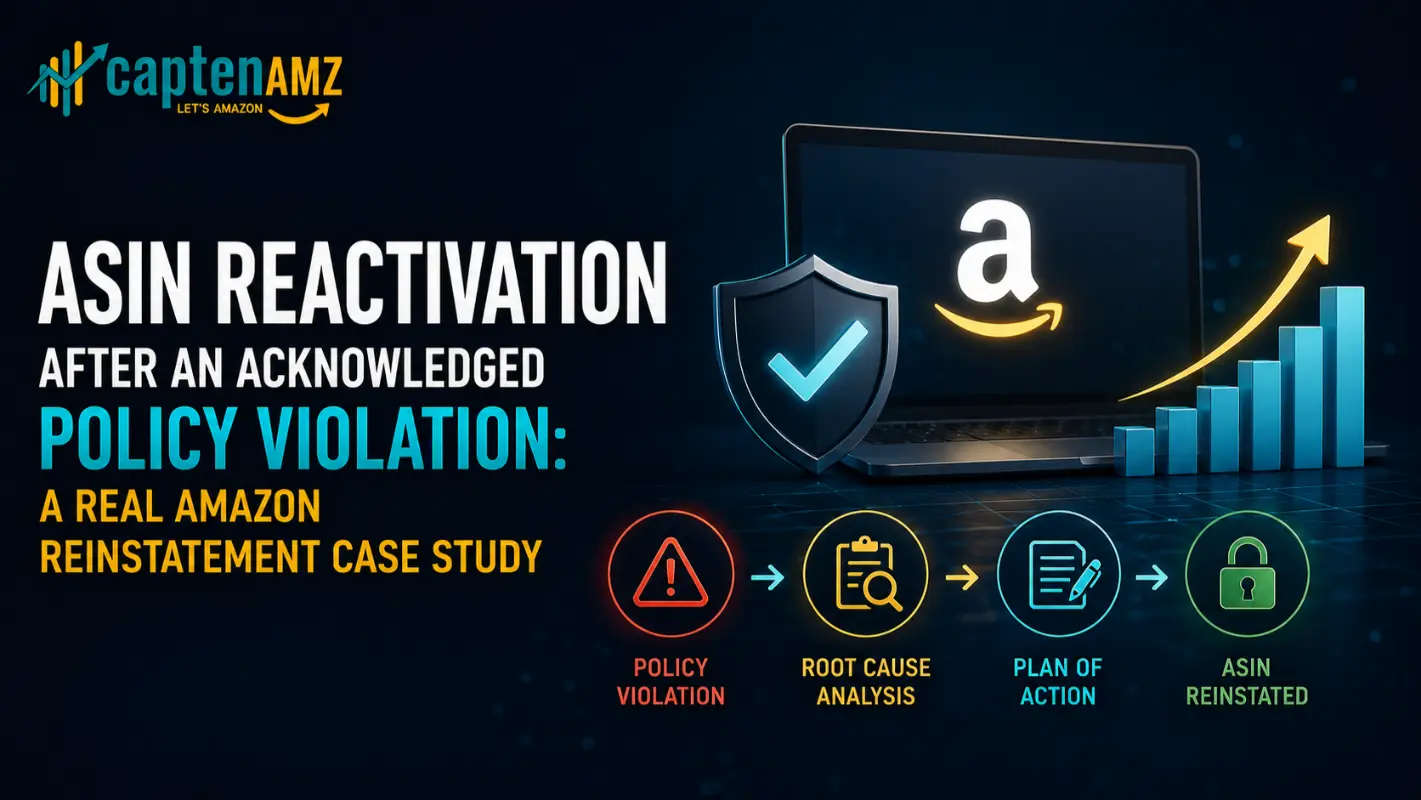
A case study breakdown of how a deactivated Amazon ASIN, already carrying an acknowledged policy violation, was brought back to active status through manual escalation, a compliance re-request, and a full backend data refresh.
Quick Answer
Yes, an Amazon ASIN reactivation is sometimes possible even after a policy violation has been acknowledged. Because Amazon’s system treats an acknowledged case as closed, the standard “Submit Appeal” path usually will not work. Reinstatement instead depends on direct escalation with Amazon Seller Support and Policy teams, a manually requested compliance re-check, and a fully refreshed, policy-compliant listing.
Most Amazon sellers are told the same thing the moment a listing shows “Policy Violation Acknowledged” on the Account Health dashboard: the ASIN is done. Acknowledging a violation closes the case inside Amazon’s system, and once a case is closed, the usual appeal path closes with it. For most sellers, that acknowledgment is the end of the story. The ASIN stays inactive, the revenue stops, and the product quietly gets written off as a loss.
This case study covers an account where that did not happen. The ASIN in question, associated with a US Amazon seller account, had already acknowledged a policy violation, showed no active compliance alert, and had no working appeal option left inside Seller Central. By every conventional benchmark, its odds of ASIN reactivation were close to zero. Instead of accepting that as the end of the process, our team treated it as an operational problem to be solved rather than a case to be closed. What follows is the exact approach we used, why each step mattered, and what any Amazon seller can take from it the next time a listing reactivation looks impossible.
What “Policy Violation Acknowledged” Actually Means
On Amazon, a violation reaches the “Acknowledged” status once a seller has already accepted responsibility for it, typically through a prior appeal, a compliance questionnaire, or a Plan of Action that Amazon has already reviewed and processed. Acknowledgment tells Amazon’s internal case-management system that the matter has been resolved procedurally. It does not mean the underlying listing issue has actually been fixed, and it does not create any new opportunity to appeal.
This is the distinction that trips up most sellers attempting an ASIN reactivation on their own. Once a violation is acknowledged, the “Submit Appeal” button next to it on the Account Health dashboard often disappears or stops functioning the way sellers expect. Amazon’s workflow treats the case as finished. There is no fresh notification to respond to and no obvious mechanism inside Seller Central to reopen the conversation. For sellers who assume every Amazon problem has a self-service fix inside the dashboard, this is exactly where the process appears to dead-end.
In practice, it is the start of a different kind of process, one that depends far less on automated Seller Central tools and far more on direct communication, precise documentation, and structured escalation with Amazon’s Seller Support and Policy departments.
Why These ASINs Are Treated as Unrecoverable
Four conditions combine to make an acknowledged-violation ASIN look unrecoverable on paper:
- No active compliance alert. The Account Health dashboard shows nothing to act on, so there is no obvious next step for the seller to take.
- Standard appeal forms are blocked. Because the case is already marked resolved, the normal appeal submission flow is unavailable for that violation.
- Reinstatement probability is treated as near zero. Across seller forums and internal case histories alike, this scenario is widely described as effectively permanent.
- No new evidence trigger. Amazon typically reactivates a listing in response to a fresh appeal tied to a new or reopened notification, and an already-acknowledged case does not generate one automatically.
Taken together, these conditions explain why many sellers, and even some agencies, walk away once a violation reaches acknowledged status. The ASIN is not technically banned forever, but the normal path back does not exist. Reaching a different outcome means working around the absence of a self-service option instead of through it.
The Case: What We Inherited
The account behind this case study is a US-based Amazon seller whose product ASIN, B08R96PNQW, had been deactivated after a policy violation was acknowledged. By the time our team was engaged, the situation matched the pattern above almost exactly:
- The violation had already been acknowledged, closing the standard appeal path for that case.
- The Account Health dashboard showed no active compliance requests tied to the ASIN.
- Reinstatement probability, by every conventional benchmark, was extremely low.
- The client had already accepted that the product might stay permanently inactive.
Our first move was not to file another generic appeal. Generic appeals rarely succeed even on open cases, and they almost never work on a case Amazon’s system has already closed out. Instead, we approached the ASIN reactivation the same way we approach any account health emergency inside our Amazon seller account management engagements: stabilize the account first, understand the root cause completely, and then build a case Amazon’s Policy team could not easily dismiss.
The ASIN Reactivation Strategy We Used

1. In-Depth Backend and Violation Analysis
Before contacting Amazon, we reviewed the ASIN’s complete backend data: performance notifications, the original violation report, order history, and every prior communication tied to the case. The goal was to isolate the exact trigger behind the deactivation rather than guess at it, since a compliance re-request built on an incomplete root cause almost never survives manual review. This is the same diagnostic pass we run through Amazon catalog management whenever a listing is suppressed or deactivated for reasons that are not obvious from the notification alone.
2. Direct Calls With Amazon Seller Support and Policy Teams
With the root cause documented, we opened multiple case escalations directly with Seller Support and Amazon’s Policy department, requesting a manual review of the ASIN’s status. This step is where most acknowledged-violation cases either progress or stall permanently. Automated case replies rarely move a closed case forward, and it typically takes several rounds of case escalation, each one referencing the previous case ID and prior correspondence, before a request reaches someone authorized to reopen a resolved case.
3. Requesting a Compliance Re-Check Despite No Visible Alert
Since the Account Health dashboard showed no active compliance alert to respond to, we explicitly requested that Amazon reinitiate a compliance check on the ASIN. This is a step most sellers never attempt, largely because there is no button for it inside Seller Central. Requesting a re-check manually gave us an official channel to submit updated documentation, effectively recreating the compliance workflow that the acknowledged status had already closed.
4. Backend and Listing Data Refresh
In parallel with the escalation, we refreshed every element of the listing that touches Amazon’s compliance and content standards: the title, images, bullet points, and backend attributes. Outdated or non-compliant listing data is one of the most common reasons a compliance re-check stalls even after Amazon agrees to look at a case again. This work spanned our Amazon listing optimization process, backend keyword corrections through our backend keyword optimization methodology, and a full flat file update to make sure every attribute matched current category requirements. Where variation structures or catalog attributes were involved, we applied the same corrections used in our guides on fixing Amazon catalog errors and resolving duplicate listings.
5. Consistent Follow-Up and Escalation
None of the previous four steps matter much without disciplined follow-up. We tracked every open case by ID, documented every reply from Amazon, and escalated to higher-level teams whenever a case went quiet for more than a few days. Persistence is often the single largest differentiator between a reinstatement that happens in weeks and a case that gets abandoned after the first automated rejection. This is the same escalation discipline built into our ongoing Amazon FBA management and account health monitoring work, where compliance cases are tracked to resolution rather than left open indefinitely.
The Outcome
After several weeks of structured escalation, documentation, and backend correction, ASIN B08R96PNQW was fully restored to active status. This is a rare outcome. Listings with an acknowledged policy violation are, by Amazon’s own case-management logic, almost never reinstated through any conventional appeal path. The result reflected a combination of accurate root cause analysis, a manually reopened compliance channel, and a listing that was fully compliant by the time Amazon’s Policy team reviewed it again.
Beyond the ASIN itself, the account’s overall Account Health dashboard showed zero remaining compliance issues, and the client’s broader account performance and brand metrics improved as a direct result. You can see how this fits into the pattern of account-level recoveries we document across our Amazon seller case studies.
What This Case Study Teaches Other Amazon Sellers
A few principles from this case apply well beyond this one ASIN, and they are worth internalizing before your next compliance issue turns into a deactivation:
- “Acknowledged” is not the same as “final.” It closes a workflow, not the possibility of reinstatement.
- Root cause accuracy matters more than apology language. Amazon’s Policy team responds to evidence and corrected data, not to a well-written but generic Plan of Action.
- Backend hygiene is part of the appeal. A listing with outdated titles, images, or attributes gives Amazon a reason to keep a case closed even after a manual review is granted.
- Escalation is a process, not a single email. Cases that stall usually need repeated, well-documented follow-up before they reach the right reviewer.
- Prevention is cheaper than reinstatement. Ongoing account health monitoring catches most compliance risks long before they reach acknowledged-violation status.
Several of our own services exist specifically to prevent this scenario or resolve it once it happens: Amazon catalog support for correcting flagged attributes, search-suppressed listing recovery, listing merge corrections, and variation and parent-child listing repair. If the deactivation affects a product supported by advertising, our Amazon PPC services and PPC consulting teams coordinate directly with catalog recovery, since a reinstated ASIN with paused campaigns still loses the momentum the reactivation was meant to protect.
Common Mistakes Sellers Make During Reinstatement Appeals
- Resubmitting the same Plan of Action. Sending an identical or lightly reworded appeal after a rejection almost always produces the same result.
- Using emotional or defensive language. Amazon’s reviewers respond to facts, root causes, and corrective steps, not frustration.
- Ignoring the listing itself. Sellers often focus entirely on the appeal text and never touch the backend data that triggered the violation in the first place.
- Losing track of case IDs. Escalation depends on referencing prior cases accurately. Losing that thread resets the conversation with every new contact.
- Giving up after the first automated reply. Most first responses on an acknowledged-violation case are templated. They are rarely the final word.
When to Bring In a Professional Reinstatement Team
Not every suppressed or deactivated listing needs outside help. A clear compliance alert with a documented fix is often something a seller can resolve directly through Seller Central. An acknowledged violation with no visible alert, a blocked appeal form, and a low reinstatement probability is a different category of problem. That combination usually calls for the kind of structured escalation and backend correction described in this case study, which is most efficient when handled by a team that manages Amazon product listing services, compliance, and account health together rather than as separate, disconnected tasks.
Our Amazon account management and Amazon FBA management services both include ongoing account health monitoring so compliance issues get caught before they reach acknowledged-violation status. For advertising-dependent brands, our Amazon advertising consultant and PPC consultant teams, covered in our guide to the best Amazon PPC agencies in the USA and our breakdown of what a strong Amazon PPC agency should deliver, work alongside our catalog and compliance team so a reinstated ASIN comes back with campaigns ready to run, not paused and losing rank. It’s the same integrated approach our New York and Seattle clients rely on for advertising performance and account stability alike.

Frequently Asked Questions
Can an Amazon ASIN be reactivated after a policy violation is acknowledged?
Yes, though it is uncommon. Acknowledging a violation closes the standard appeal path inside Seller Central, so reactivation typically requires direct escalation with Amazon Seller Support and Policy teams, a manually requested compliance re-check, and a fully corrected listing.
What is the difference between ASIN-level and account-level reinstatement?
ASIN-level reinstatement addresses a single listing that Amazon has deactivated or suppressed for a product-specific reason. Account-level reinstatement addresses a broader suspension of the entire Seller Central account, usually tied to overall performance or a wider policy issue, and generally requires a more comprehensive appeal.
How long does an ASIN reactivation like this typically take?
In this case, full reactivation took several weeks of consistent escalation and follow-up. Timelines vary by violation type, how quickly Amazon’s Policy team responds to each case, and how completely the underlying listing issue has been corrected.
What is a compliance re-request?
A compliance re-request is a manual ask for Amazon to reopen a compliance review on an ASIN, even when no active alert appears on the Account Health dashboard. It is not a standard, self-service option and generally has to be requested directly through Seller Support case escalation.
Does refreshing listing data actually help with reinstatement?
Yes. A listing with outdated titles, images, or backend attributes gives Amazon’s reviewers a reason to keep a case closed even after a manual review is granted. Aligning every element of the listing with current category and content standards removes that objection before the case is reviewed.
Do I need Amazon Brand Registry for an ASIN reactivation case like this?
Brand Registry is not strictly required to appeal a policy violation, but it does give sellers additional tools, such as more detailed catalog control and direct brand protection options, that can make backend corrections and future compliance monitoring easier to manage.
Synopsis
An acknowledged policy violation is designed to feel final. Amazon’s own workflow removes the appeal button, the Account Health dashboard shows nothing new to act on, and every conventional signal points toward a permanently inactive ASIN. This case shows that outcome is not guaranteed. With an accurate root cause analysis, direct escalation with Amazon’s Seller Support and Policy teams, a manually requested compliance re-check, and a fully refreshed listing, an ASIN that looked unrecoverable was brought back to active status with zero remaining compliance issues on the account.
If your Amazon listing is currently deactivated after an acknowledged violation, or if you want to make sure your account never reaches that point in the first place, our team handles exactly this kind of case as part of our Amazon seller account management and Amazon FBA management services. Explore more results across our case studies, read more strategy breakdowns on the CaptenAMZ blog, learn more about our team, or contact us directly for a free account health review before your next compliance issue becomes a deactivation. See us on LinkedIn & Instagram.

Maria R. Donis is an Amazon eCommerce content specialist and digital marketing writer with hands-on experience creating data-driven, SEO-optimized content for Amazon-focused brands. She specializes in producing authoritative content around Amazon PPC management, catalog optimization, listing SEO, and marketplace growth strategies.
Maria collaborates closely with Amazon growth agencies like CaptenAMZ, ensuring that every piece of content reflects real Seller Central experience, platform-specific expertise, and up-to-date Amazon best practices. Her writing is guided by practical insights into how Amazon ads, search algorithms, and buyer behavior work in real-world scenarios.