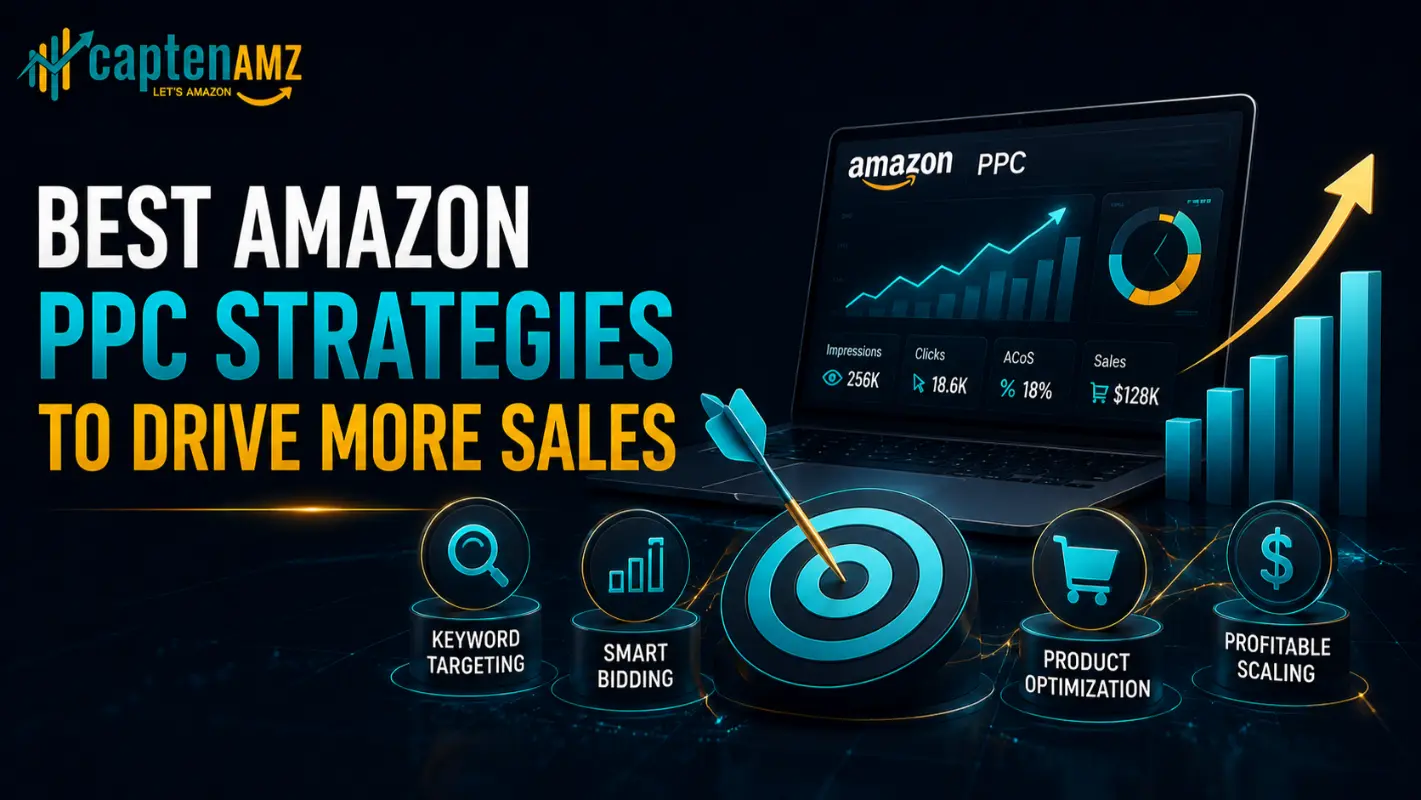
Rising CPCs and a more crowded marketplace have made one thing clear in 2026: running Amazon ads is not the same as running a profitable Amazon PPC strategy. Plenty of sellers spend heavily on Amazon PPC management and still see flat sales, because budget without structure just buys clicks, not growth. The brands pulling ahead this year treat PPC as one connected system, campaign architecture, keyword intent, bid discipline, and listing quality working together, rather than seven disconnected levers pulled at random.
This guide breaks down the 15 best Amazon PPC strategies that are actually driving more sales for sellers right now, drawn from real account data across the USA, UK, and European marketplaces. For the complete framework behind campaign structure and scaling, see our full Amazon PPC strategy guide for 2026. If you want the tactical shortcuts on top of the strategy, our Amazon PPC hacks article covers 12 additional plays worth testing.
Why Amazon PPC Strategy Should Center on Sales, Not Just ACoS
A campaign can show a healthy ACoS target while quietly starving overall sales growth, because chasing a low ACoS number often means cutting bids on keywords that were actually generating volume. The smarter approach tracks TACoS alongside ACoS, since a falling TACoS shows that organic sales are compounding on top of ad-driven sales, not just that ad spend was slashed. Sellers who only optimize for ROAS in isolation frequently miss this distinction and end up capping their own growth. The strategies below are built around total sales impact first, with efficiency metrics used as guardrails rather than the goal itself.
15 Best Amazon PPC Strategies to Drive More Sales
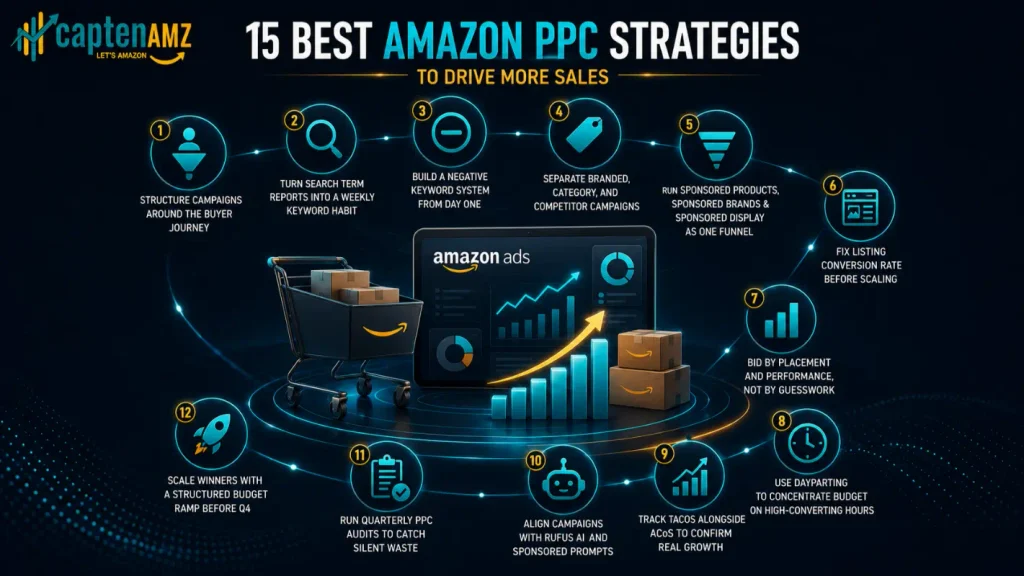
1. Structure Campaigns Around the Buyer Journey, Not Just Keywords
The highest-performing accounts run a layered structure often called the Trifecta: automatic campaigns for discovery, broad match for expansion, and exact match for conversion. Each layer plays a distinct role instead of competing against itself for the same shopper. Auto campaigns surface search terms a seller would never think to target manually, broad match tests those terms at scale, and exact match captures proven converters with tighter, more profitable bids. This structure alone is often the biggest lever in any Amazon PPC strategy, and it is covered step by step in our guide to exact match versus broad match targeting.
2. Turn Search Term Reports Into a Weekly Keyword Harvesting Habit
Every two weeks, pull the Search Term Report, identify terms in Auto and Broad campaigns converting at an acceptable ACoS, and move them into a dedicated Exact campaign with tighter, revenue-optimized bids. This process, known as keyword harvesting, is the engine that continuously improves account efficiency over time rather than letting performance plateau. A structured process for this is outlined in our Amazon keyword research for PPC guide.
3. Build a Negative Keyword System From Day One
Search terms that spend budget without generating orders after 500 to 1,000 impressions should be added as negative keywords immediately, not left to drain budget for weeks. This single habit protects click-through rate, conversion rate, and overall account health as spend scales up. Our full breakdown of negative keywords on Amazon covers exact match versus phrase match negatives and how to build the list without accidentally blocking profitable traffic.
4. Separate Branded, Category, and Competitor Campaigns
Mixing branded searches, competitor conquesting, and generic category keywords in the same campaign makes it impossible to optimize any of them properly, since each traffic type converts at a completely different rate and should carry a different bid strategy. Branded search terms typically convert profitably at 8 to 15 percent ACoS, while competitor conquesting campaigns often run at 25 to 40 percent ACoS and still support long-term market share growth. Keeping these separate is one of the fastest ways to unlock more sales without increasing total ad spend.
5. Run Sponsored Products, Sponsored Brands, and Sponsored Display as One Funnel
Sponsored Products should carry most of the conversion workload, Sponsored Brands builds top-of-funnel awareness and defends branded search real estate, and Sponsored Display retargets shoppers who viewed a listing but did not buy. Treating these as three separate, uncoordinated ad types is a common mistake; treating them as one funnel is what drives compounding sales. A full comparison lives in our Sponsored Products vs Sponsored Brands article. In 2026, this funnel now extends beyond Amazon’s own pages too, since Sponsored Products off-Amazon creator placements auto-enrolled many US accounts on August 10, adding a new surface worth reviewing rather than ignoring.
6. Fix Listing Conversion Rate Before Scaling Ad Spend
PPC drives traffic, but the listing determines whether that traffic converts into a sale, so scaling budget on a weak listing simply buys more visits to a page that was already losing shoppers. Before raising bids, confirm the listing optimization fundamentals are in place: a title built on a proven product title formula, complete A+ Content, and imagery that answers a shopper’s objections before they scroll past. Strong A+ Content services can lift conversion rate by double digits, which lowers effective ACoS without touching a single bid.
7. Bid by Placement and Performance, Not by Guesswork
Amazon allows different bids depending on where an ad appears, top of search, rest of search, or product detail pages, and top-of-search placement usually costs more but converts better for high-intent keywords. Reviewing performance by placement and adjusting bid modifiers accordingly, rather than applying one flat bid across the board, is one of the more advanced Amazon PPC optimization techniques that consistently drives more sales from the same budget.
8. Use Dayparting to Concentrate Budget on High-Converting Hours
Shopper conversion behavior is not flat throughout the day. Concentrating budget during proven high-converting windows, and pulling back during historically low-converting hours, stretches the same daily budget further and captures more sales from serious buyers. Our Amazon dayparting guide covers how to build hour-by-hour bid schedules for USA, UK, and European accounts.
9. Track TACoS Alongside ACoS to Confirm Real Growth
A dropping TACoS over time signals that advertising is building organic momentum rather than simply buying revenue at an unsustainable cost, while a rising TACoS despite a stable ACoS usually means the brand is becoming more dependent on paid traffic, not less. This distinction is essential for any seller trying to lower TACoS without cutting ad spend, since the goal is compounding organic rank, not just a smaller ad bill.
10. Align Campaigns With Rufus AI and Sponsored Prompts
Amazon’s Rufus AI now influences query interpretation, relevancy scoring, and click prediction, which means campaigns built purely on exact keyword matching without conversational intent are being systematically deprioritized. Winning Amazon PPC strategies in 2026 target intent-aligned phrases that match how shoppers actually speak to Rufus, and test the new Rufus Sponsored Prompts placement where relevant. Pairing this with the right AI tools for Amazon PPC helps sellers keep pace with a discovery layer that is changing faster than manual optimization can track alone.
11. Run Quarterly PPC Audits to Catch Silent Waste
Accounts that look profitable on the surface often carry wasted spend in overlapping keywords, stale bids, or campaigns nobody has touched in months. A structured Amazon PPC audit checklist, run quarterly rather than only when performance drops, catches this waste before it compounds. Sellers who prefer an outside review can request a professional Amazon PPC audit to pressure-test campaign structure against current account data.
12. Scale Winners With a Structured Budget Ramp, Especially Before Q4
Once core campaigns are stable and profitable, raise bids incrementally on proven keywords, roughly 10 to 15 percent per week, and monitor for at least 14 days before the next adjustment rather than jumping budgets all at once. This disciplined approach to scaling Amazon PPC and increasing ad spend matters even more heading into Q4, when demand spikes fast and campaigns without a ramp plan either underspend during peak traffic or overspend chasing it. Pairing PPC scaling with solid Q4 inventory planning prevents the common failure mode of driving a surge in ad-fueled demand straight into a stockout.
Common Amazon PPC Mistakes That Quietly Kill Sales
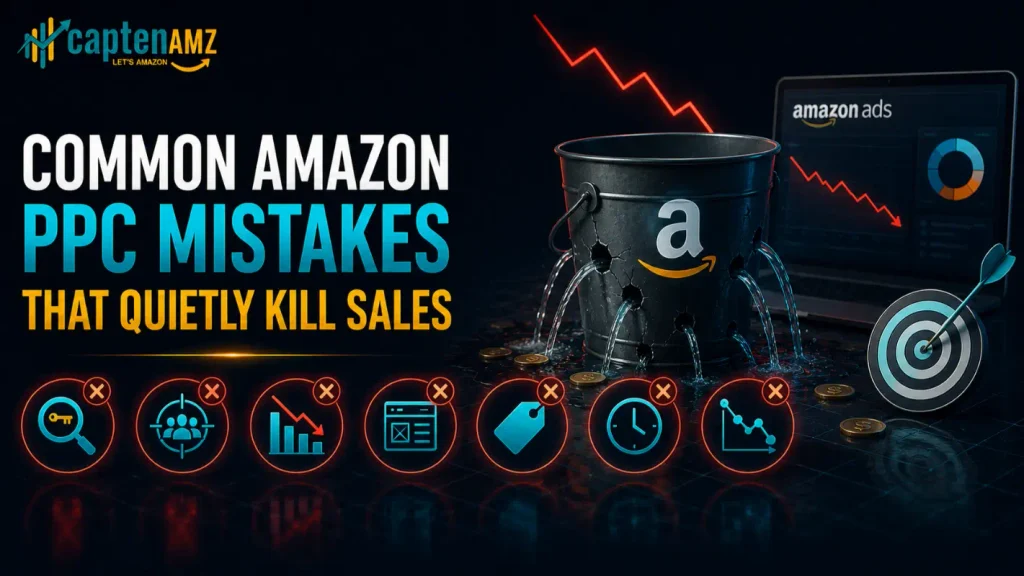
Even sellers who follow most of these strategies can lose sales to a handful of recurring mistakes. Bidding too high on unproven broad match terms, ignoring search term reports for weeks at a time, and treating campaign optimization as a one-time setup rather than an ongoing process are among the most common, as detailed in our guide to Amazon PPC campaign optimization. Weak creative is another silent killer: ACoS issues that start with bad creatives are frequently misdiagnosed as a bidding problem when the real fix is the image or headline. And no amount of PPC optimization can fix a listing that is not ranking organically in the first place, which is why it’s worth checking why a listing isn’t ranking before assuming the ad account is broken.
When to Bring In a Professional Amazon PPC Team
Running all 15 strategies consistently takes real time each week, and many growing brands eventually reach a point where in-house bandwidth is the bottleneck, not strategy knowledge. Our comparison of an advertising consultant versus an in-house PPC manager walks through the trade-offs. For sellers who want ongoing execution, Amazon PPC management handles the daily optimization, while PPC consultation and PPC consultant services suit brands that want strategy without handing over full account access. CaptenAMZ works with sellers across the USA, including New York and Seattle brands, as well as UK and German sellers expanding into European marketplaces.
How CaptenAMZ Builds Sales-Driven Amazon PPC Campaigns
CaptenAMZ has generated over 200 million dollars in revenue for Amazon sellers and reduced average ACoS by 38 percent across managed accounts, by pairing the campaign structure and keyword discipline above with catalog and listing work most agencies leave for someone else. Real account results are documented across our Amazon PPC case studies, including a European PPC scaling case study, a clothing brand campaign turnaround, and a toy brand scaling project. Sellers newer to Amazon advertising can start with our Amazon PPC for beginners guide, while established brands comparing providers may find our breakdown of the best Amazon PPC agencies in the USA useful before choosing a partner.
Frequently Asked Questions
What is the best Amazon PPC strategy to drive more sales?
The best strategy combines a layered campaign structure, weekly keyword harvesting, disciplined negative keyword management, and bids adjusted by placement rather than guesswork. Sales grow fastest when PPC is paired with a conversion-ready listing, since ad clicks only turn into revenue if the product page can close the sale.
How much should a seller spend on Amazon PPC to increase sales?
There is no universal number. Budgets should be set from break-even ACoS based on actual product margin, not a fixed percentage of revenue. Most brands start conservatively, confirm profitability over 10 to 14 days, then raise budgets in 10 to 15 percent increments on proven keywords.
What is a good ACoS for driving Amazon sales growth?
Branded search terms typically convert profitably at 8 to 15 percent ACoS, while category and competitor conquesting campaigns can run at 25 to 40 percent ACoS and still support long-term growth. A TACoS trending downward over time is a stronger signal of healthy growth than ACoS alone.
How long does it take to see results from Amazon PPC campaigns?
Most campaigns need 10 to 14 days to generate enough data for reliable optimization decisions. Meaningful ACoS and sales improvements are typically visible within 30 to 60 days once search term data has been harvested and negative keywords applied.
Should sellers use automatic or manual Amazon PPC campaigns?
Both. Automatic campaigns are best for keyword and ASIN discovery, while manual exact match campaigns are best for scaling proven converters with tighter bid control. The strongest strategies use auto campaigns to continuously feed manual campaigns.
Does Amazon listing quality affect PPC performance?
Yes. PPC drives traffic, but the listing determines whether that traffic converts. A weak title, incomplete A+ Content, or low-quality images can raise ACoS even with accurate keyword targeting, since both Amazon’s algorithm and shoppers reward listings that convert well.
Turning These Amazon PPC Strategies Into Sales
None of these 15 strategies work as an isolated tactic. Campaign structure without keyword harvesting stalls, keyword harvesting without a converting listing wastes clicks, and even a well-optimized account without TACoS tracking can’t tell the difference between real growth and expensive short-term revenue. Sales come from running these strategies together as one system, reviewed on a consistent schedule rather than set up once and left alone. Start with campaign structure and negative keywords this week, add dayparting and placement bidding once baseline data exists, and revisit the whole account quarterly using the audit checklist above.
If building and maintaining this system in-house feels like more than current bandwidth allows, CaptenAMZ’s team can build it for you. Get in touch for a free growth plan, or explore the full range of Amazon FBA and PPC services to see where the biggest opportunity sits in your account today.
Follow CaptenAMZ for more expert Amazon PPC Guides: LinkedIn | Instagram

Maria R. Donis is an Amazon eCommerce content specialist and digital marketing writer with hands-on experience creating data-driven, SEO-optimized content for Amazon-focused brands. She specializes in producing authoritative content around Amazon PPC management, catalog optimization, listing SEO, and marketplace growth strategies.
Maria collaborates closely with Amazon growth agencies like CaptenAMZ, ensuring that every piece of content reflects real Seller Central experience, platform-specific expertise, and up-to-date Amazon best practices. Her writing is guided by practical insights into how Amazon ads, search algorithms, and buyer behavior work in real-world scenarios.